White headscarves are painted in a ring around the Pirámide de Mayo in Buenos Aires. Seen without their history, they resemble a conventional memorial: a repeated emblem fixed to paving around an older monument. But the first durable memorial made by the Mothers of Plaza de Mayo was not a stone, plaque, or painted mark. It was a route.
That route emerged in 1977, when women searching for sons and daughters whom Argentina's military dictatorship had forcibly disappeared brought their demand to the plaza outside the Casa Rosada. Police told them to move along. The women moved—then returned, moved again, and made the instruction repeat on their terms. A command intended to disperse a gathering became the ronda, the weekly circuit around the pyramid.[1][2]
Months later, white cloth made the moving bodies recognizable. Names made a collective demand personal. After dictatorship, the route survived democratic transition, a bitter organizational split, official heritage protection, and the transfer of records into archives. Each change raised the same question: how can a state or city commemorate a protest whose meaning depends on refusing closure?
The Mothers' answer was never simply to reject monuments. It was to keep fixed marks answerable to living practice. The painted scarf matters because a scarf was worn; the protected site matters because people kept walking through it; the archive matters because the walk began as a demand for facts the state withheld.
Before the circle, there was an itinerary with no answer
The Mothers did not begin as an organization carrying a finished political program. They began as people following separate trails through legal offices, ministries, churches, police stations, and other centers of authority. Those searches produced paperwork and waiting, but not reliable answers. Azucena Villaflor proposed concentrating the women in the Plaza de Mayo, a place where national power was both housed and publicly addressed.[2]
Fourteen women reached the plaza on Saturday, 30 April 1977. The day was a tactical mistake: government offices were closed and the square lacked its weekday audience. They nevertheless returned. Friday was briefly considered, then rejected; Thursday became the recurring appointment.[1][2]
Official retellings compress the earliest meetings differently. A Canal Encuentro account places the police command—“move along”—at the first gathering on 30 April. The national human-rights history booklet separates that quiet Saturday from the choice of a later weekly schedule.[1][2] The exact gathering at which the walking pattern crystallized is therefore less secure than the sequence both accounts preserve: women tried to become visible in the plaza, police refused them a static assembly, and circulation became a method of staying present.
That distinction is historically useful. The ronda was not born from a ceremonial plan. It converted a restriction into a form. Walking in pairs could look like compliance with an order against gathering while producing the opposite effect: the same people stayed in the same politically charged place, acquired a rhythm, and became easier to witness. Repetition did what one demonstration could not. It made disappearance meet a public schedule.
The circle also avoided the usual direction of a procession. It did not carry participants from an origin to a destination where a petition might be accepted. It returned them to the point from which they had started. That was an exact spatial answer to forced disappearance: until the state accounted for the missing, the demand would not advance politely out of view.
A piece of infancy became public identification
The route created continuity, but it did not yet make individual Mothers easy to identify in a crowd. During an October 1977 pilgrimage to the shrine at Luján, they adopted white cloth associated with their children's diapers. The improvised marker became a headscarf, and women began embroidering the names of their disappeared sons and daughters on it.[1][2]
The material carried an argument. A black mourning veil would have implied a death that the state had not acknowledged and families could not document. White cloth recalled birth, care, and a child's body. Worn by older women in public, it did not say that the missing were safely alive; it said that the state could not force families to perform bereavement without truth.[2]
Embroidery narrowed the scale again. “The disappeared” could become a category large enough to blur the people inside it. A name stitched over a mother's hair restored a relation: this person was looked for by this person. The scarf unified the march without making every loss interchangeable.
Family photographs extended the same move. Pippa Oldfield describes later displays in which photographs normally kept in private albums were enlarged, captioned, and arranged in parks and public spaces. The family album was effectively opened outward: a passerby became an audience for a life the state had tried to remove from the civic record.[3] Scarf, name, portrait, and route worked together. None proved what had happened in detention. All prevented uncertainty from becoming anonymity.
The photograph shows why stone was not enough
The danger was never merely symbolic. Villaflor was herself abducted and disappeared. The organization she helped begin had to continue after state terror entered its own founding circle.[2]
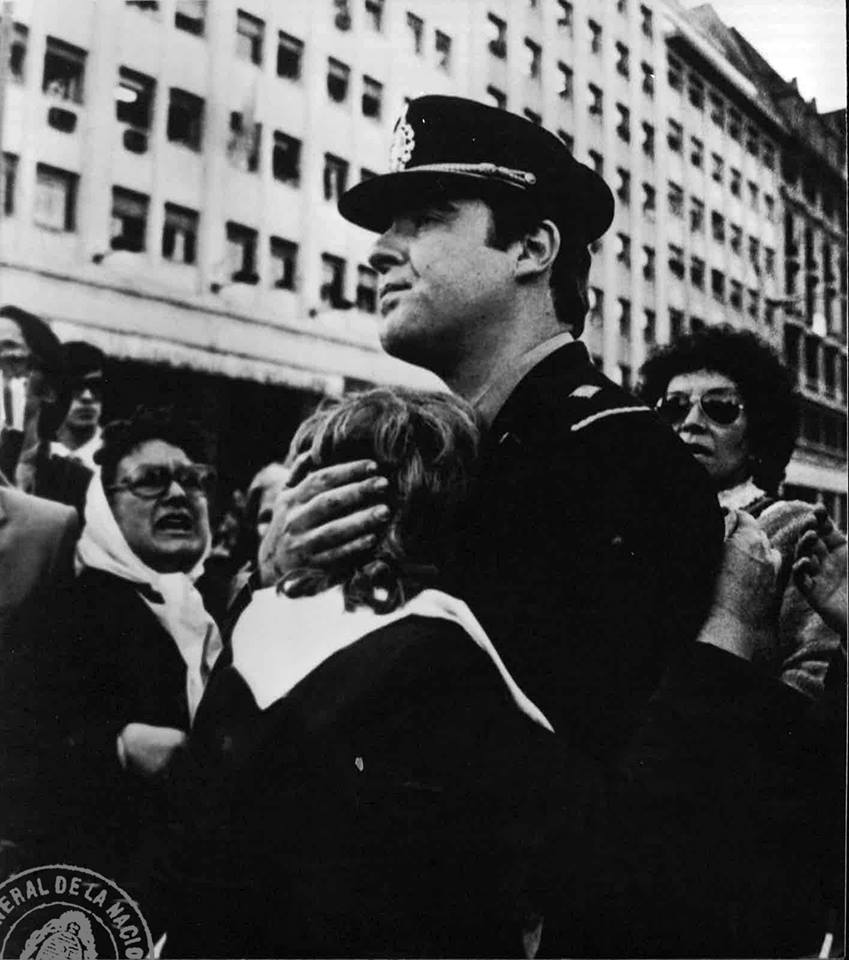
Marcelo Ranea's cover photograph catches the conflict five years later, on 5 October 1982. Federal police deputy chief Carlos Gallone occupies the center of the frame. His hand closes across the head of a Mother whose back faces the camera. Around them, other women press forward; two white scarves remain sharply visible against dark coats.[8]
The picture does not turn the scarf into a serene logo. Cloth is creased by movement. Faces are partly blocked. The circle has become a crush. The image's documentary force comes from that interruption: it shows that the emblem could be recognized precisely because a vulnerable body kept wearing it into a contested space.
This is also the limit of calling the ronda a monument. Stone can outlast a police line because stone cannot be arrested or struck. The Mothers' form was more exposed. Its continuity depended on people returning, recognizing one another, and accepting physical risk. Yet that exposure gave the route a capacity conventional monuments lack. Every attempted dispersal could become new evidence that the original demand remained unwelcome.
Democracy did not settle who could speak for the scarf
Argentina's dictatorship ended in December 1983. The new government created the National Commission on the Disappearance of Persons and initiated prosecutions of the first military juntas. Those changes mattered: testimony entered an official investigation, and state crime could be named in court. But democratic institutions did not make the Mothers' work redundant, nor did they produce one agreed politics of remembrance.[2]
In 1986, the movement split into the Asociación Madres de Plaza de Mayo and Madres de Plaza de Mayo—Línea Fundadora. María Virginia Morales shows that the division involved more than personalities. The organizations differed over reparations, posthumous tributes, relationships with governments, the place of trials, and whether motherhood should remain tied to each missing child or be socialized into a broader political identity. Both continued to define themselves through the plaza and its counterclockwise circuit.[4]
The split complicates an easy heritage story. It would be convenient to say that private grief became one universal human-rights symbol and then entered national memory intact. In reality, the same scarf could support distinct claims about justice, political alliance, and what it meant to continue the children's projects. Natalia Carolina Marcos describes this as an insurgent memory that changed with historical circumstances and challenged official versions of the past rather than merely filling a blank in them.[5]
One need not collapse the two organizations or adjudicate every later dispute to see the central point. Commemoration did not remove politics from the symbol. It created a valuable, difficult question of authority: who may say what the scarf now demands? The continued ronda kept that question in public instead of allowing a plaque to answer on everyone's behalf.
In 2005, the route acquired a legal border
By 2005, the city had given the circuit a new status. Buenos Aires Law 1653 protected the area around the Pirámide de Mayo as a historic site, identifying it with the first gathering, the Thursday rounds, and the white headscarves first displayed at Luján. The scarves painted on the paving turned a path made by bodies into a permanent visible ring.[6]
The achievement contains a paradox. A movement created because women were not permitted to remain still now has a fixed municipal footprint. The city that once treated their presence as a problem protects the place where that presence recurred.
There are two ways to read the change. Heritage recognition can tame dissent: a dangerous claim becomes an admired symbol, safely assigned to the past. But protection can also preserve the spatial grammar of the protest. The painted scarves do not occupy a remote memorial garden. They remain around the pyramid, opposite executive power, tracing the route on which the demand was made.
The difference depends on practice. If the paint becomes the whole story, the ronda is reduced to design. If the mark directs attention back to names, bodies, Thursday repetition, and unresolved evidence, institutional recognition does not end the protest's meaning. It gives that meaning another surface from which to be renewed.
An archive can verify the route, but it cannot walk it
The same tension appears in the archive. In 2006, UNESCO's Memory of the World program inscribed a coordinated body of Argentine human-rights records covering the 1976–1983 dictatorship. The collection joined documents made by repressive state agencies to testimony, photographs, legal records, denunciations, and campaign material produced by people and civil-society organizations resisting the regime. UNESCO emphasizes that the records remain evidence for clarifying forced disappearances and for judicial proceedings.[7]
Archiving changes the form of memory again. A scarf becomes a catalogued object; a march becomes a dated photograph; a testimony becomes a recording that can be compared with a state file. That translation is indispensable. Without preserved records, the history would depend too heavily on a familiar emblem and too little on evidence.
But an archive and a ronda do different work. The archive allows a claim to be tested. The route makes the reason for testing it publicly unavoidable. The painted scarves establish a site. The worn scarves restore people to it. None is sufficient alone.
That is why the Mothers of Plaza de Mayo made a memorial that had to keep moving. Its subject was not a completed event whose meaning could be delegated to stone. It was a state practice designed to separate bodies from names, facts from families, and private searching from public knowledge. The Mothers answered by joining those things again—name to cloth, cloth to body, body to route, route to archive—and by repeating the connection where power could see it.
The circle around the pyramid does not promise that history returns neatly to its beginning. It promises something narrower and harder: the demand will return until public memory remains accountable to evidence, and protected symbols remain accountable to the people who made them.
Sources
- Argentina's Ministry of Culture, “Encuentro emite un capítulo de la serie sobre las Madres de Plaza de Mayo” (30 April 2020) — official account of the first gathering, the police order to circulate, the weekly route, and the later adoption of white headscarves.
- Argentina's Secretariat of Human Rights, Memoria, Verdad y Justicia: Herramientas para pensar y construir memoria (2022), pp. 17–22 — national history booklet on the Mothers' searches, early schedule, scarf and name, Villaflor's disappearance, and democratic transition.
- Pippa Oldfield, “Exploded Albums: Re-working the Family Photo Album in Women's Protests against State Terrorism in Argentina” (2013) — scholarly analysis of how the Mothers moved family photographs into public placard displays.
- María Virginia Morales, “Escisión y dos modos de ser ‘Madres de Plaza de Mayo’: tensión y complejidad en la socialización de la maternidad,” Estudios Sociológicos 35, no. 104 (2017) — open-access study of the 1986 split, the two organizations, and their differing constructions of motherhood and political action.
- Natalia Carolina Marcos, “La memoria insurgente de las Madres de Plaza de Mayo en la lucha por los Derechos Humanos,” Deusto Journal of Human Rights 5 (2008) — analysis of remembrance as a changing political practice that contests official memory.
- Government of the City of Buenos Aires, “Reseña de la Ley 1227” — heritage register entry for the area around the Pirámide de Mayo, protected under Law 1653/2005, with the history of the first gathering, white scarves, and Thursday rounds.
- UNESCO Memory of the World, “Patrimonio documental sobre derechos humanos 1976–1983” — official record of the 2006 inscription, participating archives, document types, evidentiary uses, and later additions.
- Wikimedia Commons, “File:Madre plaza policia.jpg” — source page for Marcelo Ranea's 5 October 1982 photograph from Argentina's General Archive of the Nation, used as the article image.