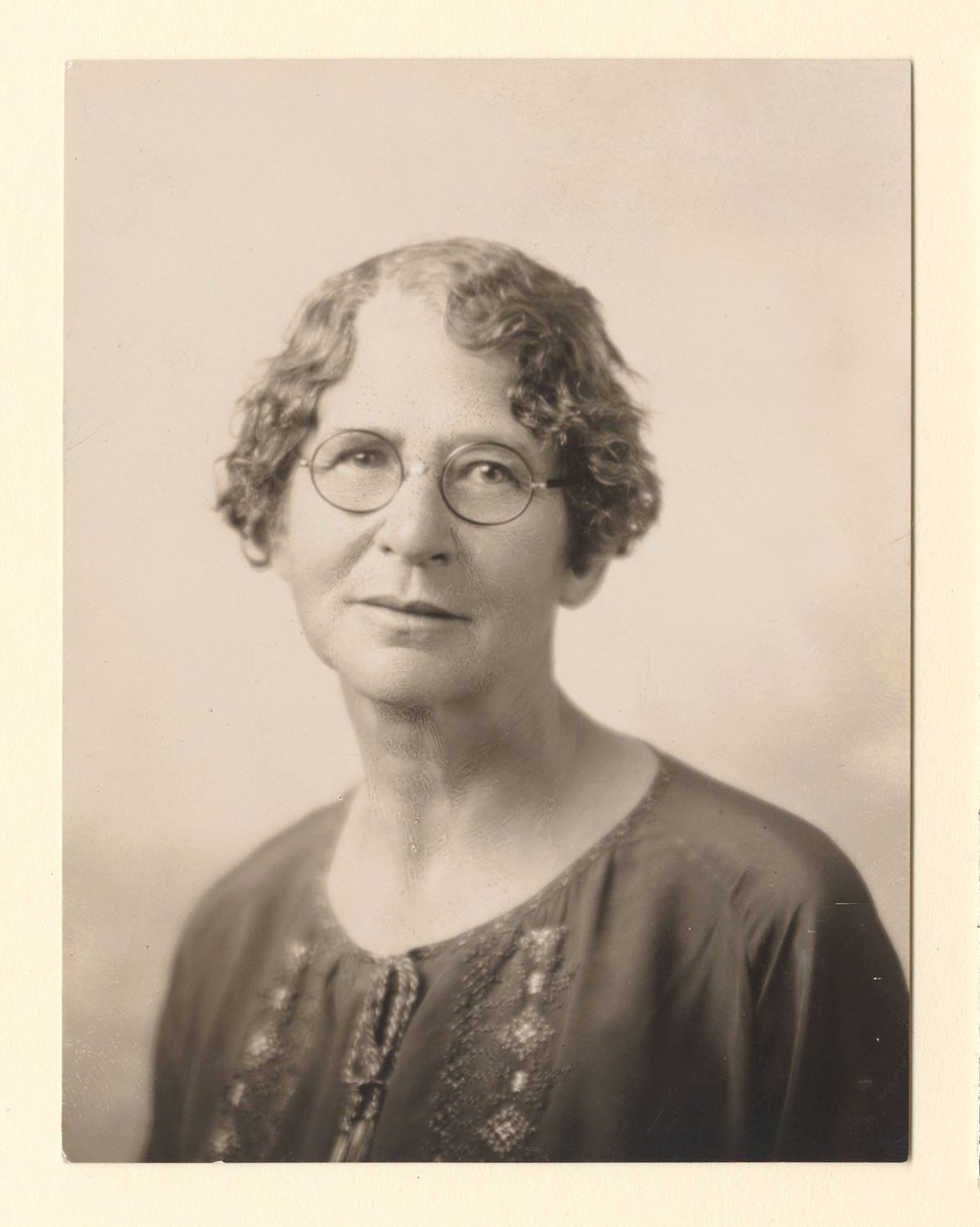
In July 1925, Ynés Mexía wrote to Alice Eastwood, curator of botany at the California Academy of Sciences, before joining a Stanford collecting expedition to western Mexico. Mexía was fifty-five and had begun taking botany classes at the University of California, Berkeley, only four years earlier. The Academy's finding aid summarizes the practical terms of her approach: she noted her long experience of Mexico and offered to collect duplicate plant specimens for the institution.[1]
That offer contains the mechanism of her career. The familiar version of Mexía's life is an adventure story: an older Mexican American woman starts late, travels farther than convention permits, and returns with an astonishing quantity of plants. The archival record supports the courage and scale. It also reveals something less cinematic. Mexía became scientifically consequential because one gathering in the field could become many preserved sheets, and those sheets could move—to a curator, a specialist, a buyer, and several herbaria. Her authority took durable form in specimens, labels, letters, sales, and names.
This was independence, but not solitude. Mexía's field judgment supplied the material. Eastwood and other taxonomists determined plants. Nina Floy Bracelin processed collections and built a worldwide correspondence. Universities lent facilities and institutional standing. Local guides found trails, trees, boats, and shelter. Here “independent collector” describes Mexía's control of expeditions and collecting practice; it does not mean she worked alone.[2][3][4]
A late beginning was not an empty beginning
Mexía was born in 1870 to a Mexican father and an American mother. Parts of her early biography remain uncertain, including conflicting accounts of her birthplace.[1] The broad route is clearer: schooling in the United States, long residence in Mexico, management of family property, and a move to San Francisco in 1908 after two marriages and severe personal strain. In California she entered conservation and natural-history circles before enrolling in botany courses at Berkeley in 1921.[4][6][7]
Calling her simply a “late bloomer” hides the resources she brought to the field. She had money and social standing, experience managing a ranch, fluency in Spanish, and long familiarity with both Mexico and the United States.[4][6][7] Those advantages did not cancel the age and gender barriers surrounding field science. They do explain how she could convert a late education into expedition work so quickly. The California Academy's own account stresses both sides: Mexía crossed boundaries that constrained women while also writing about Indigenous people in disparaging, hierarchical terms.[6]
Her 1929 account of western Mexico makes the dependency visible. Mexía names guides including Mauro, Juan, and Reyes; describes collecting from canoes and traveling by pack train; and records advice from the civil engineer and botanist J. Gonzales Ortega. She also says she worked under Berkeley's auspices and carried a university permit whose gold seal impressed officials. The narrative voice is emphatically hers, but the route was socially produced. Local knowledge moved her through the landscape, and institutional paper moved her through checkpoints.[3]
The same source preserves what Mexía did exceptionally well. She noticed habitats at walking pace, collected across plant families rather than chasing only spectacular flowers, assigned field numbers, recorded locations, and kept material intact through difficult travel. In the mountains near Puerto Vallarta on December 1, 1926, she collected a composite later sent to B. L. Robinson at Harvard's Gray Herbarium. Robinson determined that it represented a new genus and named it Mexianthus mexicanus. Discovery here was a chain: field recognition, preservation, shipment, comparison, specialist judgment, and publication.[3]
One field number could become a traveling set
The numbers attached to Mexía's work can look contradictory until the specimen economy is understood. A contemporary summary by Bracelin counted about 8,800 field numbers and approximately 145,000 specimens across Mexía's career. The 1925 western Mexico trip produced 500 numbers but 3,600 specimens; the 1926–1927 expedition produced 1,600 numbers but 33,000 specimens. A field number identified a particular gathering. When enough material was collected, multiple physical specimens from that gathering could be prepared as duplicates and divided into sets for different institutions.[2]
Duplicates were not botanical leftovers. Herbaria needed series that could be compared, named, exchanged, and consulted far from the original landscape. A historical study of museum duplicates shows that by the late nineteenth and early twentieth centuries, distributing repeated specimens could strengthen an institution's standing just as much as accumulating them. Duplicates functioned as research material and as a kind of professional currency.[5]
Mexía grasped that economy before her first major trip. Her offer to Eastwood promised the Academy a share of material not yet collected. In return, an institution could provide identification, credibility, contacts, or money. The arrangement multiplied the reach of one collector. A plant gathered once in Nayarit might acquire a Berkeley label, go to a Harvard specialist, enter a Michigan or federal collection, and generate a published name. No single sheet carried the whole career; their distribution did.[1][2][3]
This also explains why the raw total matters less than the architecture behind it. The California Academy finding aid rounds Mexía's collection to about 150,000 specimens, while Bracelin's 1938 summary gives approximately 145,000. Those are compatible estimates, not a reason to manufacture precision. More important is the gap between thousands of numbered gatherings and many more physical sheets. That gap measures how thoroughly fieldwork was designed for circulation.[1][2]
Bracelin built the home end of the expedition
Mexía met Nina Floy Bracelin during a University of California extension course in 1927. By January 1928, Bracelin had taken over the unfinished processing of Mexía's Mexican collections. The surviving oral history and appended archival notes describe her tasks: preparing labels, laying out duplicate sets, sending material to specialists for determination, arranging sales, corresponding with curators, and finally distributing the sheets. The first set remained at the University of California; other sets traveled outward.[2]
That work was not clerical cleanup after the “real” expedition. A pressed plant without a reliable label loses much of its scientific meaning. A stack never sent to a specialist cannot become part of a taxonomic comparison. A duplicate never offered or sold cannot finance the next journey. Bracelin made the field material legible and mobile. Her correspondence became so extensive that, according to the oral-history introduction, curators abroad knew her better than some members of Berkeley's own herbarium staff.[2]
The partnership complicates the heroic portrait in a productive way. Mexía was meticulous in preparing specimens and unusually detailed in her field notes, but she had little interest in prolonged processing after returning home. Bracelin preferred the exacting work of organizing those returns. Each supplied the labor the other did not. Mexía's will later funded Bracelin's continued employment at the California Academy, extending their arrangement beyond Mexía's death in 1938.[1][2][6]
Specimen sales joined that division of labor to finance. Bracelin recalled having to sell as many sheets as possible and described material committed to institutions in advance. A later Library of Congress account likewise identifies sales as a source of expedition money.[2][7] This was not a modern research grant with a fixed budget and deliverables. It was a cycle: collect enough well-documented material to create desirable sets; use the sets to meet curators and recover costs; turn money and reputation into another journey.
The cycle reached its largest scale between 1929 and 1932, when Mexía traveled through Brazil and the upper Amazon into Peru. Bracelin's summary assigns that expedition 3,200 field numbers and about 65,000 specimens.[2] The Library of Congress account follows the travel narrative, while Mexía's sheets remain distributed among institutions whose collections can be studied long after the expedition story has faded.[7][8]
Independence was a position inside a network
There are two tempting but incomplete interpretations of Mexía. One casts her as a lone explorer who defeated academic exclusion by force of personality. The other treats her as merely a supplier whose plants became knowledge only when credentialed taxonomists touched them. The first erases Bracelin, guides, curators, wealth, and institutions. The second misses the expertise required to find, distinguish, document, preserve, and repeatedly deliver useful material from environments most herbarium botanists would never see.
The better interpretation sits between them. Mexía controlled the field end of a distributed scientific process. She selected places, negotiated transport, read plant communities, and produced unusually large, carefully documented sets. She did not generally author the formal descriptions based on them. Taxonomic authority and collecting authority were related but distinct, and her career depended on making the latter indispensable.[2][3][6]
That distinction gives the archival portrait its proper scale. Mexía faces the camera alone, as portraits require. Her career never did. It ran from a guide's trail knowledge to a plant press, from a numbered note to Bracelin's label, from a duplicate sale to the next ticket, and from a specialist's comparison to a name in print. The sheets traveled separately, but together they gave a late-starting collector a durable place in botanical history.
Ynés Mexía began late. That fact is worth remembering because it enlarges our sense of when a consequential life can start. But age is not the most revealing fact in her story. The sharper question is how field collection became durable scientific authority. Her answer, first visible in the 1925 offer to Eastwood, was material and collaborative: collect well, make sets, and let a career travel in duplicate.
Sources
- California Academy of Sciences Archives, “Ynes Mexia Photographs,” MSS.326 finding aid — July 1925 letter to Alice Eastwood, expedition chronology, collection scope, and Bracelin provision.
- Nina Floy Bracelin, The Ynés Mexía Botanical Collections: Oral History Transcript (interviews conducted 1965 and 1967; Regional Oral History Office, UC Berkeley, 1982) — processing, sales, duplicate distribution, expedition totals, and the division of labor.
- Ynés Mexía, “Botanical Trails in Old Mexico—The Lure of the Unknown,” Madroño 1 (September 27, 1929), pp. 227–238 — primary account of the 1926–1927 expedition, guides, permits, field practice, and the collection later named Mexianthus mexicanus.
- California Academy of Sciences, “Archives Unboxed: Ynes Mexia” (January 6, 2014) — early-life chronology, conservation work, independent field practice, hired guides, and the first major expedition.
- Ina Heumann, Anne Greenwood MacKinney, and Rainer Buschmann, “Introduction: The Issue of Duplicates,” The British Journal for the History of Science 55, no. 3 (2022), pp. 257–278 — the scientific, exchange, and institutional value of duplicate museum specimens.
- Katherine Montana, California Academy of Sciences, “Ynes Mexia” — archive-based biography addressing privilege, field photography, Bracelin's curatorial work, Indigenous representation, and legacy.
- Claire D'Mura, Library of Congress, “145,000 Plants with Adventuress Ynes Mexia” (October 11, 2024) — expedition synthesis, specimen sales, primary-writing links, and provenance for the Bancroft Library portrait used here.
- UC Berkeley Research, “University and Jepson Herbaria” — institutional description of preserved, documented specimens and the continuing research uses of older collections.