The Silent Parade of July 28, 1917 is easy to remember as a precursor: before the March on Washington, before mid-century sit-ins, before televised civil-rights spectacle, thousands of Black New Yorkers walked down Fifth Avenue in disciplined quiet. That is true, but it flattens the march. Its force came from being two things at once. It borrowed the grammar of older civic pageantry: ordered lines, children in white, women in white, men in dark suits, banners, drums, and a famous city avenue. At the same time, it made a recognizably modern rights claim: the federal government could not praise democracy abroad while leaving Black citizens exposed to lynching, riot, segregation, and official indifference at home.[2][4]
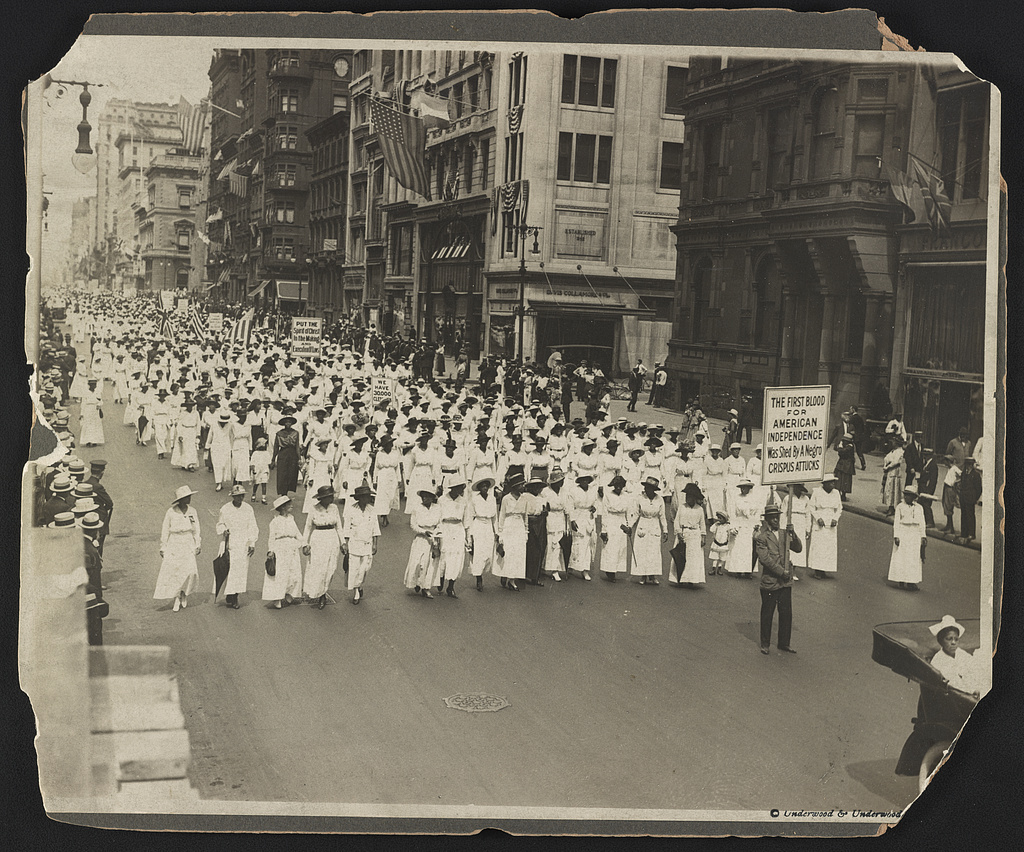
That double identity is why the photograph matters. The Library of Congress image shows a march that looks controlled almost to the point of ceremony: placards held steady, bodies spaced, spectators watching from the curb and upper windows.[1] It is not a photograph of chaos after violence. It is a photograph of a community turning grief into public form. The quiet was not withdrawal. It was a demand that the city look.
A Riot Becomes a National Question
The march cannot be separated from East St. Louis. In July 1917, after weeks of racial tension tied to wartime labor, white mobs attacked Black residents of the Illinois industrial city. Britannica summarizes the violence as one of the worst wartime episodes of racial antagonism in the United States, with Black residents stabbed, clubbed, hanged, driven from homes, and forced into flight; it gives a toll of 40 Black people and 8 white people killed, while other accounts and commemorative materials report wider ranges because the destruction and displacement made counting contested.[5] The Beinecke Library's account notes that the violence left thousands homeless and that the marchers understood East St. Louis as part of a wider national pattern, not a local disturbance.[2]
That distinction mattered. A local riot could be treated as a city failure. A national pattern demanded federal attention. The National Humanities Center's primary-source packet for the parade preserves the NAACP's advance flyer and banner mottoes, tying the Fifth Avenue action to lynching, riot violence, and the particular horror of East St. Louis.[4] In the parade's own logic, the victims were not isolated casualties of disorder. They were evidence in an indictment of American citizenship.
The timing sharpened the indictment. The United States had entered World War I in April 1917. President Woodrow Wilson's administration spoke in the idiom of democracy and civilization, while Black Americans confronted segregation in federal offices, mob violence in cities, and the threat of lynching across states.[2][5] The parade therefore did not merely ask for sympathy. It exposed a contradiction between the country's international claim and its domestic conduct.
Pageantry Without Celebration
Comparing the Silent Parade to ordinary civic parades makes its innovation clearer. Public processions on major city streets often displayed belonging: military units, ethnic associations, political clubs, veterans, labor groups, religious societies. They used route, costume, music, flags, and spectatorship to say, "we are part of the public." The 1917 march used the same street technology but reversed the emotional register. It was a parade without celebration.
The Beinecke account emphasizes the choreography: drums led the procession; NAACP officers and organizers followed; children dressed in white came next, then women in white, and finally men in dark suits with banners.[2] That order made grief visible through families and generations. Children were not decorative. Their placement near the front made vulnerability political. Women in white intensified the mourning and protective claim. Men in dark suits brought the rear as a disciplined civic body rather than an armed retaliatory one.
Silence was the hinge. BlackPast's summary preserves the event's alternate name, the Silent March, while the Beinecke account notes that drums were the only sound allowed to lead the procession.[2][6] In a normal parade, music often turns crowd movement into festivity. Here the near-absence of sound made the march harder to consume as entertainment. Spectators could not easily fold it into the city's usual pageant noise. The quiet asked them to read banners, bodies, clothing, and sequence.
That is why the phrase "We march" from the NAACP flyer is so efficient.[2] It is both plain and formal. The sentence does not beg; it declares collective motion. In comparison with later protest forms, the march seems restrained. In comparison with the civic culture of 1917, it was confrontational because it moved Black sorrow onto one of the country's most symbolic avenues and made refusal of spectacle part of the spectacle.
Petition, Street, and Federal Failure
The parade also sits between two tools: petition and mass protest. The organizers did not treat the street as a substitute for law. They paired public procession with a direct appeal to the federal government. The Beinecke Library notes that a committee planned to present a petition on lynching to President Wilson and Congress on August 1, 1917, only to be turned away by Wilson's secretary with the explanation that the president was too busy.[2]
That refusal helps explain the march's historical position. The parade's discipline did not guarantee recognition from power. Its respectability did not make the White House receive the delegation. But the failed petition did not make the public action irrelevant. It revealed the distance between formal citizenship and actual access. The marchers could occupy Fifth Avenue in orderly silence and still meet a closed presidential door days later.
In that sense, the Silent Parade belongs to the same long anti-lynching campaign that later took legislative form. The Library of Congress civil-rights exhibition places the parade-era NAACP beside legal challenges and the federal anti-lynching fight. It notes that Representative Leonidas Dyer introduced an anti-lynching bill in April 1918, that the House passed the bill on January 26, 1922, and that a Senate filibuster defeated it.[3] The sequence is sobering. The parade helped make federal responsibility visible, but visibility did not become law on demand.
That failure should not be read as a failure of the march. It shows the structure the march confronted. Local violence, state inaction, and federal reluctance reinforced one another. The NAACP's strategy had to move across all three levels: collect evidence, stage public outrage, petition officials, pursue legislation, and preserve records. The photograph is only one surface of that machine.
A Bridge Between Eras
The comparative historical value of the Silent Parade lies in how it bridges two eras of Black politics. It had the moral vocabulary of anti-lynching activism associated with Ida B. Wells and late nineteenth-century protest, but it also anticipated the mass choreography of twentieth-century civil rights. Its organizers understood newspapers, photographs, central streets, prominent leadership, and disciplined participants as a single public communication system.[2][6]
The march also belonged to the Great Migration moment. The Beinecke account connects the racial tensions of 1917 to Black movement from the rural South into northern urban centers, competition over jobs and housing, and white supremacist backlash.[2] That context matters because the parade was not only a response to southern lynching. East St. Louis was an industrial city linked to wartime production. Racial violence had followed Black workers into the urban North and Midwest. The march made New York answer a national geography of danger.
This is where the comparison with later rights marches should be careful. The Silent Parade did not yet have the broadcast infrastructure, legal victories, or Cold War political setting of the 1950s and 1960s. It did not produce immediate federal anti-lynching law. It did not stop the Red Summer of 1919, when racial violence erupted in multiple cities and James Weldon Johnson gave the season its enduring name.[2] Its achievement was more basic: it proved that mass Black protest could be organized as disciplined national address before the mid-century movement made that form famous.
The photograph, then, should not be treated as quaint evidence of early protest manners. The suits, dresses, banners, and straight lines were not politeness for its own sake. They were a political technology built for a hostile public. The marchers refused the racist story that Black protest meant disorder, while also refusing the comforting idea that order meant consent. Their silence announced that there was nothing left to explain about mob murder except the country's willingness to tolerate it.
The Silent Parade made mourning legible as citizenship. It turned Fifth Avenue into a measuring device: if thousands could walk in quiet order after East St. Louis, and if the federal government still could not act decisively against lynching and racial terror, the failure was no longer a failure of Black respectability, organization, or proof. It was a failure of American power to protect the people whose discipline it was willing to photograph.
Sources
- Library of Congress Prints & Photographs Online Catalog, "Silent protest parade in New York City against the East St. Louis riots, 1917" - archival photograph record and image metadata.
- Michael Morand, Beinecke Rare Book & Manuscript Library, "1917 NAACP Silent Protest Parade, Fifth Avenue, New York City" (July 26, 2020) - institutional account of route, organizers, petition, choreography, and archival holdings.
- Library of Congress, "The Segregation Era (1900-1939)," The Civil Rights Act of 1964: A Long Struggle for Freedom - context on the NAACP, Silent Protest Parade image, and the Dyer anti-lynching bill.
- National Humanities Center, "The Negro Silent Protest Parade" primary-source packet - NAACP flyer, banner mottoes, and contextual notes on East St. Louis.
- Encyclopaedia Britannica, "East Saint Louis Race Riot of 1917" - overview of the violence, wartime labor context, casualties, displacement, and NAACP response.
- BlackPast.org, "New York City NAACP Silent Protest Parade (1917)" - concise historical summary of the Silent Protest Parade, its organizers, route, and anti-lynching context.