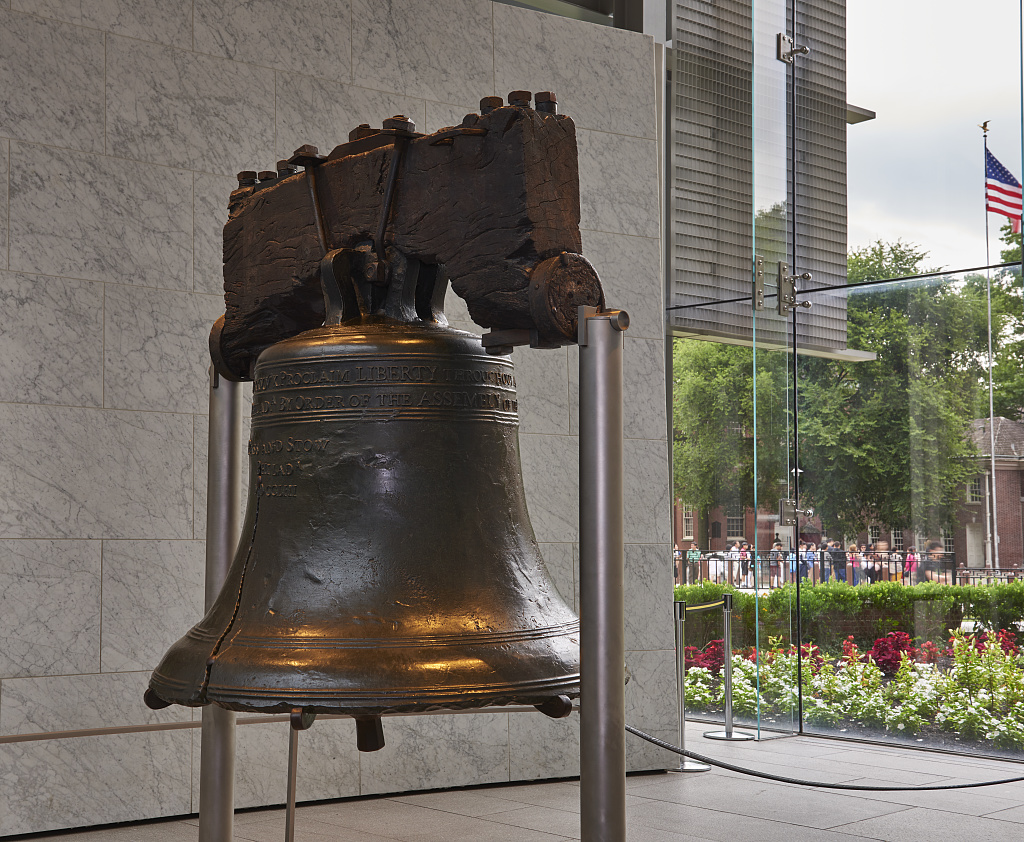
The Liberty Bell is easy to mistake for a founding relic with one fixed meaning. It sits in Philadelphia, bears a biblical command to "Proclaim LIBERTY," and carries a crack so famous that the damage has become part of the icon.[1] But the bell's historical force is not that it rang once for American independence. The National Park Service is explicit that there is evidence it rang for the Stamp Act and its repeal, but no evidence that it rang on July 4 or July 8, 1776.[1] The better story is stranger: an ordinary State House bell became a national memory object because later Americans kept hearing demands in an inscription the Revolution itself had not fully answered.
That is why the crack matters. Not as folklore, but as a visual argument. A working bell calls people together and then the sound disappears. A broken bell sits still and asks to be read. By the twenty-first century, the Liberty Bell Center presents the object through exhibits that run from the bell's State House origins to its use by abolitionists and civil-rights advocates.[3] The exhibit route fits the real history. The bell became loudest after its sound had failed.
A signal bell before it was a symbol
The bell began as infrastructure. Isaac Norris, speaker of the Pennsylvania Assembly, ordered a bell in 1751 for the Pennsylvania State House, now Independence Hall.[1] The first Whitechapel Foundry bell cracked during testing, so Philadelphia metalworkers John Pass and John Stow recast it locally. The finished bell, dated 1753, called lawmakers to meetings and townspeople to public news.[1] That early function was civic and practical, not mythic.
Its inscription came from Leviticus 25:10, a Jubilee verse about returning property and freeing people every fiftieth year.[1] Norris may have chosen it to mark the fiftieth anniversary of William Penn's 1701 Charter of Privileges, which connected Pennsylvania identity to religious liberty and self-government.[1] Yet the NPS notes that the inscription went largely unnoticed during the Revolutionary War.[1] The words were already there, but they had not yet become the bell's public meaning.
That delay is the first key to the bell's commemoration. The object did not automatically become a universal symbol because metalworkers cast a verse into bronze. It became one because later movements found that the verse exposed a national contradiction. The bell's afterlife was not a smooth transfer from Independence Hall to patriotic memory. It was a struggle over what the word liberty could be made to include.
Abolitionists heard accusation, not nostalgia
The name "Liberty Bell" appears early in abolitionist usage. In February 1835, a writer in The Anti-Slavery Record, published by the American Anti-Slavery Society, visited the old State House bell, noticed the inscription, and called it the Liberty Bell.[2] The NPS identifies this as the earliest known recorded instance of the State House Bell being called by that name.[2] That matters because the phrase began not as soft heritage branding but as an abolitionist reading.
The writer's point was sharp: if the bell proclaimed liberty to all inhabitants, then slavery made the proclamation false.[2] The article was published when slavery was still legal in the United States and more than two million Black people were enslaved, according to the NPS context for the document.[2] In that setting, the inscription did not congratulate the republic. It judged it.
Memory often cleans this edge away. It is more comfortable to imagine the bell as a simple emblem of independence than as an object abolitionists used to indict independence's limits. But the abolitionist naming is the moment when the bell becomes historically interesting. A civic instrument from 1753 is reinterpreted in 1835 as evidence that the nation had not obeyed its own chosen words.[1][2]
The same pattern continued after the abolitionist moment. The NPS notes that George Lippard's 1847 fictional story, "Ring, Grandfather, Ring," helped millions of Americans encounter the bell as a patriotic symbol, while late-nineteenth-century exposition tours carried it across the country.[1] Those tours made the bell portable as a national relic. Yet portability came after protest. The patriotic icon rested on an abolitionist renaming.
The crack turned failure into legibility
The famous crack is not a clean original wound. The NPS explains that no one recorded exactly when or why the bell first cracked, but the most likely explanation is a narrow split that developed in the early 1840s after decades of use.[1] In 1846, metalworkers widened that split by stop drilling, trying to stop the spread and restore the tone. The visible wide crack is therefore largely a repair scar. A second fissure then ran from the abbreviation for Philadelphia up through the word "Liberty," silencing the bell permanently.[1]
That physical sequence changed the way the bell could work as memory. Had the repair succeeded, the bell might have remained a ceremonial sound. Instead, it became an object whose wound was easy to see and hard to ignore. The crack made the bell photogenic, legible, and morally available. A visitor can stand before it and understand damage before reading a panel.
But the damage should not be sentimentalized. A cracked bell is not automatically a better symbol. What makes this crack meaningful is its placement inside the larger history of reinterpretation. The bell had already been named by abolitionists before its visible silence became the dominant public image.[1][2] Its later stillness did not create the contradiction; it preserved a way to look at it.
In that sense, the second fissure through "Liberty" is almost too neat as symbolism. It tempts the viewer to treat material accident as moral destiny. The historical discipline is to resist that shortcut. The crack happened through metallurgy, use, and failed repair. The meaning came from people who had already made the inscription a public argument.
The modern exhibit keeps the argument open
The Liberty Bell Center is not merely a container for an old object. It shapes the bell's current memory. The NPS says the center's exhibits line the left side of the hallway and cover topics from the founding of the State House bell to its use by abolitionists and civil-rights advocates.[3] That structure matters because it refuses a one-date story. The visitor moves through layers: casting, inscription, crack, abolition, suffrage, civil rights, global symbol.
The bell's modern display also changes the body's relationship to the object. A working bell once gathered listeners by sound. The museum bell gathers viewers by sight. Carol M. Highsmith's 2013 Library of Congress photograph captures the object in that later condition: bronze surface, widened crack, display setting, and a relic whose sound has to be imagined rather than heard.[4] The photograph is not an incidental illustration. It shows the bell in the form most people now know it.
That visual form can be flattening if it turns the bell into a postcard. It can also be clarifying if it makes visitors ask why the inscription has had so many owners. Abolitionists claimed it in 1835. Suffragists later made their own "Justice Bell," chained until the passage of the Nineteenth Amendment in 1920.[1] Civil-rights advocates found in it another way to insist that constitutional language had to reach people excluded by practice.[1][3] Each use depended on the same basic move: take the nation's honored words seriously enough to expose where they had failed.
The Liberty Bell's commemoration therefore works best when it is neither worshipful nor cynical. Worship turns the bell into a sacred object that proves American freedom without asking who was denied it. Cynicism treats the object as only hypocrisy, which misses why reformers kept returning to it. The bell mattered because its inscription was broad enough to be used against narrow versions of the nation.
That is the unresolved power of the cracked bell. It began as a practical State House signal in 1753, took on abolitionist force in 1835, became physically silent after the failed 1846 repair, and now sits in a center that narrates its meanings through protest as well as patriotism.[1][2][3] Its silence is not empty. It is a demand that the viewer supply the missing sound by deciding what liberty should mean when the bronze can no longer ring.
Sources
- National Park Service, "The Liberty Bell" - official history of the bell's casting, inscription, crack, abolitionist symbolism, later reform uses, and factual cautions about 1776 ringing claims.
- National Park Service, ""The Liberty Bell." in The Anti-Slavery Record - February 1835" - official page and transcript context for the earliest known recorded use of "Liberty Bell" by an abolitionist publication.
- National Park Service, "Visiting the Liberty Bell Center" - official visitor page describing the modern display, exhibit sequence, location, and interpretation of abolitionist and civil-rights uses.
- Library of Congress, Carol M. Highsmith, "The Liberty Bell, an iconic symbol of American independence, located in Philadelphia, Pennsylvania" - 2013 photograph used as the article image.