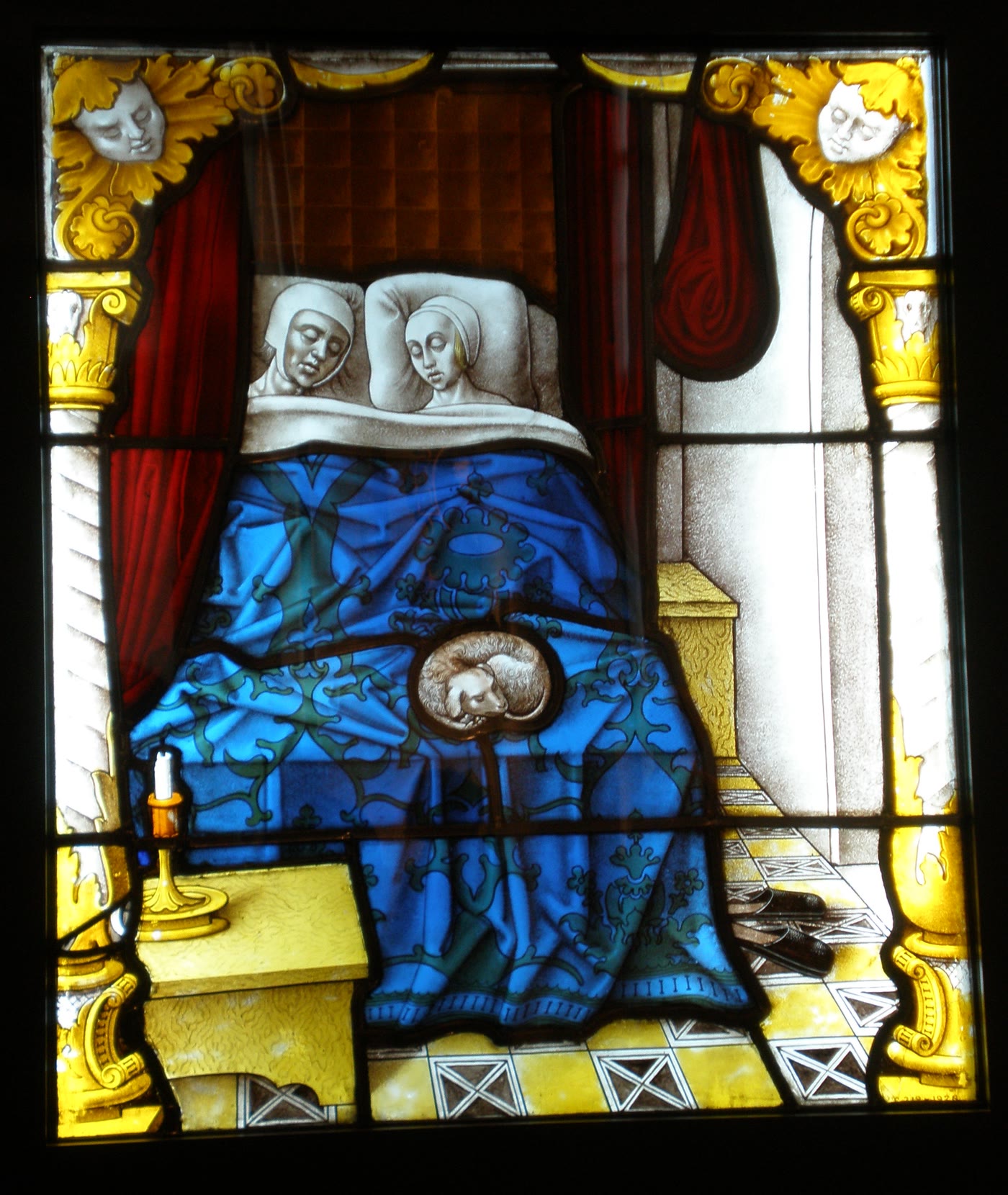
In a stained-glass panel made in the Lower Rhine around 1520, Tobias and Sara lie under the same cover, framed by patterned curtains. Their shoes wait below. A small dog sleeps at their feet. The scene preserves a bed, bodies, and fabric. It cannot preserve what happened four hours after the couple closed their eyes.[9][14]
A bed survives. A sleep schedule does not.
That is the difficulty inside one of the most memorable claims in the history of everyday life: before industrial modernity, people in Western Europe ordinarily slept twice. They took a “first sleep,” woke around midnight for a quiet interval, then returned for a “second” or “morning sleep.” Historian A. Roger Ekirch made that pattern visible in a landmark 2001 article; Niall Boyce reopened the case in 2023, arguing that the same words can describe several kinds of broken or continuous sleep.[1][3]
The dispute is not over whether an early modern person ever woke and slept again. Plainly, some did. It is over prevalence and structure: was a divided night a widely understood routine, or has a vivid but flexible vocabulary been mistaken for a timetable?
The debate has nested geographic scales. Ekirch’s thesis ranges across Britain and Western Europe; Boyce tests a narrower body of sixteenth- to eighteenth-century English evidence. Laboratory and contemporary field studies can bound what is physiologically plausible and show human variation. They cannot measure prevalence in historical England.
This is a historical question, not a prescription for how anyone should sleep now. Its importance lies elsewhere. It asks how historians can recover a repeated, largely unrecorded behavior from texts written because something unusual happened—and how laboratory and field research can test plausibility without becoming a time machine.
Interpretation one: a customary divided night
Ekirch’s case begins with accumulation. In court depositions, diaries, letters, medical advice, prayer books, plays, poems, and novels, he found references to “first sleep,” “second sleep,” “morning sleep,” and equivalent expressions in several European languages. The phrases often arrive without explanation. For Ekirch, that casualness is evidence: writers could leave the terms undefined because readers already knew the rhythm they named.[1]
Legal testimony is especially valuable here. A deponent describing a theft, fire, illicit meeting, or suspicious noise had practical reasons to locate an action within the night. Such witnesses were not trying to theorize sleep. When one remembered rising after a first sleep, the temporal phrase could be incidental to the case and therefore revealing of ordinary assumptions.[1]
Read together, the references produce a recognizable sequence. Households retired after evening activity, slept for several hours, and woke for up to an hour or more. During the interval, people might pray, recall dreams, tend a fire, urinate, talk, work, or have sex before sleeping again. The point is not that every sleeper performed the same ritual. It is that wakefulness could occupy a legitimate middle of the night rather than appearing only as failed sleep.[1]
Ekirch’s later account found eighteenth-century precursors but placed the main, protracted consolidation of Western sleep in the nineteenth century. More artificial illumination enlarged the usable evening; changing labor and cultural expectations pushed sleep toward one block. This was an uneven social transition, not a switch thrown by the first streetlamp. Affluent urban households could buy brighter evenings before many rural or working households could, and language such as “first sleep” persisted after behavior began to change.[2]
The strongest form of this interpretation is therefore cultural, not mechanical. It does not require every person to wake at the same minute. It proposes that a divided night was familiar enough to organize expectations: waking after the first bout was intelligible, and returning to sleep belonged to the pattern.
Interpretation two: many broken nights, no single template
Boyce’s challenge begins by rereading a selected, mostly English sample from Ekirch’s 2001 corpus in fuller context. “First” can identify the beginning or deepest phase of one continuous process; “second sleep” can be nothing more than sleep resumed after a disturbance. A phrase can be conventional without naming a universal schedule.[3]
Consider three examples from early modern England. In 1547, physician Andrew Boorde advised a sleeper who woke after a first sleep to urinate if necessary and change sides. Yet he also told the reader to turn over as often as waking occurred. That passage permits a neat two-part night, but it also permits several brief awakenings. In 1582, Thomas Bentley titled a prayer “At Mid-night, If You Happen to Awake.” The conditional makes nocturnal waking imaginable without making it inevitable. And in 1662, the regicide Miles Corbet reportedly said on the day of his execution that his first sleep lasted until two o’clock and that he had slept twice since—three bouts during an exceptional, anxious night, not two balanced halves of an ordinary one.[3]
Context can reverse the evidentiary force of a citation. An author awake with gout, a prisoner before execution, a sailor working watches, or a character startled by a dream proves that fragmented sleep was possible. None automatically represents an ordinary household night. Printed advice may tell readers what to do if they wake, not document how often they did. Court records select nights on which crimes, noises, movement, or conflict made someone’s whereabouts worth recording.[3]
This does not make the archive worthless. It changes the question asked of each item. A reference can establish vocabulary. A fuller passage can establish the cause and duration of one awakening. Only a sample with some denominator—ordinary nights as well as noteworthy ones—can establish frequency.
Boyce’s strongest conclusion is correspondingly limited: the early modern evidence supports diverse patterns of sleep, including segmentation, but does not yet prove that a first sleep, a substantial waking interval, and a second sleep formed the sole or predominant English model.[3] The critique trims the thesis at its most universal edge; it does not explain away every ordinary-sounding reference in Ekirch’s much broader archive.
The disagreement became direct in 2024. Ekirch replied that Boyce had concentrated on a fraction of the 2001 evidence while giving too little weight to his enlarged corpus and later revisions; he again argued that convergence across many places and genres supports predominance. Boyce answered that more brief references cannot substitute for close context or resolve the social diversity hidden by a long period. Their exchange clarifies the methodological divide. For Ekirch, independent allusions assemble like pieces of one pattern. For Boyce, an ambiguous piece remains ambiguous even when placed beside many others.[10][11]
A dark laboratory is not an early modern house
A famous experiment seems, at first, to give the divided night a biological foundation. In 1992, psychiatrist Thomas Wehr reported what happened when healthy volunteers moved from a conventional 16-hour light period to a 10-hour one. With 14 hours of darkness available, their sleep expanded and usually separated into two roughly symmetrical bouts with one to three hours of wakefulness between them. Melatonin secretion and the nightly phase of rising sleepiness expanded too.[4]
The experiment matters because it demonstrates capacity. Under a long dark interval, modern human sleep can reorganize into a pattern resembling the one Ekirch described. It weakens the assumption that consolidated sleep is the only biologically coherent arrangement.[4]
But resemblance is not identification. A controlled photoperiod does not reproduce work, cold, infants, animals, illness, noise, prayer, fire-tending, household rank, seasonal labor, or the cost of fuel. It can show what human physiology permits under specified conditions. It cannot tell us how often a farm servant in Kent or an artisan in York woke in 1650, or what that waking meant.
Using the experiment as proof of the historical thesis would confuse two questions. Wehr tested whether long darkness can elicit biphasic sleep. Historians are trying to determine whether particular communities treated that response as a customary social pattern.
Three field studies, three different nights
Research outside industrialized settings complicates any simple equation between darkness and two sleeps. In 2015, Gandhi Yetish and colleagues used wrist actigraphy among Hadza hunter-gatherers in Tanzania, San hunter-gatherers in Namibia, and Tsimane forager-horticulturalists in Bolivia. Participants generally began sleeping well after sunset, and the researchers did not observe regular, extended midnight wakefulness. Their result showed that life without electric lighting does not by itself generate one universal sleep architecture.[5]
Ekirch replied in 2016 that three contemporary equatorial societies could not support a claim about all preindustrial humanity. He pointed to historical and ethnographic reports of first and second sleeps in Africa, Asia, the Middle East, Australia, and the Americas, while explicitly stopping short of calling segmented sleep predominant in every non-Western society.[6] The exchange exposed a symmetry of caution: present-day communities are not living fossils, just as European phrases are not actigraphy traces.
Then came results that refused to line up neatly on either side. A 2017 study followed 21 people for 292 recorded days in a rural, nonelectric agricultural community in Madagascar. It found post-midnight activity on 49 percent of nights and daytime napping on 89 percent of recorded days—a pattern the authors judged consistent with segmented sleep.[7]
On Tanna Island, Vanuatu, a 2019 study compared nearby subsistence-horticultural villages with and without grid electricity. Among 519 recorded nights, activity divided sleep into separate bouts on 73 nights, or 14 percent. Splits were sporadic and occurred at varying times, so the authors described the prevailing pattern as monophasic. Participants in grid-served villages averaged sleep onset 23 minutes later and 28 minutes less nocturnal sleep than those in non-grid villages, but the duration gap was driven mainly by breastfeeding mothers. Most people in the non-grid group used dim solar torches, and adding naps removed the significant difference in total daily sleep.[8]
Madagascar shows that a divided night can be recurrent in a nonelectric agrarian setting. Tanna shows that a non-grid setting can instead contain occasional splits within a mostly consolidated pattern. The three-country study shows still another configuration. These communities cannot adjudicate what England did four centuries earlier. They reveal the number of variables hidden by the label “preindustrial”: latitude, season, subsistence, childcare, sleeping surface, co-sleepers, noise, ritual, and local ideas about time.
What the debate actually settles
The two strongest interpretations now overlap more than a simple pro/con framing suggests.
The customary divided-night interpretation has the advantage of breadth and convergence. Repeated, unexplained terms across genres and places; descriptions of useful midnight activity; a laboratory demonstration of biphasic capacity; and field evidence from Madagascar establish segmented sleep as a real, documented practice.[1][4][7]
The plural-sleep interpretation has the advantage of contextual precision. Individual phrases often fail to specify a long interval, a predictable hour, or two—and only two—sleep bouts. Modern field studies show that limited electric light does not fix sleep into one form. On this reading, segmentation was one available and sometimes familiar practice inside a varied ecology of rest, rather than the default timetable of nearly everyone.[3][5][8]
The remaining disagreement is the distance between familiar and predominant. Historians possess many positive sightings but no representative population-level census of nights. The archive is rich in numerator and poor in denominator.
Smaller quantitative efforts show both the promise and the limits of building one. Using event-selected Antwerp criminal-court depositions—principally from 1750 to 1795—Gerrit Verhoeven inferred that segmented sleep was rare. Ekirch objected that depositions about nocturnal incidents could not reveal ordinary waking intervals that witnesses had no reason to report.[12][16] Hartmut Schulz and Gerhard Dirlich reconstructed a year of sleep in 1755–1756 from one unusually systematic Hamburg diary; that year contained both short interruptions and longer gaps consistent with segmented nights. Antwerp offers a broader but selection-bound set of observations; Hamburg offers repeated whole nights for only one person. Neither stands for early modern Europe, but both move the unit of analysis from an isolated phrase toward analyzable sets of observations.[13]
Evidence could still move the balance. The divided-night case would strengthen if a systematic sample of diaries, household accounts, and depositions showed first and second sleeps recurring across ordinary nights, seasons, occupations, genders, and social ranks—with a stable waking interval rather than incidental disturbance. The plural-sleep case would strengthen if the vocabulary clustered around illness, danger, shift work, prayer, or literary convention, while long runs of comparable diaries showed no repeated middle interval. Digitized text searches could help only if researchers inspect full passages, track variant terms, and count the relevant documents in which the pattern does not appear.
The stained glass offers the right final warning. We can see Tobias and Sara’s bed in exquisite detail, but the panel gives us no clock and no next frame. Ekirch taught historians to notice that a night could have a middle. Boyce asks them to prove how many nights did. Between those insights lies the most defensible answer: first and second sleep belonged to the repertoire of early modern life; whether they ruled it remains open.
Sources
- A. Roger Ekirch, “Sleep We Have Lost: Pre-industrial Slumber in the British Isles,” The American Historical Review 106, no. 2 (2001), 343–386 — the foundational historical case for customary first and second sleeps.
- A. Roger Ekirch, “The Modernization of Western Sleep: Or, Does Insomnia Have a History?” Past & Present 226, no. 1 (2015), 149–192 — the argument for gradual sleep consolidation across the industrial era.
- Niall Boyce, “Have we lost sleep? A reconsideration of segmented sleep in early modern England,” Medical History 67, no. 2 (2023), 91–108 — a contextual re-reading of the textual evidence and its ambiguous terminology.
- Thomas A. Wehr, “In short photoperiods, human sleep is biphasic,” Journal of Sleep Research 1, no. 2 (1992), 103–107 — the laboratory photoperiod experiment.
- Gandhi Yetish et al., “Natural Sleep and Its Seasonal Variations in Three Pre-industrial Societies,” Current Biology 25, no. 21 (2015), 2862–2868 — actigraphy in Hadza, San, and Tsimane communities.
- A. Roger Ekirch, “Segmented Sleep in Preindustrial Societies,” Sleep 39, no. 3 (2016), 715–716 — a response mapping historical and ethnographic counterexamples.
- David R. Samson et al., “Segmented sleep in a nonelectric, small-scale agricultural society in Madagascar,” American Journal of Human Biology 29, no. 4 (2017), e22979 — actigraphy and polysomnography in a rural agrarian community.
- Andrea N. Smit et al., “Sleep timing and duration in indigenous villages with and without electric lighting on Tanna Island, Vanuatu,” Scientific Reports 9 (2019), article 17278 — a within-island comparison of sleep timing, duration, and fragmentation.
- Wikimedia Commons, “BLW Stained Glass — Tobias and Sara,” photograph by David Jackson (2010) — source page, object description, full-resolution file, and CC BY-SA 2.0 UK license metadata for the article image.
- A. Roger Ekirch, “Reflections on ‘Have we lost sleep?’” Medical History 68, no. 3 (2024), 254–262 — Ekirch’s defense of the enlarged evidentiary corpus and revised chronology.
- Niall Patrick Boyce, “Response to: Reflections on ‘Have we lost sleep?’” Medical History 68, no. 3 (2024), 263–264 — Boyce’s reply on contextual ambiguity and the limits of generalization.
- Gerrit Verhoeven, “(Pre)Modern sleep. New evidence from the Antwerp criminal court (1715–1795),” Journal of Sleep Research 30, no. 1 (2021), e13099 — a quantitative analysis of criminal-court eyewitness reports.
- Hartmut Schulz and Gerhard Dirlich, “Sleep in a 1-year diary from the mid-18th century,” Journal of Sleep Research 33, no. 3 (2024), e14067 — a night-by-night reconstruction from a Hamburg diary.
- Victoria and Albert Museum, “Panel: Tobias and Sara on their Wedding Night” (C.219-1928) — the current catalog record for the object’s date, Lower Rhine production, materials, and provenance.
- Creative Commons, “Attribution-ShareAlike 2.0 UK: England & Wales” — the license deed governing David Jackson’s photograph and its resized derivative.
- A. Roger Ekirch, “Response to Dr Gerrit Verhoeven, ‘(Pre)Modern sleep: New evidence from the Antwerp Criminal Court (1715–1795),’” Journal of Sleep Research 30, no. 1 (2021), e13167 — a methodological critique of the court-record analysis.