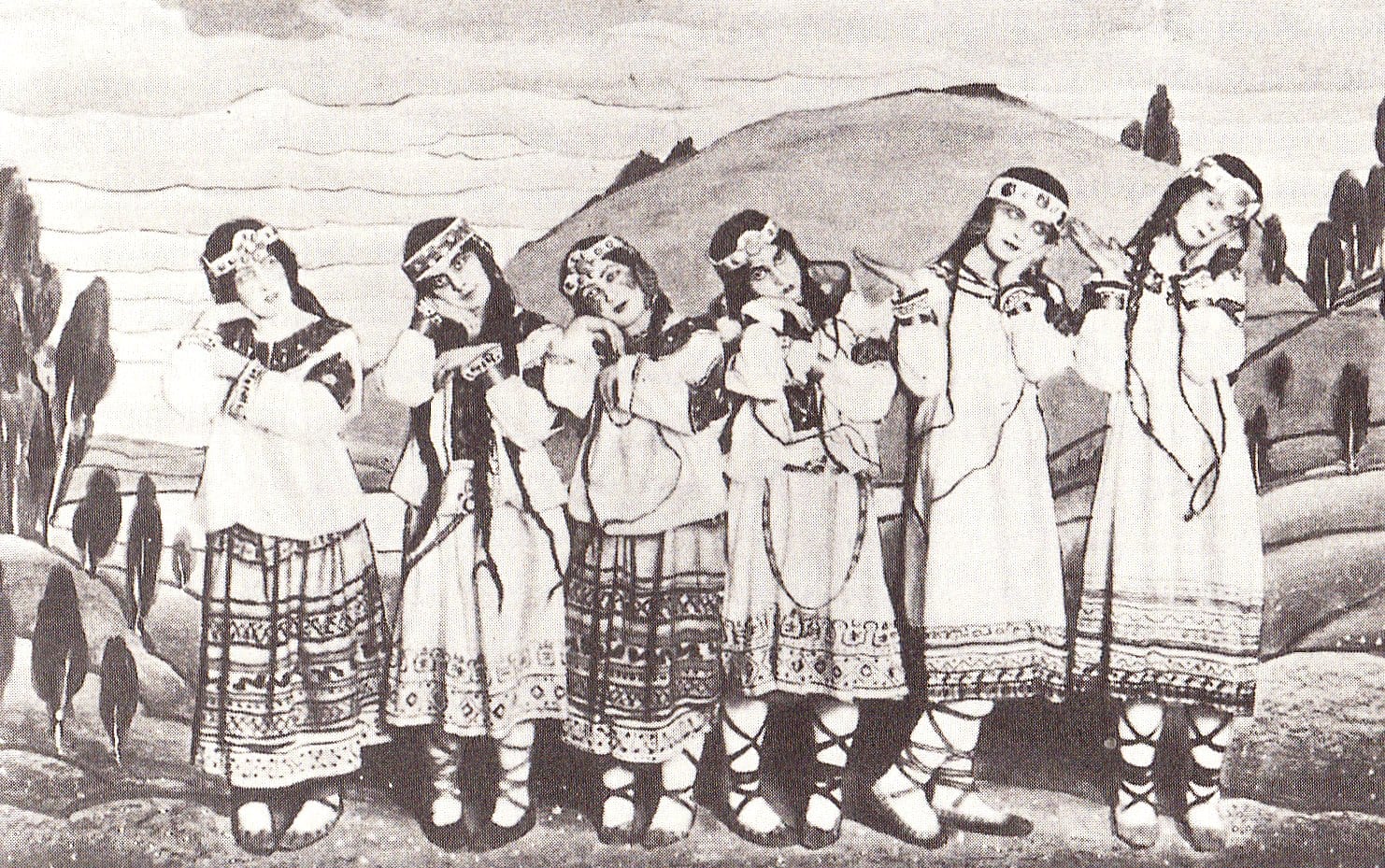
The photograph is quiet. Six dancers face the camera in Nicholas Roerich’s long, patterned costumes. Their knees bend, their feet press into the floor, and a painted landscape stands behind them. Nothing in the posed group portrait reveals the sound that would attach itself to The Rite of Spring: laughter, whistles, rival shouts, an orchestra playing on, and a choreographer calling numbers from the wings.[2][6]
That silence is useful. It separates the work onstage from the legend in the auditorium. The premiere on May 29, 1913, at Paris’s new Théâtre des Champs-Élysées really was disrupted. Yet “the riot” has become such an efficient story about modern art shocking a complacent public that it can obscure a harder theatrical question: how did the dancers finish a ballet when the audience made the orchestra difficult to hear?[1][2][4]
The answer began before opening night, in rehearsal rooms where counting was already part of the choreography.
May 28: one last rehearsal, no ready-made scandal
The open general rehearsal took place on May 28, one day before the premiere. It is the source of occasional confusion over the ballet’s first-performance date, but the work’s catalogue is explicit: May 28 was the rehearsal; May 29 was the public premiere.[5] It passed without the public premiere’s confrontation, although later memories differ about how smoothly the stage work went.[1]
Order did not mean ease. The production joined Igor Stravinsky’s score to Vaslav Nijinsky’s choreography and Roerich’s sets and costumes under Serge Diaghilev’s Ballets Russes. Stravinsky’s shifting accents and irregular rhythmic groupings were difficult to embody. Nijinsky’s movement made that difficulty visible: instead of the lifted line and turned-out feet associated with classical ballet, the dancers appeared weighted, bent, turned in, and close to the earth. Roerich’s thick felt garments and wigs added literal weight.[2]
The dancers had struggled to follow the score’s counts. Diaghilev therefore brought in Marie Rambert, trained in Émile Jaques-Dalcroze’s eurhythmics, to help translate unfamiliar musical patterns into movement the company could retain. A surviving piano score annotated by Rambert records Nijinsky’s choreography in pencil—material evidence that this apparently elemental ritual depended on exact rehearsal and notation.[2][3]
That is the first correction the chronology supplies. The premiere was not an explosion of unprepared spontaneity. It was the public presentation of a heavily drilled coordination among pit, stage, and wings. On May 28, that coordination held in front of an audience. On May 29, a second performance began in the seats.
May 29: the audience enters the score
Pierre Monteux raised his baton. The ballet’s introduction opened with a bassoon pushed into an unusually high register, followed by woodwind lines that made the sound’s source hard to locate. Reports place laughter or jeering near the beginning. When the curtain revealed Nijinsky’s grounded choreography and Roerich’s costumed figures, disapproval met approval: boos drew counter-boos, and rival factions tried to defeat one another by volume.[1][2]
It is tempting to describe a single audience recoiling from a single novelty. The evidence is less tidy. Sarah Gutsche-Miller’s study of Parisian newspaper and specialist-press coverage finds reactions directed variously at the music, choreography, décor, costumes, performers, and people associated with the production. Those reports also carried wider social and political tensions into their descriptions of the room.[4] “Paris rejected modern music” is therefore too blunt. The auditorium contained supporters as well as opponents, and spectators were reacting to a total production while also reacting to each other.
The disturbance altered the event it judged. Noise from the house competed with sound from the pit. The dancers, whose movements had been keyed to a difficult score through weeks of work, could no longer reliably hear the orchestra. In the account preserved by the Royal Ballet School, Nijinsky climbed onto a chair in the wings and called the counts toward the stage while Diaghilev switched the house lights on and off in an attempt to settle the room. Monteux kept the orchestra moving.[2]
In that account, Nijinsky’s numbers were not a second composition and not an improvised replacement for Stravinsky. They were a practical bridge back to the rehearsed ballet. Each shouted count converted musical position into an instruction the dancers might catch above the audience. The premiere’s decisive action was therefore not only confrontation. It was repair in real time: pit continued, wings transmitted, dancers recovered their places, and the staged rite advanced.
The work proceeds in two parts, from spring games and rival tribes to the selection and sacrificial dance of the Chosen One.[5] The interruption did not prevent that arc from reaching its end. The company completed the ballet. This does not make the disturbance trivial. It locates its consequence more precisely: the audience damaged the performers’ acoustic connection without stopping the performance itself.
After the curtain: one night, two interpretations
Once the curtain fell, the event became evidence for competing histories.
The first interpretation treats the premiere as a genuine near-riot caused by an unprecedented work. Institutional accounts preserve opposing factions shouting, the blinking lights, and Nijinsky’s counts. In this reading, the first night dramatizes a collision between an avant-garde production and spectators who experienced its sounds, bodies, and ritual as an attack on theatrical expectations.[2]
The second interpretation does not require a silent or polite evening. It argues that later retellings amplified a disorderly scandal into a foundational myth. Participant memories were written after The Rite of Spring had become famous; vivid anecdotes accumulated; and the word “riot” gave the work a compact origin story. Gutsche-Miller’s close reading of the contemporary press explicitly challenges the exaggerated rhetoric that has shaped later understanding of the supposedly riotous first night.[4]
These interpretations share more ground than their labels suggest. The strongest common core is a loud, confrontational audience that impaired communication with the stage. The uncertain zone includes the scale and sequence of physical violence, the motives assigned to a socially mixed room, and details sharpened in memoir. “Nothing happened” cannot explain the counts from the wings. “A unified public rioted against dissonance” cannot explain the factions, the range of targets, or the story’s later enlargement.
The distinction matters because a premiere is unusually vulnerable to retrospective editing. Reviews are immediate but partisan. Memoirs are intimate but late. A famous score encourages witnesses to remember its first night as already world-historical. The more inevitable The Rite of Spring appears in the twentieth-century canon, the more tempting it becomes to cast May 29 as the exact instant an old world recognized its defeat.
June 2–13: the ballet remains on the bill
The calendar interrupts that dramatic ending. The Ballets Russes performed The Rite of Spring again in Paris on June 2, 4, 6, and 13.[5] Opening night did not close the production, and the noisy audience did not possess the final word. Each repeat required the ordinary labor that the riot legend pushes offstage: musicians following Monteux, dancers recovering the difficult patterns, dressers managing Roerich’s heavy costumes, and stage personnel resetting the two-part ritual.
The additional performances also warn against making one reception stand for a work’s meaning. A first night concentrates status, expectation, critics, supporters, and detractors. A run distributes attention over time. Even if later Paris audiences remained divided, they encountered a known controversy rather than an unknown object. Publicity had changed the conditions of seeing.
Nijinsky’s original choreography did not secure the same continuous life as Stravinsky’s score. The Ballets Russes gave it only a small number of performances, and later productions used new choreography; the 1913 staging eventually had to be reconstructed from traces including photographs, testimony, and annotated notation.[2][3] The work that history calls a single masterpiece was already beginning to separate into survivals.
1914: the music changes rooms
On February 18, 1914 by the Gregorian calendar, Serge Koussevitzky conducted the first concert performance in Moscow. A second Russian concert followed on February 25, and Monteux conducted the first French concert performance in Paris on April 5.[5] Now there were no Roerich costumes to judge, no Nijinsky choreography to track, and no dancers whose hearing could be severed from the orchestra by the house.
That change of medium was consequential. The score could be heard as a concert work rather than one component of a crowded theatrical event. The performance chronology records a decisive formal shift within nine months of the ballet premiere: The Rite of Spring had acquired a stand-alone orchestral life.[5] It did not make every listener agree, nor did it prove that the choreography had caused the premiere disturbance. It changed the variables. An audience could attend to the music without simultaneously interpreting turned-in bodies, painted antiquity, sacrificial action, and its own noisy contest.
The familiar story moves from outrage in 1913 to triumph afterward. The chronology suggests something more interesting: the object being received had changed. On May 29, The Rite of Spring was a ballet whose performance depended on fragile links among orchestra, wings, and dancers. In 1914, it could travel as an orchestral score. Its afterlife was not simply the public learning to like what it once hated; it was the work becoming available in another form.
Return, finally, to the 1913 photograph. It cannot show whether anyone threw a punch. It cannot tell us what a critic heard, or how loudly Nijinsky counted. It does show the bodies, costumes, and visual world that vanished when the music entered the concert hall.[6] Beside Rambert’s marked score, it preserves a fragment of the staged work that the scandal nearly displaced in memory.[3]
The loudest fact about May 29 is not that order disappeared. It is that enough order survived. While the audience performed its dispute, the people behind and on the stage kept count, and The Rite of Spring reached its final beat.
Sources
- Thomas Forrest Kelly, First Nights: Five Musical Premieres (Yale University Press, 2000) — a source-led reconstruction of the premiere, its dress rehearsal, participants, and reception.
- The Royal Ballet School, “The Rite of Spring (1913): Modernist masterpiece” in its historical timeline — rehearsal difficulties, Marie Rambert’s role, choreography, costumes, audience noise, Nijinsky’s counting, and performance history.
- Library of Congress Research Guides, “Igor Stravinsky: Special Collections” — catalogue context for the 1913 Rite of Spring score bearing Marie Rambert’s pencil annotations of Nijinsky’s choreography.
- Sarah Gutsche-Miller, “The Rite of Spring in the Parisian Press,” in The Cambridge Companion to The Rite of Spring (Cambridge University Press, 2025) — analysis of contemporary coverage, its varied targets, social context, and later mythmaking.
- K Catalog, “K015 The Rite of Spring” — annotated Stravinsky work catalogue with the ballet’s structure and dates for the May 28 rehearsal, May 29 premiere, June repeats, and 1914 concert performances.
- Wikimedia Commons, “File:RiteofSpringDancers.jpg” — source and rights record for the public-domain 1913 archival photograph used as the hero image, originally published in The Sketch.