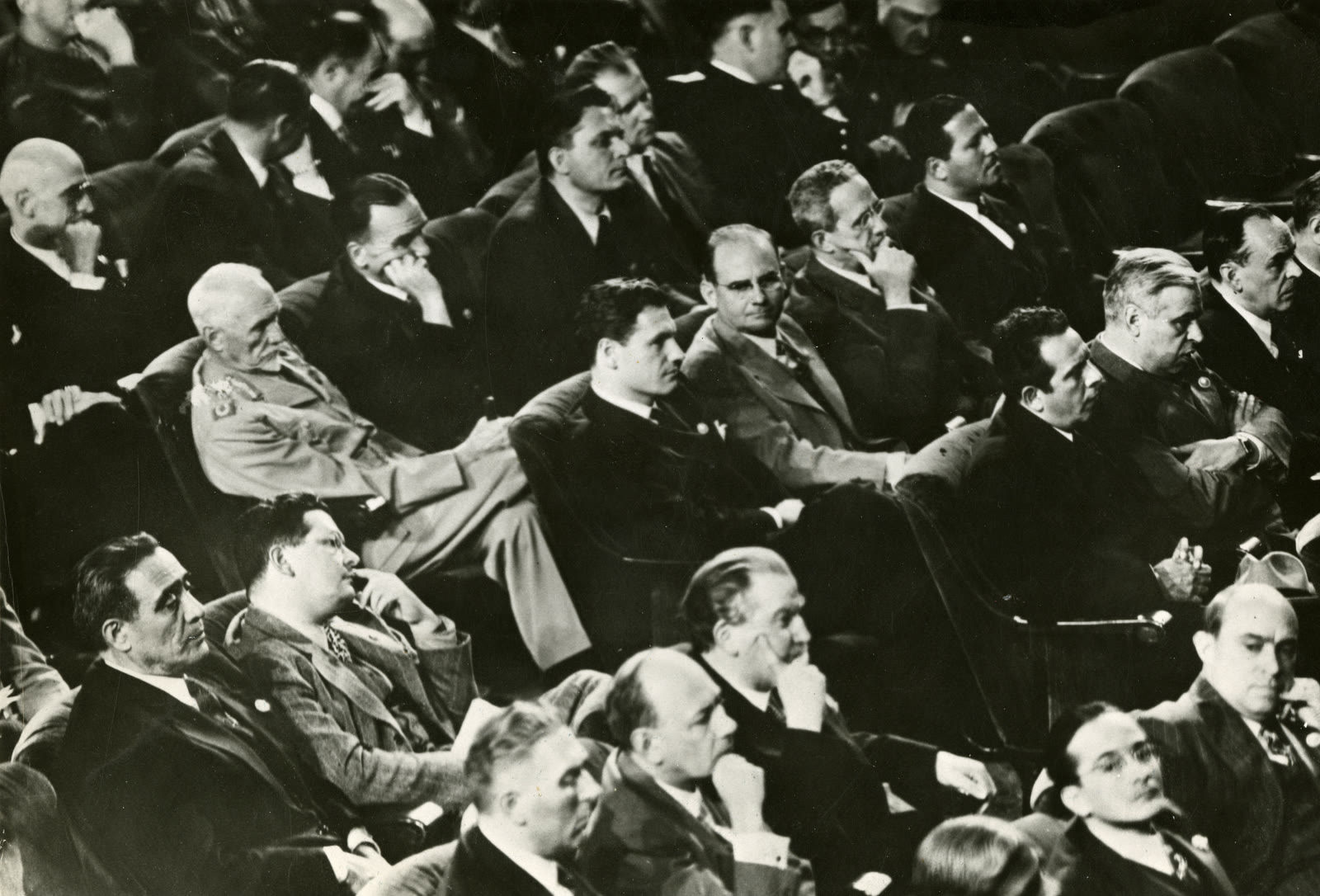

The film begins by making international organization look like a destination. San Francisco Bay, the Golden Gate Bridge, steep streets, and arriving aircraft establish a city ready to receive the world. Delegates descend steps, move through crowds, and enter a packed auditorium. Before the viewer learns how the proposed organization will work, the camera has supplied an origin story: nations have traveled from elsewhere, gathered in one visible place, and taken their seats.[1]
That visual confidence conceals how unsettled the project remained. The United Nations Conference on International Organization opened on April 25, 1945, thirteen days after Franklin D. Roosevelt's death and while the Second World War was still being fought. Germany surrendered during the conference, on May 8; the war against Japan continued after the delegates left. By the closing session on June 26, fifty participating nations had agreed on a Charter, but agreement did not itself bring the organization into legal existence. That required ratification, and the Charter entered into force only on October 24, 1945.[2][3]
The surviving film is therefore valuable for more than the people and rooms it records. It shows how a new institution presented itself to a public that had to believe cooperation could outlast the alliance of wartime. Its orderly montage turns negotiation into momentum. Read beside the conference record, however, the same images reveal a harder achievement: thousands of delegates, advisers, staff, interpreters, journalists, and observers had to convert a draft largely shaped by great powers into machinery that a much wider membership could accept.[3][4][5]
Image context: the cover is a real Office of War Information staff photograph dated June 22, 1945, not a frame extracted from the video. Its rows of attentive delegates preserve the plenary scale while the museum record identifies several people near the aisle, including South African field marshal Jan Christiaan Smuts, U.S. assistant secretary of state Nelson A. Rockefeller, and Mexican foreign secretary Ezequiel Padilla.[6]
A design arrived before the delegates did
San Francisco was a founding conference, but it did not begin with a blank page. The diplomatic sequence reached back through the Atlantic Charter of August 1941, the Declaration by United Nations of January 1942, the Moscow declaration of October 1943, and the Dumbarton Oaks conversations of August–October 1944. Dumbarton Oaks supplied the main proposals for a general international organization. At Yalta in February 1945, Roosevelt, Winston Churchill, and Joseph Stalin settled the voting formula for the Security Council, including the privileged position of its permanent members.[2][4]
That inheritance made the conference both real and bounded. Delegates could revise the design, argue over it, and add language; they could not plausibly create an enforcement system that the principal Allied powers refused to join. The U.S. Office of the Historian notes that the permanent-member veto formula had been finalized at Yalta, including an understanding that the veto would not prevent the Security Council from discussing a dispute.[4] Even that line nearly broke down in San Francisco: the documentary record preserves a June 2 U.S. warning of a “serious crisis” when the Soviet position appeared to extend unanimity into consideration and discussion as well.[8]
The broader conference nevertheless mattered. Fifty nations participated, working through a plenary, four general commissions, and twelve technical committees. More than five thousand documents were considered. The UN's history describes 850 delegates and a conference population of roughly 3,500 once advisers, staff, and the secretariat are included, alongside more than 2,500 press, radio, newsreel, and civil-society observers.[3] Those numbers explain why the film alternates between spectacle and procedure. The Opera House could make the world assembly visible; smaller rooms had to make its text workable.
The institutional film
The United Nations Audiovisual Library of International Law identifies the footage as the edited film San Francisco Conference, produced by the U.S. Information Agency, and catalogues the full version at about eleven minutes.[2] The embedded copy is published by the official UN GENEVA CONFERENCES YouTube channel. That provenance does not make the film a neutral window. It makes it an institutional primary source: archival images arranged to explain, dignify, and popularize the organization whose birth they depict.
The film's first three minutes are a lesson in political geography.[1] Around 0:30, the bridge and bay place the event at a recognizable American threshold. Street scenes then bring the scale down from landmark to circulation. Aircraft, airport crowds, and formal greetings turn distance into arrival. The repeated motion matters: internationalism is rendered not as an abstract principle but as bodies successfully crossing borders and converging.
At roughly 3:00, the visual grammar changes. A wide view of the auditorium replaces movement with order: rows face a platform, flags frame the proceedings, and individual delegates become part of a seated whole.[1] The composition makes equality easy to imagine because every delegation appears inside the same room. Yet equal visibility was not equal power. The Charter would give every member a General Assembly vote while reserving permanent Security Council seats and vetoes for China, France, the Soviet Union, the United Kingdom, and the United States.[3][4] The camera can show co-presence; it cannot by itself show the constitutional hierarchy organizing that presence.
Where the pageant becomes a working conference
The most revealing stretch arrives later, when the film leaves the grand hall. Around 6:00, tables crowded with papers and people replace the monumental auditorium. A speaker stands close to other delegates rather than far above them. The scene has less ceremonial symmetry and more documentary friction: heads turn, pages accumulate, and participants occupy one another's working space.[1] This is closer to where amendments, definitions, and compromises acquired wording.
The UN Archives preserves the material infrastructure behind such scenes. Its conference exhibit describes heated debate over the Big Five veto, an international secretariat servicing all four commissions and twelve technical committees, and a system for preparing minutes, translating and interpreting proceedings, and printing and distributing documents.[5] Translation operated in two working languages and five official languages. The Charter was not simply spoken into being from a dais. It moved through clerks, interpreters, typists, printers, couriers, committee officers, and successive texts.
Around 7:00, the film responds with organizational graphics: the Security Council and General Assembly appear first, then the International Court of Justice, Economic and Social Council, and Trusteeship Council.[1] The sequence is explanatory, but it also performs a political trick. Boxes and labels make contested bargains look like clean architecture. That is not false—the bodies were created—but the neat diagram has no visual vocabulary for leverage, exclusion, or compromise. It shows what survived the argument, not how expensive agreement was.
The record also complicates any story in which only the great powers authored the result. The UN Archives credits Dominican diplomat Minerva Bernardino with helping secure the Article 1 language on human rights and fundamental freedoms without distinction as to race, sex, language, or religion.[5] Such interventions did not erase the power structure fixed around the Security Council. They demonstrate why San Francisco cannot be reduced either to a Big Five imposition or to an assembly of formally equal authors. It was both a constrained settlement and a site where other delegations changed what the settlement said.
Three dates, not one founding moment
The film's title dates the conference from April 25 to June 26, encouraging the viewer to experience those nine weeks as a complete arc.[1] Legally and politically, the ending had three stages. The Charter and the Statute of the International Court of Justice were adopted unanimously at the Opera House on June 25. Delegations signed the Charter the next day at the Veterans War Memorial Building's Herbst Theatre. It entered into force on October 24, after the five permanent Security Council powers and a majority of the other signatories deposited their ratifications.[2][3]
Keeping those dates separate prevents ceremony from swallowing institution-building. Adoption established agreement on a text. Signature authenticated each government's commitment. Ratification supplied domestic consent and triggered entry into force. The delay also exposes a fact that the closing pageant could not settle: a charter is only potential until states authorize and use it.
Harry Truman acknowledged that boundary in his June 26 closing address. He praised the signed Charter, but called it a first step and said no one claimed it was final or perfect.[7] His speech then turned immediately toward ratification and action. The distinction is important because the film's confidence can otherwise be mistaken for historical certainty. In June 1945, the delegates knew the League of Nations had failed, the United States had once rejected membership in it, and the wartime coalition already contained deep political conflict. The new institution looked inevitable only after editing.
What the footage leaves us
That constructed quality is the film's strength as evidence. Its bridge, planes, flags, auditorium, committee tables, and charts reveal the public language chosen for the postwar order: movement toward meeting, diversity disciplined into procedure, procedure clarified as structure, and structure offered as hope.[1] The film does not need to be dismissed as propaganda to be read critically. It records real people doing real institutional work while arranging that work into a persuasive sequence.
The written archive supplies what the montage compresses. It restores the pre-conference bargains, the veto dispute, the labor of translation and document control, the interventions that expanded human-rights language, and the ratifications still required after the cameras captured signatures.[2][4][5] The moving image contributes something those records cannot: the physical ambition of gathering so many governments before air travel and simultaneous communication became routine, and the deliberate effort to make a new constitutional order visible.
San Francisco did not prove that war had become impossible. It showed that a wartime alliance could be translated, imperfectly, into a standing forum with rules, organs, and a text. The archival film matters because it preserves the moment that contingent bargain learned to look like a world institution.
Sources
- UN GENEVA CONFERENCES, “United Nations Conference on International Organization, San Francisco Conference, 1945” — official YouTube publication of the archival conference film.
- United Nations Audiovisual Library of International Law, “Charter of the United Nations” — procedural history, adoption and entry-into-force chronology, and catalogue provenance for the edited conference film.
- United Nations, “The San Francisco Conference” — official account of participating nations, conference organization, personnel, documents, adoption, signature, and ratification.
- Office of the Historian, U.S. Department of State, “The Formation of the United Nations, 1945” — diplomatic background, Dumbarton Oaks and Yalta decisions, Security Council voting, and U.S. participation.
- United Nations Archives and Records Management Section, “United Nations at 70: From Aspirations to Actions” — archival exhibit on committee work, the veto debate, document distribution, interpretation, and Minerva Bernardino's contribution.
- The National WWII Museum, “Delegates at United Nations conference, San Francisco, California, 1945” — collection record and official caption for the June 22 Office of War Information photograph used as the cover image.
- Harry S. Truman Library and Museum, “Address in San Francisco at the Closing Session of the United Nations Conference” (June 26, 1945) — closing speech on the Charter as a first step requiring ratification and use.
- Office of the Historian, Foreign Relations of the United States, 1945, volume I, document 269 — June 2 telegram recording the dispute over whether the permanent-member veto could block Security Council consideration and discussion.