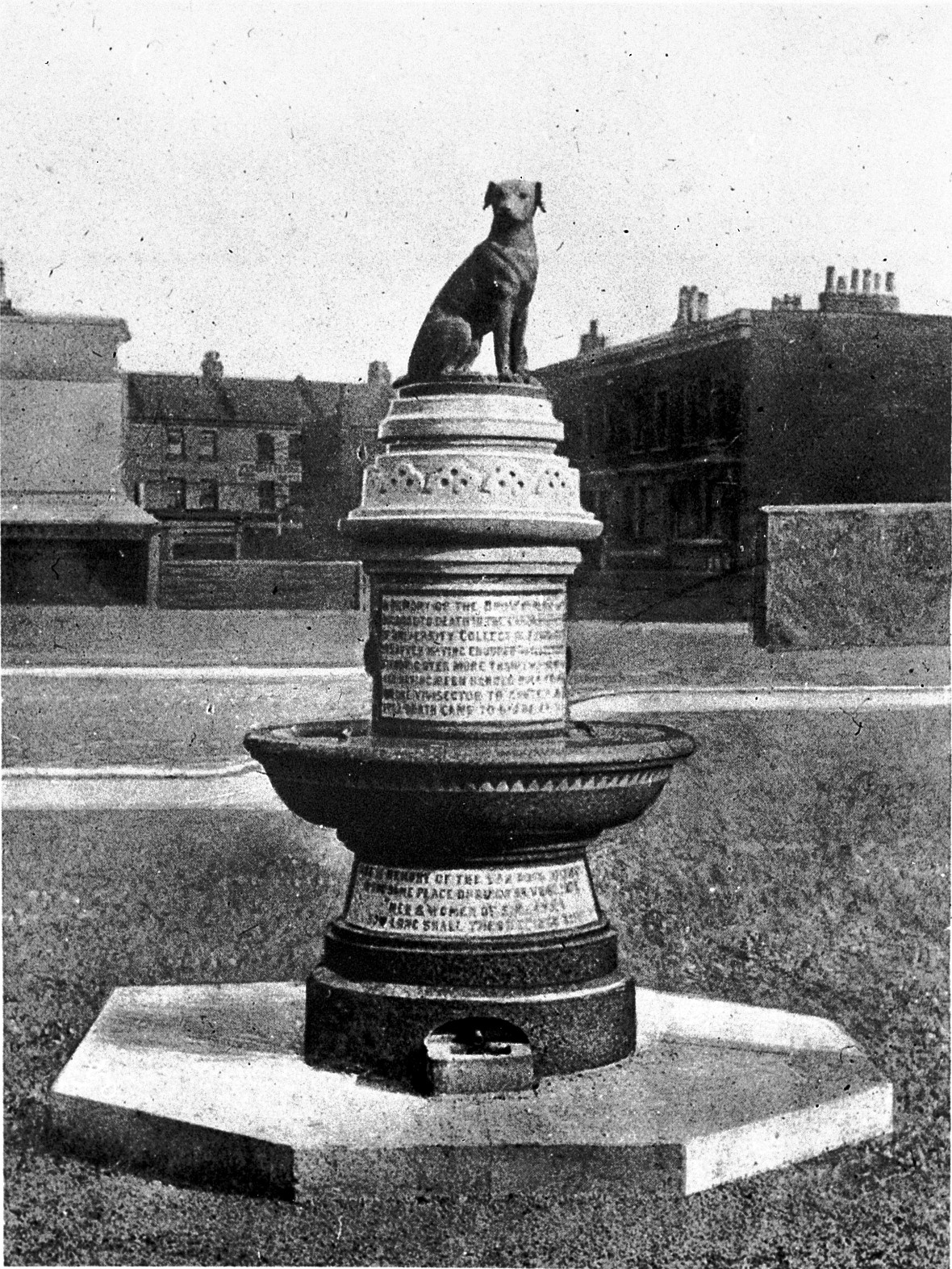
The dog in the photograph is small enough to miss at first. A bronze terrier sits upright above a broad stone drinking fountain, surrounded by railings and Edwardian brick. The monument was built for a public park, but it was not designed to settle quietly into one. Its inscription named University College London, accused its laboratories of prolonged cruelty, and ended by asking England how long such things would continue. In stone and bronze, a contested account had acquired a permanent address.[6][8]
That address changed the scale of the dispute. On 2 February 1903, a brown terrier was an experimental subject inside a UCL physiology lecture. By 10 December 1907, medical students were marching through London with an effigy of the dog, residents and campaigners were defending its monument, and police were fighting to keep order. On 10 March 1910, the original statue disappeared under municipal authority. The quarrel had traveled from a laboratory to a notebook, from a public speech to a libel court, from a court defeat to a memorial, and from a memorial into the daily work of policing.[1][2][5]
The movement between those settings is the real chronology of the Brown Dog affair. Each institution answered a narrower question than the controversy demanded. A court could decide whether William Bayliss had been libelled; it could not make the ethics of animal experimentation disappear. A borough could permit a memorial; it could not control how its accusation would be received. Police could keep a statue standing; they could not make its words neutral. The affair lasted because every apparent ending created another forum.
Image context: the cover photograph comes from the Wellcome Library’s Physiological Society collections and shows the original monument, not the replacement installed decades later. The terrier is physically elevated above the fountain and its long inscription, making an anonymous experimental animal look outward from a piece of working public furniture.[8]
February 1903: the experiment became two incompatible records
Louise Lind af Hageby and Leisa Schartau had come from Sweden and enrolled at the London School of Medicine for Women while investigating British animal experiments. Their access took them into lectures at other institutions, including UCL. There, in February 1903, they watched Ernest Starling and William Bayliss use a brown terrier in a physiology demonstration before roughly sixty students. They recorded what they saw in notes later published as The Shambles of Science.[1][2]
The central facts did not remain uncontested. Lind af Hageby and Schartau said that the dog had already endured earlier operations, was inadequately anaesthetised, and struggled during the demonstration. Bayliss and his professional supporters maintained that anaesthetic had been administered and that the animal was insensible. The surviving case record includes evidence about morphine and an alcohol-chloroform-ether mixture; a modern veterinary history nevertheless reads purposeful movement and the animal’s reuse as evidence of serious failures in anaesthetic practice and legal compliance.[3][4]
Those positions cannot be merged into a comfortable retrospective certainty. The 1903 British Medical Journal report is a substantial contemporary record of Bayliss v. Coleridge, but it also came from the medical profession whose practices were under attack.[4] The later reassessment brings modern anaesthetic expertise to the testimony, but it is not a measurement taken in the lecture theatre.[3] What is secure is that two observers made an allegation, the physiologist denied it, and the question of what the dog experienced became inseparable from the question of who had authority to describe a laboratory.
On 1 May 1903, anti-vivisection leader Stephen Coleridge read the women’s account to a large meeting at St James’s Hall. His speech turned a technical and legal allegation into a public moral drama. Bayliss responded with a libel action. The move seemed capable of forcing the dispute into a venue where evidence could be tested and a verdict delivered.[2]
November 1903: a verdict closed the case and enlarged the cause
The libel trial did establish a legal winner. The jury found for Bayliss, and he received £2,000 in damages; costs were reported at another £3,000. Testimony about the sequence of operations and the use of anaesthetic weakened Coleridge’s claim that Bayliss had knowingly conducted an unlawful, cruel demonstration. For Bayliss and much of the medical press, the verdict vindicated a scientist whose reputation had been attacked.[2][4]
Yet a libel verdict was not the same as a public consensus about vivisection. Newspapers divided over the outcome, and sympathisers raised about £5,700 for Coleridge within months. The subscriptions did more than pay a legal loss. They allowed supporters to treat defeat in court as proof that the controversy required another kind of public hearing.[2]
This is the first hinge in the story. The court had tested whether Coleridge’s accusation could be defended under the law of libel. Campaigners continued asking whether the laboratory system adequately protected animals and whether professional testimony should decide that question by itself. Bayliss won the case placed before the jury. The movement answered by changing the object on trial.
September 1906: the accusation became street furniture
On 15 September 1906, anti-vivisectionists unveiled Joseph Whitehead’s Brown Dog memorial at Latchmere Recreation Ground in Battersea. The choice of site mattered. Battersea had a strong radical political culture and local institutions associated with animal welfare; the memorial stood amid a municipal housing landscape rather than inside a university, courthouse, or specialist museum.[2][6]
The object combined use with accusation. People could drink from its fountain, and a lower trough served animals. Above both sat the terrier. The inscription declared that the dog had been “done to death” at UCL, commemorated hundreds of other dogs used there, and challenged the country to respond.[6][8] It was a monument, but it behaved like a permanently posted indictment.
That form bypassed the courtroom’s closure. No reader needed to buy a campaign book or attend a meeting; the claim now occupied shared ground. Nor was the animal represented as a specimen. Whitehead’s alert terrier had posture, scale, and a place from which to look back at passers-by. Historian Hilda Kean argues that this public positioning made the statue part of Battersea’s political space, not merely an illustration of an earlier controversy.[6]
For medical students, the inscription did more than condemn an abstract practice. It attached an allegation of cruelty to their institution and profession in a durable public form. UCL explored legal options, but stone was harder to cross-examine than a speaker. The contest shifted again: if the message could not readily be defeated in court, opponents could try to remove its material carrier.
November–December 1907: the monument acquired defenders
Students attacked the memorial in November 1907, bringing tools and damaging it before police intervened. Further confrontations followed. What might have remained vandalism became a struggle over who could act in public space: medical students claimed to be resisting a libel in stone, while local residents and anti-vivisection campaigners defended a monument lawfully placed in their borough.[2][5]
The largest confrontation came on 10 December 1907. A student mobilization moved first toward the Brown Dog and then through central London. Marchers carried a stuffed dog on a stick, sang against the memorial, and treated its destruction as a defense of professional honor. In and around Trafalgar Square, sections of the crowd clashed with police. Arrests and fines followed; sporadic disruption continued at later anti-vivisection meetings.[2]
The label “Brown Dog riots” can make the episode sound like comic Edwardian eccentricity. The sequence was more revealing. Medical authority, women-led activism, labor politics, borough radicalism, and police power had become entangled around one vulnerable object. People were not fighting because bronze had confused them. They were fighting over whether the statue’s account deserved protection, whether professional students could erase an insult by force, and who controlled the meaning of a municipal place.
The memorial also changed the coalition around the issue. A passer-by did not need to agree with every anti-vivisection argument to oppose a crowd arriving to destroy local property. Once residents and police defended the fountain, the statue’s right to remain and the truth of its inscription became related but distinct questions. Its attackers had inadvertently given the monument another claim to public standing.
February 1908: protection became policy
By 6 February 1908, the Brown Dog had entered the House of Commons as a policing problem. Sir Philip Magnus asked whether a controversial public inscription should be allowed to impose special protection costs. Home Secretary Herbert Gladstone replied that six constables were then employed each day at the monument, with much larger deployments required during disturbances elsewhere in London.[5]
Gladstone did not propose a general law against offensive memorials. He did, however, suggest that if partisan monuments became common, those who erected them might have to bear the cost of protection. That answer exposed a second life for the inscription. It was no longer only a claim about one dog or one university. It had become a question about whether government should protect accusatory speech in physical form and who should pay when opponents threatened it.[5]
Police protection preserved the statue while making it politically expensive. Every guarded shift demonstrated that the monument remained under threat; every expense gave its opponents a new argument for removal. Security kept the Brown Dog visible, but it also converted controversy into an accumulating municipal burden.
March 1910: removal ended the guard, not the argument
In March 1910, Battersea Council removed the original monument. The operation was conducted quietly and with police protection. The statue’s later fate is less secure than the fact of removal: it is often described as melted down, while the archival image record more cautiously treats it as presumed destroyed. No original bronze returned.[6][8]
Anti-vivisectionists answered with another march to Trafalgar Square on 19 March, carrying banners and images of the absent terrier. Removal therefore reversed the monument’s visual logic without erasing it. The stationary dog vanished, but reproductions of it moved through London. The council had ended the daily need to guard a fixed object; it could not withdraw the photograph, the inscription, or the story from circulation.[2][6]
The broader regulatory argument continued as well. A second Royal Commission on Vivisection, appointed in 1906 amid a much older national debate, issued its final report in 1912. It recommended tighter oversight, stronger anaesthetic protections, and limits on experiments used merely to illustrate lectures, while retaining exceptions for licensed scientific work.[7] The report did not deliver either side’s complete program, and it should not be reduced to a direct product of the Brown Dog affair. It does show that the dispute belonged to a continuing struggle over how law could supervise expertise.
A replacement Brown Dog by Nicola Hicks was unveiled in Battersea Park in 1985. Kean’s comparison makes the difference instructive: the newer work commemorates both the animal and the lost memorial, but it does not occupy the same charged site or perform the same public function.[6] The original did not simply remember a dispute. It intervened in one.
The Brown Dog affair endured for seven years because no single verdict could contain all its questions. The witnesses asked what suffering looked like. The court asked whether an accusation was legally defensible. The statue asked the public to remember a claim the court had rejected. Students asked whether that claim deserved to stand. Police and Parliament asked what protecting it would cost. The council answered only the last practical question by taking the object away.
What remained was a new kind of evidence: a photograph of a monument that no longer existed, surrounded by the records of institutions that had each tried to narrow the controversy. The dog’s experience can no longer be observed directly. The route taken by the argument can. A laboratory dispute became public history when stone gave it somewhere to stay—and when repeated efforts to silence that stone taught the city how much space an accusation could occupy.
Sources
- UCL Special Collections, “MS ADD 273 — Bayliss Papers” — archive catalogue for experimental notes, correspondence, press cuttings, and photographs relating to William Bayliss and the Brown Dog affair.
- Asha Hornsby, The Pen and the Scalpel: Literature and Vivisection, 1875–1912, UCL doctoral thesis, 2021 — detailed reconstruction of the experiment, libel case, monument, student protests, removal, and print culture surrounding the affair.
- R. Eddie Clutton, “An Anglocentric History of Anaesthetics and Analgesics in the Refinement of Animal Experiments,” Animals 10, no. 10 (2020) — modern veterinary assessment of the anaesthetic evidence, reuse of the dog, and regulatory context.
- British Medical Journal, “Bayliss v. Coleridge” (November 21, 1903) — contemporary 11-page report of testimony and judgment in the libel trial, preserved by PubMed Central.
- UK Parliament, Hansard, “Vivisection — The Battersea Brown Dog” (February 6, 1908) — Commons exchange documenting daily police protection, additional deployments, public cost, and the proposed policy response.
- Hilda Kean, “An Exploration of the Sculptures of Greyfriars Bobby, Edinburgh, Scotland, and the Brown Dog, Battersea, South London, England,” Society & Animals 11, no. 4 (2003) — author-hosted copy analyzing the original monument’s political site, destruction, and altered commemoration in its replacement.
- Great Britain, Royal Commission on Vivisection, Final Report of the Royal Commission on Vivisection, Cmd. 6114 (1912) — official report and recommendations on inspection, anaesthesia, repeated procedures, and lecture demonstrations.
- Wellcome Collection, “Statue of brown dog” — catalogue record and high-resolution archival photograph of the original Battersea memorial, reference L0023179.