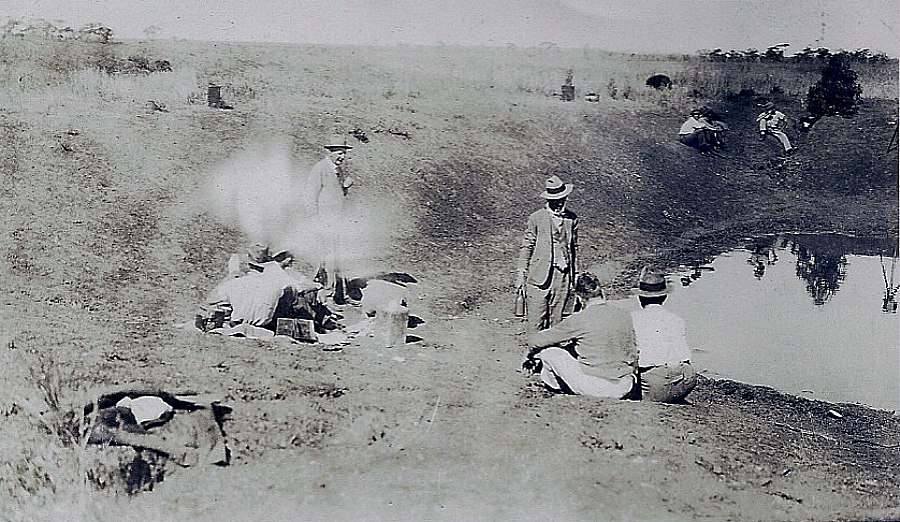
The internet version of the Emu War has the efficiency of a joke: Australia declared war on birds, fired nearly 10,000 rounds, and lost. The nouns are real. In November 1932, a Royal Australian Artillery detachment did take two Lewis guns and 10,000 rounds into Western Australia's north-eastern wheatbelt. Thousands of emus were moving through cultivated land. The first ambushes went badly, politicians laughed, and the birds remained.[1][2]
But a punchline is not yet an explanation. Australia issued no declaration of war against a non-human state, mobilized no national army, and accepted no surrender terms. Defence Minister George Pearce authorized a small pest-control operation after farmers asked for military weapons. Contemporary newspapers and parliamentarians themselves called it an “Emu War,” often while ridiculing the policy.[3][4][5] The modern meme did not invent the metaphor; it stripped away the quotation marks.
So did Australia lose? If war means an armed conflict between political adversaries, there was no war to lose. If loss means that a conspicuous government intervention failed to control the damage for which it was sent, the verdict is harder on the humans. The emus did not defeat soldiers in battle. They exposed a mismatch among weapon, landscape, animal behavior, and political promise.
The myth is compressed, not fabricated
The story begins before a gun crew arrived. During the 1920s, Western Australia's wheatbelt expanded into drier country. Many growers on its margins were returned servicemen already carrying debt and exposure to volatile wheat prices. Murray Johnson's history places the 1932 demand for machine guns inside that soldier-settlement crisis, not outside it as a comic detour.[2] Emus made the pressure visible, but they did not create the farm economy that made one damaged harvest dangerous.
The birds were also not an invading army. Emus are highly mobile opportunistic feeders. Rainfall and food pulses can bring dispersed birds together and send them over long distances; crops and farm water provided new resources on routes humans had divided with fences. Historian Libby Robin estimates that about 20,000 emus occupied roughly forty square miles near Southern Cross in 1932. In her ecological reading, the birds were responding to an unexpectedly abundant planted landscape.[1]
That distinction matters. “Invasion” implied an enemy crossing a stable frontier. The evidence shows a moving native species encountering a recently transformed habitat. Farmers nevertheless faced real losses: emus ate and trampled wheat and broke fences, opening passages for rabbits. Correcting the war metaphor should not turn their distress into another joke. It should reveal why a military answer could look attractive when agricultural, ecological, and financial problems arrived together.
Pearce approved the weapons on the condition that military personnel operate the Lewis guns. The deployment was small: Major G. P. W. Meredith, Sergeant S. McMurray, Gunner J. O’Halloran, two automatic weapons, and 10,000 rounds, assisted by local settlers.[1][2] That is enough to make “the Army fought emus” literally defensible. It is nowhere near enough to make the episode a war conducted by Australia as a nation.
The first campaign failed in public
Operations began on 2 November 1932 after rain delayed the start. The plan assumed that settlers could drive large groups of emus toward fixed guns. It converted a machine gun's strength—concentrated fire against a massed target—into a liability when the target scattered across open country.
The clearest failure came before dawn on 4 November. Roughly 1,000 emus approached a watering point where the gunners had prepared an ambush. The birds did enter range, but the gun jammed after about twelve had been killed. By 6 November, Robin reports about fifty kills at a total expenditure of more than 2,500 rounds.[1] The ratio was politically fatal even before anyone could agree on the exact carcass count.
On 8 November, Pearce stopped the operation. In the following days, newspapers carried parliamentary questions about the “farce,” its cost, and the prospect of campaign medals.[9] The Argus reported on 10 November that the guns had been withdrawn after only a few days and that the results did not justify continuing at that stage.[3] This is the episode from which the clean story of retreat descends.
It was a genuine setback. A tool selected partly for its spectacular efficiency had produced spectacle without persuasive efficiency. The force could kill individual birds, but it could not hold a mobile population in the geometry the guns required. Emus did not employ tactics in any conscious military sense. Flocking, scattering, speed, and distance were enough to make the human plan look tactical—and therefore mockable.
The first withdrawal lasted only days
The most common version ends at the first withdrawal. The historical operation did not.
Farmers and the Western Australian government pressed for its return, insisting that emus were still damaging crops and that early press reports understated the kills. On 12 November, the Canberra Times announced “Emu War Again”: the Defence Department had agreed to resume after representations from Western Australia.[4] Meredith's party returned to the field on 13 November.
Pearce defended that decision in the Senate on 18 November, as reported by the Argus the following day. His strongest case was not that the first week had gone well. It was that initial reports of only a few kills were wrong, hundreds of birds had been destroyed, and the agricultural threat remained serious. Senator James Guthrie supplied the counterargument by asking whether there was a “more humane, if less spectacular” method.[5] Those positions define the real dispute: useful crop protection versus an expensive and highly visible cull whose suffering and effectiveness were both in question.
The second phase was less cinematic and, in Meredith's account, more productive. He was recalled on 10 December; his final report claimed 986 definite kills from 9,860 rounds and estimated that another 2,500 wounded birds later died.[2] Those are the numbers from which the ten-rounds-per-bird refrain comes.
They should be presented as Meredith's claims, not a census. The neat arithmetic—exactly ten rounds for each confirmed kill—and the unobservable later deaths invite caution. Contemporary reporting also swung between “a few,” hundreds, and the commander's final total. What can be said securely is narrower: the second deployment killed more emus than the first reports suggested, yet it neither removed most of the estimated population nor ended farmers' demands for protection.
What would count as victory?
There are two serious readings of the outcome.
The first calls it an administrative and operational failure. The government chose a centralized, heavy weapon for animals that dispersed under pressure. It paused the mission after ridicule, resumed it under political pressure, and finished without a measured reduction in crop damage. On the two sides' own estimates—and counting only Meredith's 986 claimed definite kills—roughly 95 percent of the estimated local population remained. Requests for further military assistance returned in later years.[1][2] On the intervention's broad purposes of durable crop protection and population suppression, the evidence does not show success.
The second reading rejects the word defeat. No soldier was beaten in combat; a culling team killed hundreds of animals and then was recalled by its own government. Pearce's defense was not absurd on its face: farmers wanted immediate help during harvest, and a dead emu could no longer damage a crop. A 1935 press retrospective even argued that the machine guns had saved what wheat remained.[2] If the objective is narrowed to killing some birds and protecting some fields for a few weeks, “total failure” claims more than the records can prove.
The problem is that the narrow standard was never paired with good measurement. The cited records provide no control district, reliable before-and-after crop-loss estimate, or verified population count at the end. Carcass totals measured the gun crew's activity, not the policy's outcome. The operation became easy to score as a war precisely because its agricultural result was hard to score at all.
The bigger body count did not produce a cleaner victory
Later policy makes the machine-gun mismatch clearer without making the human story triumphant. Western Australia continued paying bounties. Robin summarizes the 1935 record as 57,034 birds in six months; smaller mobile parties and drives killed far more than Meredith's fixed-gun operation.[1] An official fence analysis supplies a wider frame for that familiar number: during the first major Northampton invasion of the mid-1930s, it records 57,034 birds destroyed from August to January north of the No. 3 Fence and another 28,577 south of it.[6] The comparison shows that local, distributed methods fit the task better. It does not turn any one tally into a statewide or long-term victory.
A 2007 benefit-cost analysis prepared for Western Australia's Department of Agriculture and Food, and later tabled in Parliament, records enormous later bounty totals but concludes that high annual killing had little or no effect on long-term emu population levels and did not prevent later mass movements.[6] The more durable response was spatial rather than martial: maintain, upgrade, and extend the rabbit-proof barriers, built between 1902 and 1907, to slow migrations into farming districts. The state's agriculture department still describes the State Barrier Fence as protection against large emu movements as well as wild dogs.[7]
That long afterlife changes the verdict. The lesson is not simply that rifles beat machine guns, or that fences “won” a rematch. Bounties dispersed effort across people who knew the terrain, while fences addressed movement before birds reached crops. Each policy defined the problem differently. None turned emus into a defeated political enemy.
The Emu War survives because its comic frame was present from the beginning. Politicians supplied “war,” campaign medals, and victories as jokes; A. E. Green said any medals should go to the emus, which had “won every round so far.”[9] Newspapers made a small pest-control operation readable through the language of the First World War, which many of the farmers and officials had just lived through.[2][3][5] The meme is therefore a historical artifact of 1932 as well as an internet afterlife.
Its falsehood lies in scale and agency. “Australia” becomes one embarrassed combatant; “the emus” become another; a contested cull becomes a decisive campaign. Its truth lies in outcome and optics. A government promised concentrated force, the landscape refused to concentrate, and the intervention could not demonstrate that it had protected the system it was meant to save.
The emus did not win a war. They outlasted a policy that made its firepower visible but never made its agricultural result measurable.
Sources
- Libby Robin, “Emu: National Symbols and Ecological Limits,” in Libby Robin, Leo Joseph, and Robert Heinsohn, eds., Boom & Bust: Bird Stories for a Dry Country (CSIRO Publishing, 2009) — ecological and operational account of the 1932 deployment, later bounties, and emu mobility, preserved by the Australian National University.
- Murray Johnson, “‘Feathered Foes’: Soldier Settlers and Western Australia’s ‘Emu War’ of 1932,” Journal of Australian Studies 30, no. 88 (2006), pp. 147–157 — scholarly reconstruction of the farming crisis, deployment, politics, and disputed outcome.
- The Argus, “War on Emus” (10 November 1932) — contemporary report on the first withdrawal and its stated justification, digitized by the National Library of Australia.
- The Canberra Times, “Emu War Again” (12 November 1932) — contemporary report announcing the decision to resume the operation after renewed Western Australian representations.
- The Argus, “‘Emu War’ Defended” (19 November 1932) — contemporary report of Pearce’s Senate defense and Guthrie’s objection to the cull’s spectacle and humanity.
- URS Australia, Benefit-Cost Analysis of the State Barrier Fence (prepared for the Western Australia Department of Agriculture and Food, 21 November 2007; later tabled in Parliament) — official commissioned review of historic emu movements, bounty totals, population effects, and barrier-fence policy.
- Western Australia Department of Primary Industries and Regional Development, “State Barrier Fence” — official history of the rabbit-proof fences’ later role in limiting major emu migrations into agricultural areas.
- Wikimedia Commons, “Australian soldiers resting during Emu War” — catalogue page for the November–December 1932 campaign photograph used as the article image; the source notes the camera reflected in the water.
- The West Australian, “Questions in Representatives” (9 November 1932) — contemporary report of parliamentary ridicule, including the exchange about campaign medals and emus winning every round.