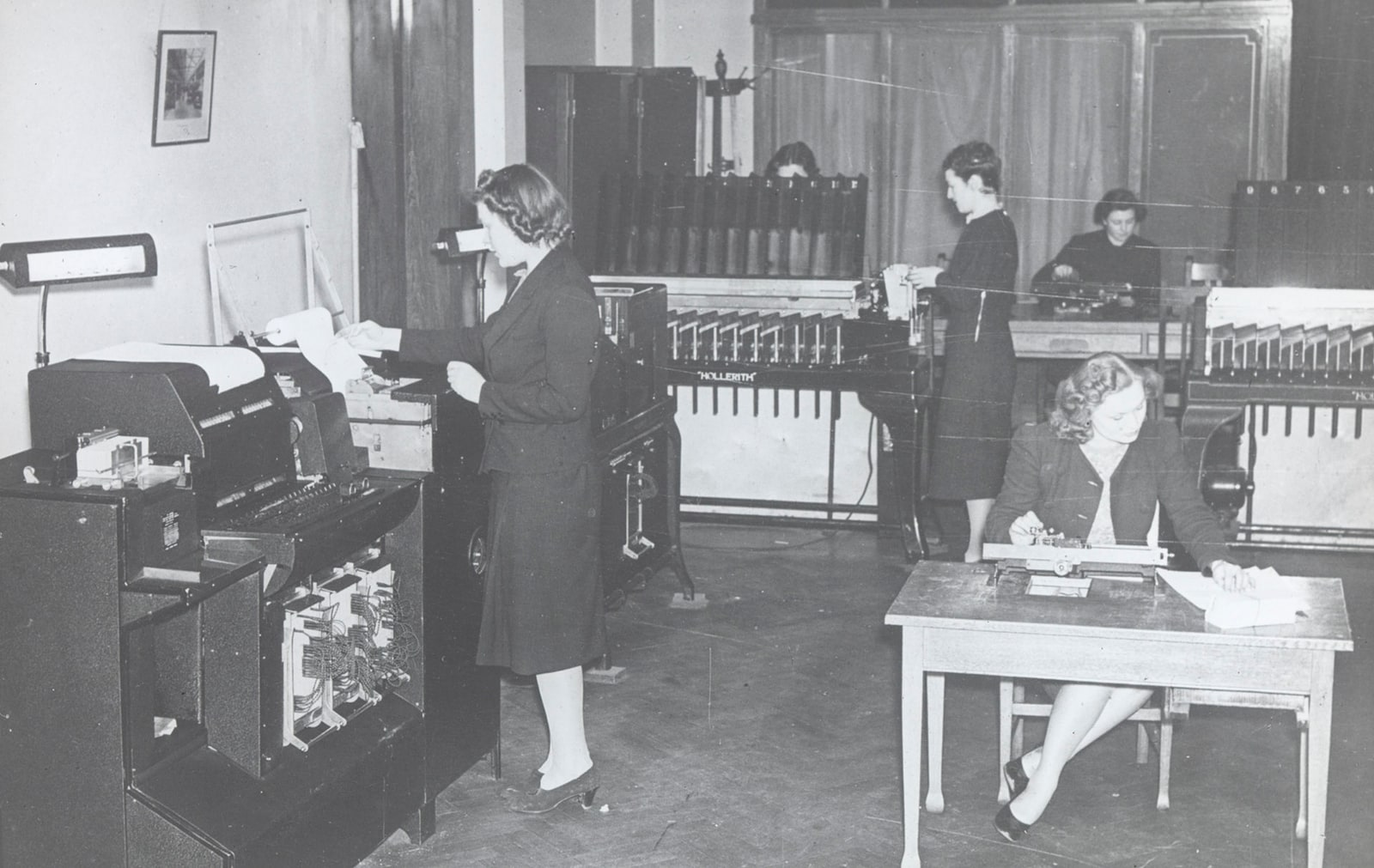
A Red Cross photograph from around 1940 shows workers operating a Hollerith machine, equipment associated with punched cards and tabulation. Preserved as a glass lantern slide in the University of Melbourne Archives, it records a less familiar scene of wartime assistance: people working through information about prisoners.[1]
The machinery invites a story about speed. Comparing the Red Cross tracing agencies of the two world wars reveals something more consequential. The organization improved how it received news, matched identities and found people worth asking for further evidence. A record could help answer a family's enquiry; rearranging records could also suggest where the next answer might be found.[3][5][6]
In 1914, two streams of paper had to meet
The International Committee of the Red Cross established its International Prisoners-of-War Agency in Geneva on 21 August 1914. By the year's end, approximately 1,200 people were working for the organization, principally in the agency. Daniel Palmieri's institutional history describes volunteers drawn initially from the committee's relatives and friends, followed by paid employees as the workload expanded.[2]
The agency received information from belligerents and national Red Cross societies alongside enquiries from families. Its staff organized the work into national sections and maintained a separate civilian section. That organization mattered because the same apparently simple question—where is this person?—might require different languages, authorities and routes of correspondence.[2]
The surviving archive makes the matching process visible. A name appearing on a prisoner list generated an index card carrying a reference to that list. A family's request generated another kind of card. A reference could lead to evidence of capture, transfer or death; an enquiry card recorded that someone was looking. The cards therefore carried different kinds of knowledge. A question about a missing man was not itself confirmation that he had been captured.[3]
The Australian War Memorial preserves evidence of the next stages. Its German-language lists of British and Australian prisoners, dated 1916–1918, appear to have travelled from the German Red Cross to the British Red Cross through Geneva. The Australian department used these as working records, marking the Australian names; they often supplied the first notification of imprisonment.[4]
A name could then acquire an address for assistance. Separate Australian case files record parcels sent, acknowledgements returned, requests for supplies and correspondence with relatives. Finding a prisoner and sustaining contact with him were connected tasks, each leaving its own paperwork.[4]
In 1939, the prisoner could shorten the route
The Central Prisoners of War Agency opened in September 1939 with experience its predecessor had accumulated under pressure. It also had a firmer institutional basis: the 1929 Geneva Convention had provided for a central information agency in a neutral country.[5]
One important change concerned the origin of a report. The ICRC's historical guide describes capture cards developed through its delegate in Berlin. Prisoners completed them on arrival at a camp, and the cards went directly to the agency. Staff could begin processing this news without waiting for a detaining power to compile and transmit its official lists.[5]
This was a change in the path information took. The handwritten capture card supplied a report from the prisoner; the index card helped staff retrieve information; the punched card made selected details sortable by machine. Treating all three as the same object would conceal where the improvement occurred. Faster sorting was useful only after a report existed and could be associated with the right person.[3][5][6]
Sorting could produce a new question
A retrospective published in January 1957, signed M. K., describes the ICRC's wartime machinery. Operators encoded information, punched cards, sorted them by fields such as unit or prisoner number, and used tabulators to print lists. Its account is especially revealing about the expanded French regimental enquiry of January 1941.[6]
The agency arranged names of missing French combatants by unit and matched them with lists of captured soldiers from those units. It then asked prisoners whether they knew what had happened to their missing comrades. The machine helped identify potential witnesses; a person's recollection supplied the evidence.[6]
Regimental enquiries had already been used during the First World War; machines expanded their scale.[5] The operational detail is more persuasive than the retrospective's celebratory tone: a list grouped by unit gave each question a better destination.
What an orderly file could not establish
Both systems depended on information reaching the agency. The First World War archive's own guide cautions that prisoner lists were not supplied consistently. Some were never made or never sent; records could also disappear or contain human errors. A failed search therefore cannot establish that a person was never imprisoned.[3]
Nor should the Second World War's administrative improvements become a claim of universal protection. In a statement adopted in 2006, the ICRC acknowledged its failure toward victims of Nazi persecution, including its failure to do everything within its power. It identified restrictive procedures, a narrow legal framework and the decision against public condemnation among the reasons for that failure.[7]
The comparison leaves two achievements to distinguish. Better records could make a known captivity easier to trace. Better questions could bring additional testimony into the file. Neither achievement guaranteed access to those being persecuted or the action needed to protect them. For a family awaiting news, the value of all that careful office work lay in what could finally be learned about one person.
Sources
- University of Melbourne Archives, “Red Cross workers calculating POW capture cards using a Hollerith Machine,” circa 1940, item 2016.0081.00003 — photograph and catalogue provenance.
- Daniel Palmieri, “The International Committee of the Red Cross in the First World War,” ICRC, 9 September 2014 — agency establishment, staffing and organization.
- ICRC, “Prisoners of the First World War in the ICRC archives: FAQ,” pp. 1–2 and 7–9 — index cards, enquiry cards, source lists and gaps in the surviving record.
- Australian War Memorial, “Australian Red Cross Society records (1DRL/0428): Prisoner of War Department,” updated 14 April 2021 — circulating prisoner lists and separate parcel correspondence.
- ICRC Library, “The Central Tracing Agency,” 30 August 2020 — the 1929 framework, the 1939 agency and direct capture cards.
- M. K., “Machines in the Service of the Red Cross,” Revue internationale de la Croix-Rouge, English Supplement, January 1957, pp. 13–16; Library of Congress scan — punched-card processing and regimental enquiries.
- ICRC Assembly, “The Nazi genocide and other persecutions,” adopted 27 April 2006, published 25 October 2007 — the organization's assessment of its wartime failure.