On 7 January 1927, Walter S. Gifford, president of AT&T, spoke from New York to Sir Evelyn Murray of Britain's General Post Office. Their prepared remarks inaugurated a commercial telephone service across the Atlantic. Gifford promised that the two cities would be brought “within speaking distance.” The recording, described in the Library of Congress's account, also preserves the static that accompanied the achievement.[1]
What made that conversation possible was more than a powerful transmitter. A changing radio signal had to be joined to ordinary telephone networks and kept intelligible while two people exchanged the right to speak. Behind the celebrated voices stood technical operators adjusting the circuit, and relays deciding which way speech could travel.[5]
From a voice heard to a service offered
Speech had crossed the ocean before the ceremonial call. Bell engineers transmitted intelligible speech from near Washington to Paris in 1915. In an account published in April 1927, Bell Laboratories described those experiments as both a success and a demonstration of the formidable work still required. Wartime activity interrupted the direct effort, while improvements in transmitting vacuum tubes helped prepare the later attempt.[3]
That distinction matters. A demonstration establishes that a voice can arrive under the conditions of a particular experiment. A commercial service makes a more demanding promise: customers should be able to arrange a conversation without becoming radio experimenters themselves. Power was essential, but so was the organization of the complete connection.
The surviving part of the Rugby transmitter makes the scale tangible. The Science Museum Group catalogs an assembly about 1.76 metres high and weighing 200 kilograms. Its maker, Standard Telephones and Cables, used single-sideband transmission, which the museum explains reduced power requirements and used the available radio band more economically. The equipment carried speech in the longwave band.[4]
A caller's familiar telephone thus depended on machinery quite unlike the instrument on the desk. The ocean crossing was only one part of the connection; the service had to make it usable from the existing telephone system. The celebrated New York–London conversation marked the opening of that arrangement, following experimental two-way conversations in 1926.[1]
Keeping speech usable
The contemporary explanation by engineers S. B. Wright and H. C. Silent, published in the Bell System Technical Journal in October 1927, describes technical operators stationed at both ends of the radio path. They could adjust the speech current entering a transmitter so that it used the transmitter's capacity. Receiver amplification could also be altered as the radio path's transmission efficiency changed.[5]
These were active adjustments to the sound-bearing circuit. Connecting the customer was one task; keeping the customer's voice usable across a variable path was another. The engineering account places human attention inside the mechanism of the service.
The same paper describes automatic control of conversational direction. Both directions used one wavelength, so voice-operated relays and delay circuits allowed transmission in only one direction at a time. This prevented a station's outgoing speech from operating its own receiver.[5]
The resulting conversation depended on two kinds of intervention: operators adjusted levels, while apparatus controlled direction. The apparent simplicity of speaking into a handset rested on careful management of what the circuit should amplify and when it should listen.
A public service with narrow doors
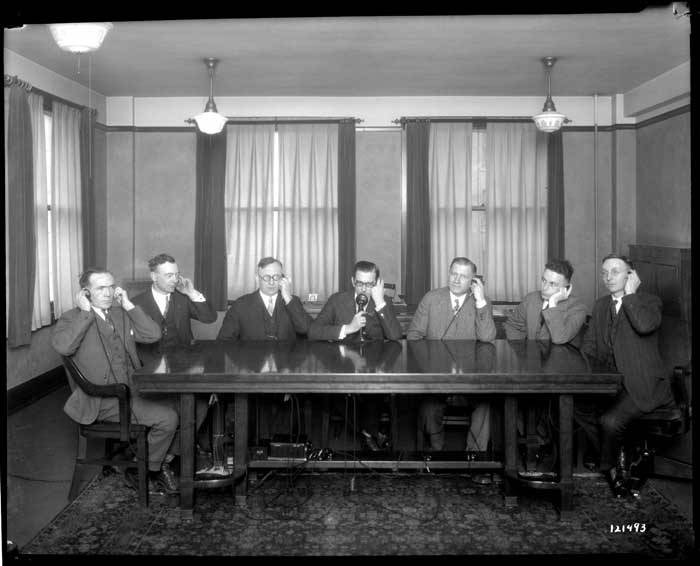
The Seattle photograph records the widening reach of the new connection. According to its collection description, Morrill's test preceded the opening of service between Seattle and Great Britain on 26 February 1927. Customers could arrange calls during a morning window, from 5:30 to 10 Pacific Coast time, corresponding to the afternoon in Britain. The first three minutes to London cost $87, with each additional minute priced at $29.[2]
Those details change the meaning of availability. A person could use an existing telephone to reach someone overseas, yet access still had an appointed time and a formidable price. The photograph's group of listeners also catches something a milestone date can obscure: a telephone conversation could itself be an event worth gathering to witness.
The tariff should remain attached to its route and date. It was the Seattle–London rate, not a universal price for every transatlantic call. David Hay, writing as BT's head of heritage and archives for the Science Museum, gives a different example: the basic British rate to New York in 1928 was £9 for three minutes.[6]
What the cable changed
Hay's account also explains why an existing telegraph connection did not automatically supply a telephone service. Transatlantic cable telephony depended on further developments, including insulated coaxial cable and reliable submerged repeaters to strengthen signals along the route. When TAT-1 opened on 25 September 1956, it provided 30 telephone circuits to the United States and six to Canada.[6]
The earlier radio service had already made an extraordinary social promise credible: a subscriber could arrange to talk across the ocean. Its engineering history reveals how much work that promise contained. The customer encountered a voice; behind it, people and apparatus continually managed the conditions that allowed a conversation to happen.
Sources
- Cary O'Dell, “First Official Transatlantic Telephone Call (January 7, 1927),” Library of Congress National Recording Registry essay — experimental calls, the inauguration and its recorded speeches.
- Webster & Stevens, “Seattle telephone officials make a transatlantic test call, February 25, 1927,” Museum of History & Industry collection record 6016, reproduced on Wikimedia Commons — photograph, Seattle opening date, calling window and tariff.
- Bell Laboratories, “Transatlantic Radio Telephony,” 1 April 1927, historical publication excerpt preserved by Nokia Bell Labs — the 1915 experiments and development of transmitting equipment.
- Science Museum Group, “Part of Rugby transatlantic telephone transmitter, 1927–1956,” object 1983-24 — maker, dimensions, longwave operation and single-sideband transmission.
- S. B. Wright and H. C. Silent, “The New York–London Telephone Circuit,” Bell System Technical Journal 6, October 1927, pp. 736–749 — published synopsis on technical operators, level adjustments and voice-operated directional control.
- David Hay, “Global Telephone Calls For All,” Science Museum, 25 September 2014 — the 1928 tariff, submarine cable requirements and TAT-1's opening capacity.