Henry Goulburn had a question about the proposed public libraries. Parliament was being asked to let towns pay for buildings, chairs and tables, while leaving books to voluntary contributions. During the Commons debate on 13 March 1850, he remarked that he had thought books were among the necessities of a library. His objection exposed a division that supporters of the bill were deliberately defending.[1]
The Public Libraries Act, which received royal assent on 14 August 1850, carried that division into law. Local taxation could keep a reading room warm, lit and staffed. Acquiring its books depended on other money or gifts.[2] Understanding that arrangement changes the familiar founding story: a town needed both permission to spend and people willing to supply what the new institution would lend.
Libraries already served readers through various arrangements. Historian Alistair Black describes subscription libraries, endowed collections, book clubs and coffee-house collections before 1850; access commonly involved a payment, directly or through another service. Proposals for public funding also predated the Act.[3] The question reaching Parliament was how to make access free while allocating the expense of providing it.
The Act's permission came through a narrow entrance. It applied to municipal boroughs in England and Wales with populations exceeding 10,000. Those enrolled on the burgess roll could vote on adoption; two-thirds of the votes cast had to favour it. A rejection prevented another poll for two years. Once adopted, the annual levy could reach only a halfpenny per pound of the property's annual rateable value.[2]
The spending clauses reveal the bargain particularly clearly. Section IV names fuel, lighting, fixtures, furniture and paid staff. Section VI describes books, maps and specimens as things “presented” to the institution. Section VII requires admission to be “free of all Charge.”[2] Free entry was an explicit commitment; finding a collection remained part of making that commitment usable.
The parliamentary argument supplies the reasoning behind those clauses. Joseph Brotherton, MP for Salford, stressed that voluntary contributions would provide the books. He also called the proposed institution the “cheapest police” that could be established: accessible reading, in his account, would encourage improvement and bring social classes together. Goulburn worried that poorer ratepayers might support a newsroom chiefly useful to people with leisure. These were rival expectations about who would benefit, expressed during the same debate.[1]
Neither expectation tells us, by itself, what readers subsequently did. The debate records the future each speaker wanted colleagues to imagine. It also makes the apparent omission of books intelligible. Advocates could defend a restricted public charge by pointing to generosity outside the tax system. That defence left the practical question Goulburn had raised waiting for each participating town.
Manchester shows how the arrangement could be assembled. Mayor Sir John Potter organised subscriptions for both a building and its books. The city's account records contributions from a working men's committee as well as Prince Albert. The Free Public Library opened at the former Hall of Science, Campfield, in September 1852, with Edward Edwards as its first librarian.[5]
The working men's committee matters to the interpretation. A story told only through wealthy benefactors would make the intended readers appear passive. Manchester's funding campaign included organised contributions from working people. Nor did the statutory spending boundary mean that books could never be bought: voluntary money could purchase them. The restriction concerned what the local rate was authorised to finance.[1][5]
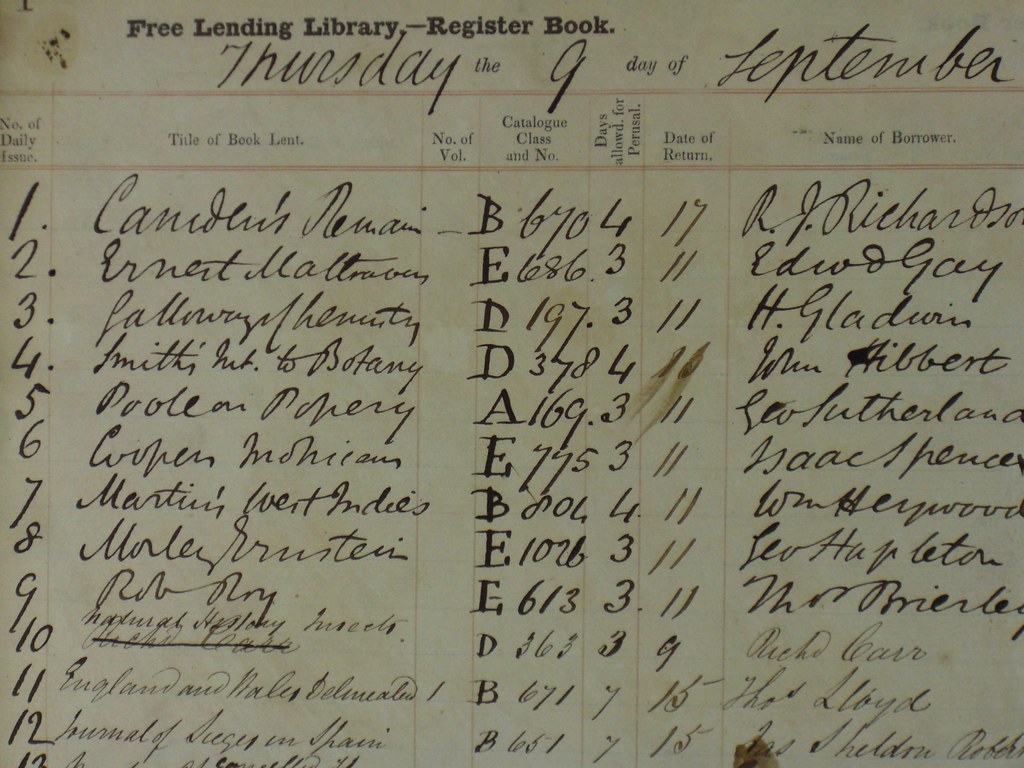
The surviving register brings the result down to the scale of transactions. Manchester Archives+ identifies the photographed page with the first books borrowed on 9 September 1852. Its printed headings and handwritten entries give the opening a material afterlife: an institution receiving support now had loans to record.[4] A page cannot establish how evenly the library served the city, but it supplies evidence of use beyond ceremonial speeches.
By 5 April 1854, William Ewart was asking Parliament to enlarge the powers. He reported that Manchester had issued 230,000 books in nineteen months and argued for a penny rate and permission to purchase books. These were figures offered by the reform's sponsor in support of further legislation.[6]
An issue count measures repeated transactions, not distinct readers. Ewart's claim therefore cannot settle Goulburn's concern about the distribution of benefits. It does show the kind of evidence a supporter thought persuasive: the proposed extension could be defended through the activity of libraries already operating. The argument had moved from an anticipated appetite for reading to reported circulation.[6]
The 1855 Act made the purchase power explicit. Section XXI places books, newspapers, maps and specimens alongside fuel and lighting among the things library authorities could provide. Section XV raises the maximum rate to a penny in the pound. The new law also extends the framework beyond municipal corporations, including qualifying districts under improvement authorities and parishes.[7]
The changed list is a small but consequential revision. A council could now use public funds to select reading material as part of running the institution. Gifts could still enrich the collection, while its development could also be paid for through the public budget. The books had entered the authorised expenditure.
That did not produce libraries everywhere. Historic England's architectural history records only 27 authorities in Britain adopting library legislation by 1867. Even the penny ceiling constrained places with many properties of low rateable value, and substantial private support could remain necessary.[8] A permission to spend yielded very different resources in different towns.
Read together, the clauses, speeches and lending record reveal the work hidden inside free admission. Voters had to authorise a levy; supporters had to assemble a collection; staff had to turn that collection into a service. The 1850 settlement made those tasks possible under tight limits. Its early revision acknowledged that a public library's continuing expenses reached all the way to the books.
Sources
- House of Commons, “Public Libraries and Museums Bills,” 13 March 1850, Hansard, vol. 109, cols. 838–850 — Goulburn's objections and Brotherton's defence.
- Public Libraries Act 1850, 13 & 14 Vict. c. 65, sections I–VIII — original enactment, voting, expenditure and free admission.
- Alistair Black, “Introduction: the public library in concept and reality,” The Cambridge History of Libraries in Britain and Ireland, vol. III (2006), pp. 19–23 — publisher's chapter summary.
- Manchester Archives+, “First ever books borrowed from Manchester Public Libraries” — register dated 9 September 1852, GB127.M740/8/16/3/1; photograph and archival description.
- Manchester City Council, “Before Central Library: Campfield” — subscriptions, book donations and the September 1852 opening.
- House of Commons, “Public Libraries and Museums Bill,” 5 April 1854, Hansard, vol. 132, cols. 453–464 — Ewart's circulation figures and proposed extensions.
- Public Libraries Act 1855, 18 & 19 Vict. c. 70, sections IV–VIII, XV and XXI — adoption, rate ceiling and book-purchasing powers.
- Historic England, The English Public Library 1850–1939 (2016), p. 2 — early adoption and the limitations of rate funding.