The first PLUTO pipeline reached across the English Channel on 12 August 1944, more than two months after D-Day. Petrol did not follow immediately. The Musée du Débarquement at Arromanches dates the first delivery to September: weeks separated getting a pipe to France from getting fuel through it.[1]
That interval is the revealing part of Operation PLUTO. Its extraordinary equipment solved the problem of carrying a long, vulnerable tube across open water. A working supply also required that tube to survive handling, hold pressure and connect securely to installations on land.
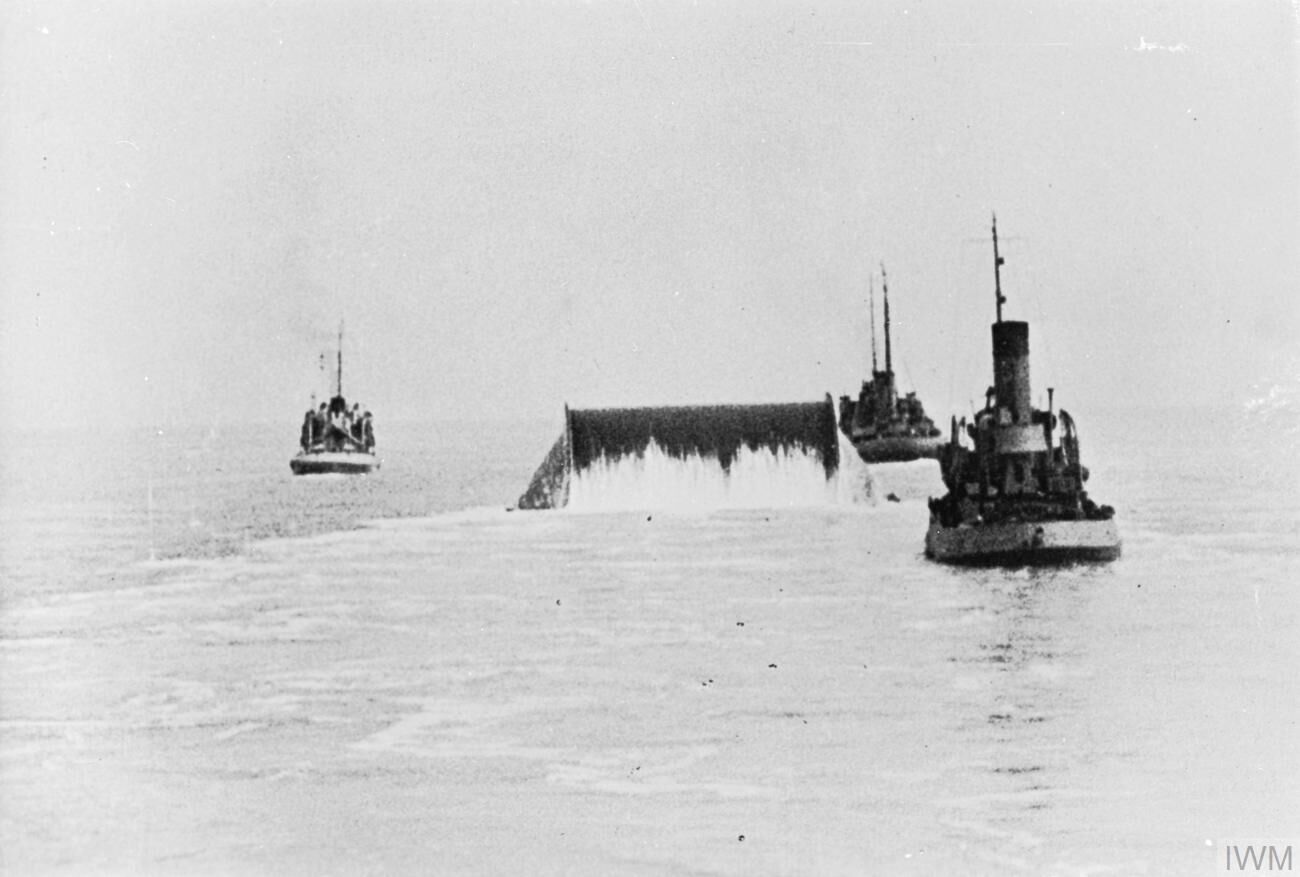
The drum's broad, curved surface rises out of the water between the tugs. Beside their familiar funnels and wheelhouses, it looks like a piece of factory machinery that has escaped to sea. Getting it across was one stage in a much longer operation.
Keep moving while the pipe goes down
The intended benefit was straightforward. Armies advancing from the Normandy landings of 6 June 1944 consumed fuel on a vast scale. Tankers needed somewhere to discharge, and unloading could be interrupted by weather or attack. A submarine pipeline offered another route from Britain to the fighting in France.[1]
In his November 1945 lecture to the Institution of Mechanical Engineers, Anglo-Iranian Oil Company engineer A. C. Hartley recalled the requirement presented in April 1942. Stopping repeatedly at sea to join sections would expose the operation to currents, weather and enemy action. His proposal combined a continuous, small-diameter pipe with high pumping pressure: manageable enough to lay while moving, yet capable of carrying useful quantities.[3]
The resulting HAIS pipe borrowed from submarine cable construction. A surviving section at the Australian War Memorial, collected by Lieutenant Lyle Clark Miller of HMS Sancroft, makes its layers tangible. Lead contained the petrol; steel tape and wire reinforced it, with paper, cotton and jute among the surrounding materials. The reinforcement wound in opposing directions to counter twisting under pressure.[4]
There was also a steel alternative, HAMEL. Hartley explained that long steel pipe could bend around a sufficiently large drum, although coiling it in a cable ship would introduce troublesome twists. The floating Conundrum let it unwind under tow. Uncertainty about sufficient lead supplies helped justify developing both designs.[3]
The two pipes therefore demanded different ways of carrying and releasing them. Choosing a material also meant choosing the machinery that would deliver it to the seabed.
A hollow cable needed support from inside
HAIS presented a further problem: its hollow centre could be crushed. During storage, handling and laying, crews kept water inside at about 200 pounds per square inch. Thin copper disks in the joints retained that pressure. They were designed to burst when higher pressure was applied to put the fuel line into service.[4]
The water was part of the installation method, supporting the tube before petrol could flow. A successful lay still left a transition to complete: establish the connections, bring the line into service and keep it intact under pumping conditions. The Australian War Memorial gives normal operating pressure as roughly 1,500 pounds per square inch.[4]
The machinery visible above the sea could finish its journey while the most consequential test remained ahead.
The vulnerable last connection
Rufus J. Moore's 1954 account in U.S. Naval Institute Proceedings describes the early failures. An escort vessel's anchor damaged the first cross-Channel HAIS line. Another attempt was lost during the shore connection. HAMEL suffered its own laying accidents, including pipe catching on a reel flange.[5]
The Isle of Wight–Cherbourg route, codenamed BAMBI, eventually had working lines of both types. On 3 October 1944, both failed. Moore identifies a faulty HAIS coupling and a sharp seabed edge beneath HAMEL, presenting both explanations as suspected causes.[5]
BAMBI was abandoned the following day. Work concentrated on DUMBO, the shorter crossing from Dungeness to the coast near Boulogne. Pumping began in late October. Even there, installation and availability remained different measures: Antony Firth's report for Historic England records six HAIS lines laid by mid-December, with four operating.[6]
One practical improvement joined the two designs. Hartley described fitting flexible HAIS sections to HAMEL's ends so barges could recover and connect them using the cable-handling procedure. The first such line entered service in January 1945. Flexibility was especially useful where steel pipe met the shore operation.[3]
Count the fuel, as well as the pipe
PLUTO's achievement becomes clearer when its contribution is measured against the wider supply effort. Firth, drawing on the British official petroleum history, explains that planners treated it as supplementary and made provision for the invasion's fuel through shipping. His report puts PLUTO's share at about 8% of cross-Channel oil supplies between D-Day and the end of German hostilities.[6]
That cumulative figure leaves room for valuable later service. It also prevents later deliveries from being credited to the opening battles. Moore describes the shorter route feeding the onward network and releasing tankers for other duties.[5]
The surviving photograph preserves a remarkable solution to the act of laying pipe. The operating record asks a harder question: how much fuel arrived, where, and when? PLUTO's history turns on the work between those two achievements—the joints, the shore ends and the repeated effort to keep a completed crossing in service.
Sources
- Musée du Débarquement, Arromanches, “PLUTO system” — purpose, first cross-Channel installation and delayed fuel delivery.
- Imperial War Museums, photograph T 29, official photographer, “Conundrum at sea”; digital reproduction and provenance on Wikimedia Commons.
- A. C. Hartley, “Operation Pluto,” lecture delivered 24 November 1945, pp. 433–438 — continuous laying, HAMEL drums and flexible shore ends.
- Australian War Memorial, “Section of 3 inch HAIS pipe-line used in Operation PLUTO,” REL25150 — surviving specimen, materials and pressure during laying.
- Rufus J. Moore, “Operation Pluto,” U.S. Naval Institute Proceedings, June 1954 — laying accidents, suspected October failure causes and the shorter crossing.
- Antony Firth, Dover Sector 1914–18 and 1939–45, report for Historic England, September 2021, p. 36, sections 4.5.6–4.5.9 — operational availability and overall contribution.