Before it promises a vote, a house or a school, the Freedom Charter decides who belongs. Its opening declaration says that “South Africa belongs to all who live in it, black and white.” Adopted at Kliptown on 26 June 1955, that sentence challenged the basis on which the country was governed. Authority would have to come from the whole population.[1]
The organisers' own report exposes the work still needed to give that collective voice substance.[4]
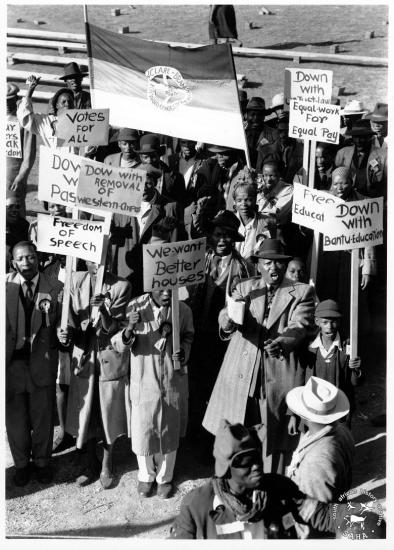
In Weinberg's photograph, those different demands occupy the same crowded space. A call for better houses sits among placards about votes, wages and schooling. The picture makes a useful entrance to the text: it lets us see particular grievances before the Charter gathers them into a national programme.[2]
The demands came before the declaration
In August 1953, Z. K. Matthews proposed a convention that would bring South Africans together to formulate a charter for a democratic future. Planning gathered organisational form in March 1954, when the African National Congress and its allied organisations met to prepare the undertaking.[3]
Volunteers were to collect demands, local committees were to organise participation, and communities were to elect delegates. Suggestions then passed through subcommittees that sorted them into categories; a small drafting committee produced the text presented at Kliptown. This sequence matters. Listening supplied material, but drafting required selection, arrangement and a shared vocabulary. The finished document was an organised expression of many demands, rather than a transcript of everything everyone had said.[3]
Its concise form also made it possible for readers with different immediate grievances to recognise themselves in the same declaration. A countrywide programme had to connect experiences that did not initially arrive as one argument.
How far did the gathering reach?
The National Action Council's report, preserved in the South African Indian Congress's October 1956 conference papers, records 2,844 delegates at the meeting of 25–26 June 1955. Most came from established urban centres; only nine represented the reserves, in its accounting.[4]
The council identified inadequate funds, weak volunteer organisation and government bans on leaders. It also admitted difficulty connecting the Charter campaign with immediate fights over removals and education.[4]
These were the organisers' judgments about their own movement. Their candour makes a crucial distinction visible: claiming that everyone belongs does not establish that everyone participated equally. The Charter's collective voice reached beyond the campaign's actual reach. Kliptown should not be mistaken for an election of the entire country.[4]
Belonging had material consequences
The Charter's first substantive section, “The People Shall Govern!”, connects political membership to voting, standing for election and participating in administration. Later sections extend freedom into movement, employment and family life: an end to pass restrictions, equal pay, schooling and housing. These promises give belonging a practical content. The repeated future tense makes them demands to be won. Adoption at a congress could announce the standard; it could not deliver those conditions.[1]
The economic programme raised a further question: which people would exercise power, and over what? Nelson Mandela addressed it in June 1956, in Liberation, the Congress movement's newspaper. He defended nationalisation of banks, gold mines and land as essential to breaking entrenched monopolies. At the same time, he rejected the idea that the Charter prescribed a socialist state. His explanation made democratic power available to a coalition of workers, peasants, professionals and small proprietors.[5]
That contemporary defence is useful because it resists smoothing away the document's ambitions. Mandela treated economic transformation as necessary while insisting on an alliance across classes. It is his political interpretation, offered in the struggle over what the Charter meant. It cannot settle every later argument about ownership, but it shows that the tension was already being discussed by its advocates.[5]
The opening sentence had opponents
Inclusive belonging also encountered resistance within the liberation movement. In his historical account, activist Norman Levy describes Africanist objections centred on dispossession: if land had been taken from Africans, how could the country simply belong equally to everyone living there? The disagreement concerned the relationship between recovering an inherited claim and building a common citizenship.[6]
Levy records the ANC's adoption of the Charter at a special conference in Orlando on 1 April 1956, amid dissent. His account places the later emergence of the Pan Africanist Congress within a wider rupture; the Charter was a focus for the conflict, not a sufficient explanation of everything that divided the movement. These were competing understandings of liberation, not a choice between recognising injustice and overlooking it.[6]
The opening promise could unite people precisely because it reached beyond the conditions of 1955. Its historical force lies in that reach—and in the organising and argument required to give it substance.
Sources
- The Freedom Charter, adopted 26 June 1955, reproduced in A Documentary History of Indian South Africans, edited by Surendra Bhana and Bridglal Pachai, via South African History Online — preamble and substantive demands.
- South African History Archive, “Delegates to the Congress of the People in Kliptown” — Eli Weinberg photograph, 1955; UWC–Robben Island Museum Mayibuye Archives; SAHATUTp064.
- South African History Online, “The Freedom Charter Campaign” — Matthews's proposal, alliance planning, collection of demands and preparation of the draft.
- National Action Council, report on the Congress of the People, preserved in the S.A.I.C. Agenda Book for 19–21 October 1956, S. S. Singh Collection; reproduced by South African History Online — delegate figures and the organisers' assessment of participation and campaign weaknesses.
- Nelson Mandela, “Freedom in our Lifetime,” Liberation, June 1956, reproduced by the African National Congress — nationalisation, democratic transformation and the alliance across social classes.
- Norman Levy, “The Freedom Charter,” chapter 10 of The Final Prize, reproduced by South African History Online — especially the postscript on Africanism, democracy and socialism.