
The Nuremberg trials are usually remembered through defendants' faces, Robert Jackson's opening rhetoric, and the moral scale of the crimes placed on record.[1][5][6] Those things matter, but the archival footage from the first weeks of the proceedings points to a different historical achievement. Before the tribunal could punish anyone, it had to solve a practical problem that earlier high-profile trials had largely avoided. Judges, prosecutors, defense counsel, and defendants did not share one working language, yet the court still wanted to look orderly, fair, and modern in full public view.[1][3][4]
That is why the headphones matter so much.[3][4] In the Nuremberg courtroom, justice had to become audible across English, French, Russian, and German at once.[3][6] The tribunal could not afford to proceed through long blocks of consecutive translation without turning itself into a procedural swamp, and it could not claim fairness if the accused could not follow the charges as they were read.[3][4] The result was a courtroom rebuilt around sound: microphones at the bench and lectern, switchboards and channels behind the scenes, interpreters working under pressure, and defendants wearing headphones while the new language of international criminal law passed over them in real time.[1][3][4]
That shift is what makes the British Pathé newsreel below worth watching now.[1] The film is short and public-facing, so it does not explain the system in the manner of a later documentary. What it does show, over and over, is the strange new posture of the trial: men who had once governed through command and spectacle now sitting in rows, listening through headsets, waiting for procedure to reach them. The most revealing story in the footage is not theatrical denunciation. It is controlled transmission.
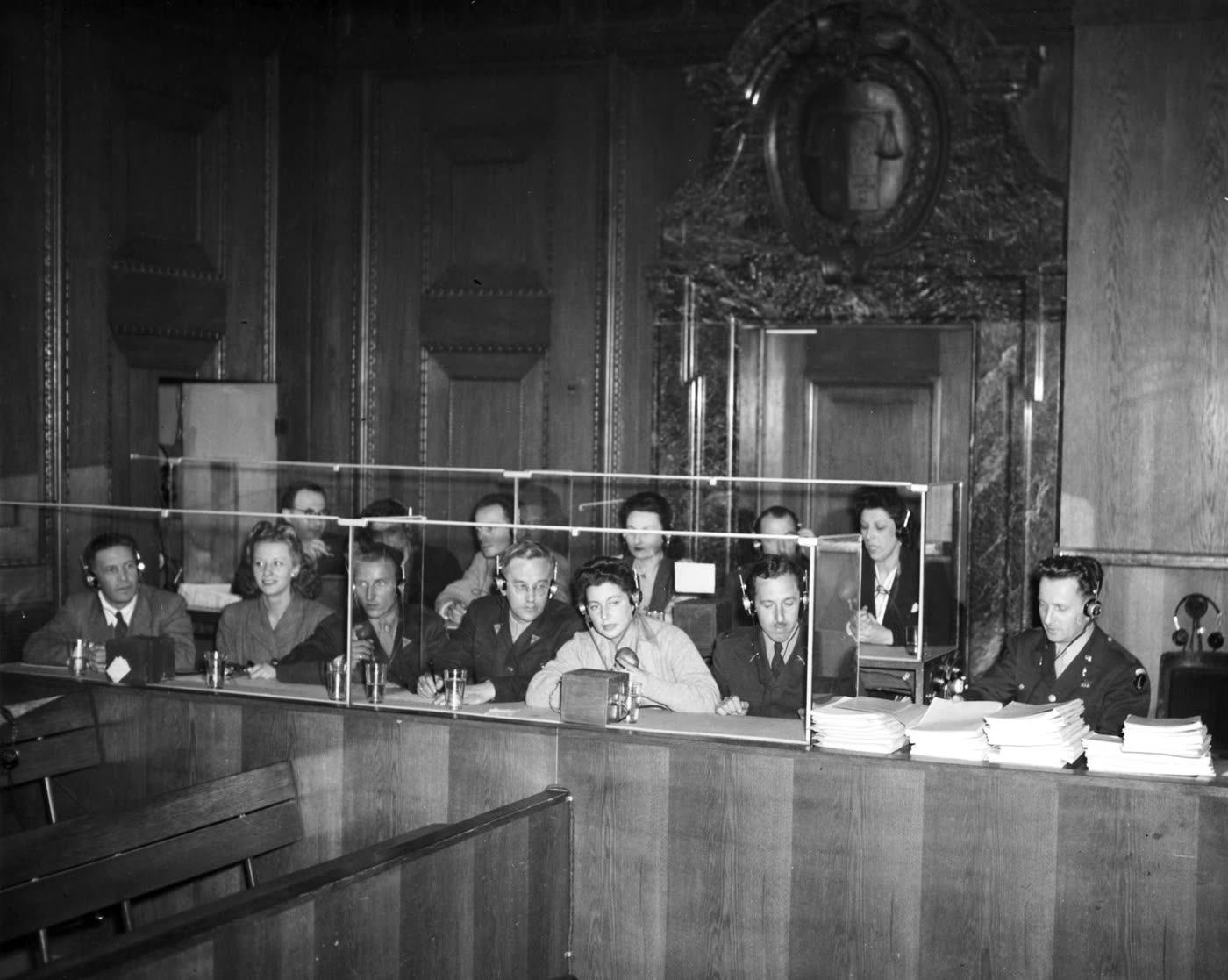
Image context: the cover uses an archival photograph of the interpreters' section at the International Military Tribunal.[2] It fits this article because the footage itself keeps returning to faces in the dock and to the formal authority of the bench, while the photograph restores the labor the camera mostly leaves off to one side. Nuremberg looked calm in public because this glass-partitioned section kept four languages moving without allowing the room to fall apart into delay and confusion.
Historical context: a trial this public could not run in one language
When the International Military Tribunal opened in Nuremberg in November 1945, it was attempting something unprecedented in both scale and visibility.[5][6] The Allies wanted individual criminal responsibility placed on record before a multinational court rather than folded into summary political vengeance. That meant the proceedings had to be legible in more than one sense. They had to create a documentary record, a public image of procedural seriousness, and a working environment in which the accused could hear and answer what was being said.[3][5][6]
PBS's background on the trial is helpful here because it keeps the legal and cinematic dimensions together.[3][6] Nuremberg was not only a courtroom; it was also a performance of legal order aimed at journalists, governments, and future readers of the record.[6] The proceedings involved four official languages, and that alone would have been enough to slow a conventional court to a crawl.[3] American Experience's technical note on simultaneous interpretation explains why the solution mattered: Nuremberg became the first major trial to rely on a full simultaneous system rather than merely alternating long stretches of speech and translation.[3]
The headphones preserved by the United States Holocaust Memorial Museum show the human scale of that solution.[4] They are not glamorous artifacts. They look almost ordinary, which is part of the point. At Nuremberg, legal authority depended on wires, dials, headsets, and disciplined listening no less than on robes and judgments.[3][4] Speakers had to stay within a rate interpreters could manage, interpreters had to keep pace across four languages, and the room had to move forward without losing the defendants' right to understand the case against them.[3][4]
That technical achievement also changed the moral atmosphere of the trial.[3][4][6] The Nazi leaders in the dock were not simply being denounced in one victorious language while everyone else watched. They were being inserted into a structure that required them to listen, wait, and receive a translated version of the law's claims in real time.[1][3] It is easy to describe Nuremberg as a triumph of principle after catastrophe. The harder and more interesting truth is that principle had to be converted into a working acoustic system before it could appear convincing on screen.[3][4][6]
Video provenance
The embedded clip is British Pathé's "The Nuremberg Trials (1945)," a period newsreel upload described by the archive as showing the court assembling, Lord Chief Justice Geoffrey Lawrence opening proceedings, the indictment being read, Hermann Göring listening on headphones, Rudolf Hess looking around the room, and Göring attempting to speak.[1] That description matters because it tells us what kind of artifact this is. It is not a later documentary shaped by retrospective interviews and explanatory narration. It is public-facing 1945 news footage, cut to make the new tribunal visible to mass audiences while the event was still becoming history.
The provenance also explains the film's strengths and limits.[1] A Pathé reel is concise, selective, and alert to faces and ceremonial emphasis. It does not pause to diagram the interpretation system or narrate the engineering behind it. Yet that is precisely why it works for an archival spotlight. The footage preserves what the courtroom was supposed to feel like in public: solemn, controlled, internationally supervised, and technologically modern enough to hold together under extraordinary political weight.
Close reading: what the footage shows about law as controlled transmission
The first thing that stands out in the reel is that the defendants are filmed less as speakers than as listeners.[1] The camera repeatedly returns to the dock and finds men wearing headphones, adjusting their posture, staring downward, or waiting while the room moves around them. That repeated image matters. The trial is often remembered for words spoken from the bench or lectern, but the footage insists on the opposite side of the exchange. Nuremberg is a room in which defeated rulers are made to receive language under supervision.
Around the early middle portion of the clip, the visual emphasis tightens even further.[1] The headphones do not merely translate content; they reorganize status. Göring, Hess, Keitel, Ribbentrop, and the others are still recognizably powerful personalities, and the camera knows it.[1] But the headsets flatten some of that charisma into procedure. The men in the dock are no longer commanding rallies or issuing directives. They are waiting for the next transmitted sentence. The trial's authority arrives not only from the judges above them, but from the fact that speech now reaches them through equipment they do not control.[1][3][4]
That is why Göring's attempt to speak lands so sharply in the newsreel.[1] The moment has drama because it tests whether personal force can break the frame that the courtroom has built. Yet even there, the footage does not turn into pure spectacle. Guards remain visible, the bench remains elevated, and the surrounding room keeps its geometry.[1] The point is not that personality vanishes. It is that the tribunal is trying to make personality answer to a procedural environment stronger than any one defendant's performance.
The camera also keeps showing how crowded with infrastructure the trial really was.[1] Military police stand behind the dock. Microphones and papers occupy the foreground. The bench and lectern anchor the sightlines. If one combines the reel with the interpreters' photograph and the later artifact pages, the courtroom begins to look less like a simple moral tableau and more like a carefully engineered relay system.[2][3][4] The newsreel does not need to show every interpreter to make that point. The recurring headphones already tell the story. They are the visible tip of a hidden labor structure that made multinational justice operational rather than merely aspirational.
Legacy: why this footage still matters now
The long afterlife of Nuremberg is usually told in legal terms: crimes against humanity, precedent, the documentary record of Nazi criminality, and the later development of international criminal law.[5][6] Those are real legacies, but the archival footage suggests another one that is easier to miss. Nuremberg also demonstrated that a global court could be built as an information system.[3][4] Language, pace, audibility, and record-keeping were not side issues. They were part of the trial's credibility.
That is one reason the archive remains so alive in the present. Stanford's Nuremberg archive work treats the proceedings as a rich documentary environment rather than a closed monument, making trial materials more searchable and teachable across formats.[5] The courtroom machine is still working, in another form, each time the records are replayed, indexed, and studied. The British Pathé reel matters in 2026 because it lets viewers see the instant when that machine first had to prove itself in public. Before Nuremberg could become a precedent, it had to become a room where four languages could move at once without dissolving the law into noise.[1][3][5]
Sources
- British Pathé, "The Nuremberg Trials (1945)," YouTube video.
- Memorium Nuremberg Trials, archival photograph of the interpreters' section at the International Military Tribunal.
- PBS American Experience, "Simultaneous Interpretation at Nuremberg."
- United States Holocaust Memorial Museum, "The Headphones."
- Stanford Center for Human Rights and International Justice, "The Nuremberg Trials" in Virtual Tribunals / World War II Collections.
- PBS American Experience, The Nuremberg Trials film page.