The familiar version of McCarthy's fall comes down to one sentence. On June 9, 1954, during the Army-McCarthy hearings, Army counsel Joseph Welch finally broke after Senator Joseph McCarthy attacked a young lawyer in Welch's firm and asked, "Have you no sense of decency?"[2] The line survives because it feels like instant moral justice: one bully exposed, one nation sobered, one career ended on live television.
That is the memory. The documentary record supports a more layered conclusion.[1][3][4] Welch's rebuke mattered because it crystallized a collapse that was already underway in full public view. By the time he spoke, McCarthy had spent months turning the Senate Permanent Subcommittee on Investigations into a stage for accusation, had dragged the U.S. Army into a sprawling charges-and-countercharges fight, and had allowed television to show millions of viewers the habits that colleagues had tolerated more easily in print: interruption, innuendo, contempt for procedure, and a taste for personal destruction.[1][3] The line was real, and it was decisive as symbol. It was not the whole mechanism.
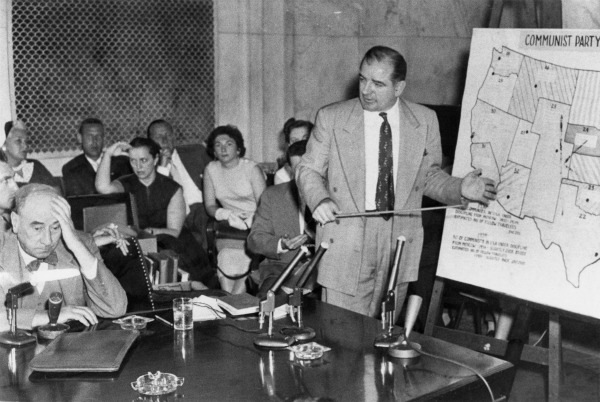
The photograph used here makes that narrower claim visible.[5] Welch sits at left, McCarthy stands at right, and the hearing table itself remains the important object. The Army-McCarthy story was not a duel floating free of institutions. It was a committee crisis that became nationally legible because the committee room stayed in frame.
Time anchors
- 1950-02-09: McCarthy claimed in Wheeling, West Virginia, that Communists had infiltrated the State Department, launching the phase of his career that made "McCarthyism" a national word.[2][4]
- 1953-01: after Republicans took control of Congress and the White House, McCarthy gained the chairmanship of the Senate Permanent Subcommittee on Investigations and widened his anti-Communist campaign inside government.[1][2][4]
- 1954-03-16: the Army-McCarthy hearings opened under acting chairman Karl Mundt after the Army charged McCarthy and Roy Cohn with seeking special treatment for drafted aide G. David Schine.[1][3]
- 1954-06-09: Welch delivered the exchange that later became the hearings' most famous scene.[2]
- 1954-06-17: the Army-McCarthy hearings ended after three months of national television coverage.[1]
- 1954-07-30: Senator Ralph Flanders introduced the censure resolution against McCarthy.[3]
- 1954-12-02: the Senate approved Resolution 301 and formally condemned McCarthy's conduct.[3][4]
Those dates matter because they break the myth of instant causation. McCarthy's public weakening took shape across a sequence, and his formal defeat arrived almost six months after the Welch exchange.[1][3][4]
Myth claim: one line ended McCarthy
The myth has a basis in evidence because the scene really was explosive. The Senate's own page on the June 9 hearing describes Welch's rebuke as "the immortal lines that ultimately ended McCarthy's career."[2] That is a fair description of the exchange's afterlife in public memory. It also captures why the moment still feels singular. Welch did not answer with technical process language. He translated procedural abuse into moral plain speech, and television let viewers watch McCarthy keep pressing after the room had already turned against him.[2]
But a symbolic turning point is not the same thing as a sufficient explanation. If one sentence had truly toppled McCarthy on its own, there would be little reason to pay attention to the hearings before June 9, the hearings after June 9, Senator Flanders's later censure effort, or the actual text of Resolution 301.[1][3][4] The record gives us all of those, and together they tell a broader story.
Evidence claim: the hearings made McCarthy's method impossible to ignore
The Senate's investigation overview is explicit that the Army-McCarthy hearings were broadcast on national television and contributed to McCarthy's declining popularity.[1] The censure case page goes further. It says that television showed him "in an increasingly unattractive light" as he badgered witnesses while ignoring parliamentary procedures and the "rules of common courtesy."[3] That description matters because it shifts attention away from one perfect quote and toward repeated exposure.
This is the key evidence boundary in the article. I infer from the Senate's own chronology that McCarthy's problem in spring 1954 was cumulative rather than instantaneous.[1][3] Television did not simply capture one bad afternoon. It converted style into evidence across weeks. Viewers could see tone, rhythm, interruption, facial reaction, and the way accusation kept outrunning proof. What had once worked as headline warfare began to look less like fearless anti-Communism and more like undisciplined committee power.
That is why the Army mattered so much. McCarthy had attacked many civilian agencies before, but going after the Army while Republicans controlled the executive branch changed the political geometry.[1][3][4] He was no longer embarrassing only Democrats or anonymous bureaucrats. He was forcing a Republican administration and the Senate itself to absorb the costs of his method. Once the Army fight moved into a nationally televised room, colleagues could no longer pretend that McCarthy's style was merely rough but useful. It had become a liability for the institution that housed him.[1][3]
In that setting, Welch's line worked not as magic but as compression. He said out loud what the hearings had already been teaching viewers to see.[2][3]
What the censure record actually punished
The cleanest evidence against the one-line myth is the censure document itself. Resolution 301, preserved by the National Archives, did not condemn McCarthy for suffering a famous rhetorical defeat on June 9.[4] It condemned him for broader conduct. In Section 1, the Senate said he had failed to cooperate with the Subcommittee on Privileges and Elections, had repeatedly abused that subcommittee and its members, and had thereby obstructed the constitutional processes of the Senate.[4] In Section 2, it condemned later attacks on the Select Committee studying censure charges, including his descriptions of the special Senate session as a "lynch-party" and "lynch bee."[4]
This point is decisive. The formal punishment attached to committee abuse, obstruction, and attacks on the Senate's own disciplinary machinery.[3][4] The Welch exchange belongs in the causal chain because it helped destroy McCarthy's legitimacy with the public and with colleagues. But the Senate's own resolution shows that the institution judged him on a pattern, not on a single humiliation.
The Senate censure page reinforces that interpretation. It places the hearings, the damage to McCarthy's public image, Flanders's July 30 resolution, the committee report of November 8, 1954, and the Senate vote of December 2, 1954 inside one continuous process.[3] Once that sequence is restored, June 9 looks less like a self-contained execution and more like a hinge. It turned accumulated conduct into a moment that colleagues could no longer evade.
The better historical conclusion
So what should replace the myth? Not the opposite myth that Welch's line was irrelevant. The line mattered enormously.[2] It became the hearing's moral shorthand because it named the vice that television had been exposing in slow motion. A culture that remembers politics through scenes was always going to preserve that sentence.
The stronger evidence-based conclusion is narrower and better. McCarthy fell because the Army-McCarthy hearings made his style of power visible at the exact moment when he had overreached into the Army, alienated Senate colleagues, and forced the institution to decide whether his methods were still bearable.[1][3][4] Welch's rebuke was the clearest dramatic expression of that collapse. The actual Senate defeat came later, through a censure resolution that condemned a broader pattern of conduct as "contrary to senatorial traditions."[4]
That distinction matters because it keeps history from collapsing into quotation. One line can summarize a downfall. It usually cannot explain it by itself. In McCarthy's case, television made the sentence memorable, but committee procedure, institutional patience, and the later censure record explain why the sentence landed with such force.[1][3][4]
Sources
- U.S. Senate, "McCarthy and Army-McCarthy Hearings" - overview of the 1953-1954 investigations, March 16-June 17 Army-McCarthy schedule, national television coverage, and the hearings' role in McCarthy's declining popularity.
- U.S. Senate, "Have You No Sense of Decency?" - June 9, 1954 hearing note on Joseph Welch, live television, and the exchange's symbolic afterlife.
- U.S. Senate, "The Censure Case of Joseph McCarthy of Wisconsin (1954)" - chronology from the hearings to the July 30 resolution and December 2 Senate vote, plus the committee-abuse framing of the case.
- National Archives, "Senate Resolution 301: Censure of Senator Joseph McCarthy (1954)" - transcript of the resolution condemning McCarthy's conduct as contrary to senatorial traditions.
- U.S. Senate Historical Office, "1954 Army-McCarthy hearings (Senate Permanent Subcommittee on Investigations)" - source page for the Joseph Welch / Joseph McCarthy hearing photograph used here.