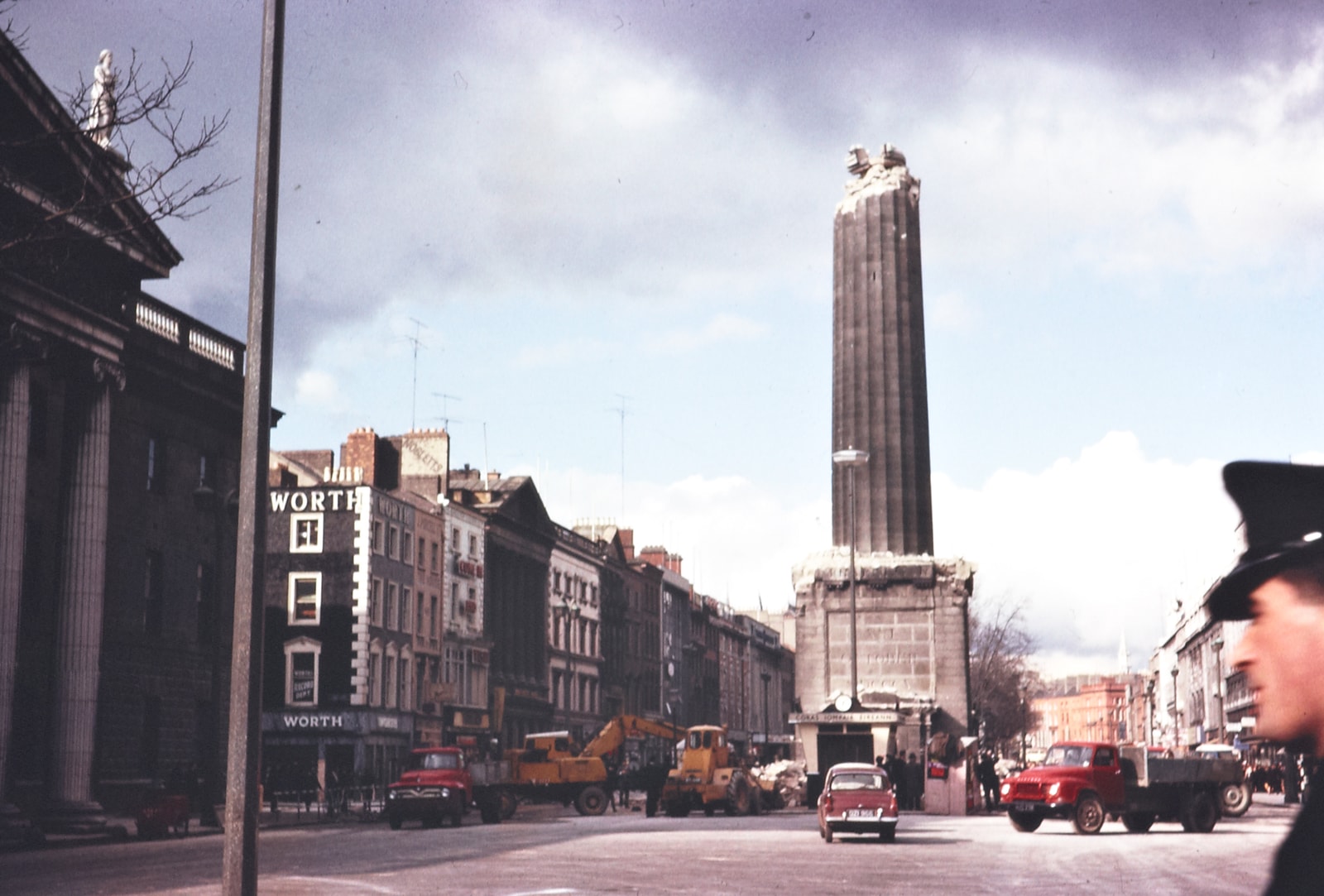
The cover photograph catches Nelson's Pillar in a state that lasted only six days. Its statue and upper shaft are gone. The surviving column ends raggedly above O'Connell Street while traffic, rubble removal, police, and spectators gather below. Michael S. Walker made the color image on 8 March 1966; it survives through the National Library of Ireland's collection.[1] It is not quite a photograph of a monument, and not yet a photograph of an absence.
That interval is the key to the Pillar's afterlife. An explosion at 1:32 a.m. on 8 March had brought the stone admiral and the top of the column into the street. On 14 March, the Irish Army demolished the unstable remainder. Yet the Pillar did not disappear when the dust cleared. It continued as a trust with income claims, as a compensation liability, as a head in municipal custody, as an unresolved address at the center of Dublin, and as an argument about what could legitimately stand there next.[2][4][6]
The destruction was swift. The work of turning destruction into public memory took decades.
Before it was an imperial problem, it was a piece of city equipment
The monument began with the Battle of Trafalgar in 1805. Dublin subscribers funded a memorial; a foundation stone was laid in 1808, and the Pillar opened on 21 October 1809, the battle's fourth anniversary. Francis Johnston adapted William Wilkins's design into a Doric column 121 feet high, topped by Thomas Kirk's 13-foot Portland-stone statue of Vice-Admiral Horatio Nelson. Visitors paid to climb 168 internal steps for a view over the city.[2][3]
Its political message was plain: a British naval victory towered over the principal street of a city incorporated into the United Kingdom after the Act of Union. But long use complicated that message without cancelling it. The Pillar became a tram terminus, a viewing platform, an orientation point, and a place to meet. Dublin City Libraries records the everyday phrase, “I'll meet you at the Pillar.”[2] An imperial memorial had acquired municipal functions.
That double identity helps explain both its survival and the intensity of its removal. The Pillar remained standing through the 1916 Easter Rising; photographers even used its height to record the damaged street below. In 1922, architect R. M. Butler could attack it not only as a political relic but as an obstruction that divided traffic and injured the north side's commercial prospects.[3] The argument was never solely Nelson versus Irish independence. It also concerned a staircase, a view, a traffic island, a landmark, and a familiar silhouette.
Kathleen James-Chakraborty's comparative history of Irish monuments places the Pillar inside a broader, uneven change of regime. After independence, Dublin adapted many inherited buildings to new uses, while statues associated with British rule were more vulnerable. The state removed Queen Victoria from outside Leinster House in 1948, but several other imperial monuments were damaged or destroyed through unofficial attacks rather than a systematic public program. Nelson remained until 1966.[7]
It would be too simple, then, to say that independent Ireland merely forgot to decolonize its main street. The Pillar's meaning was hostile to the new state's founding story, but the structure had also become useful, privately administered, and socially ordinary. Political sovereignty had changed faster than the street's habits and property arrangements.
Two explosions did not express one decision
The first blast and the second are often compressed into a single sentence: Nelson's Pillar was blown up. They were different acts.
The Irish Architectural Archive describes the first perpetrators cautiously as a still-unidentified republican splinter group. The timing—weeks before the official fiftieth-anniversary ceremonies for the Easter Rising—made the commemorative challenge unmistakable, but no public consultation or state order authorized it.[3] The broken monument in Walker's photograph was therefore evidence of an accomplished act whose political ownership remained uncertain.
The Army's demolition on 14 March was an official response to an unsafe stump. The Irish Times's contemporary report records thousands gathering, singing, and dancing in the surrounding streets, alongside a last-minute attempt by architects to obtain an injunction. A High Court judge refused it; the blast went ahead at 3:30 a.m.[4] The Irish Architectural Archive adds another practical context: clearing the stump prevented it from dominating the official 1916 anniversary ceremonies soon to take place across the street at the General Post Office.[3]
Safety, commemoration, and urban clearance converged, but that did not create consensus. In the Senate later in 1966, Owen Sheehy-Skeffington framed the blast as an architectural wound: he said the destroyer had made Dublin look more like Birmingham and less like an ancient city on the Liffey.[5] The criticism concerned the loss of urban form, not a demand that Dublin continue honoring the admiral. That distinction matters. One could reject the monument's subject and still oppose the destruction of its architecture.
For six days the half-column made those choices visible at once. Restore the structure, replace its figure, preserve the stump, or clear the site: each option separated the Pillar's architecture from Nelson's commemoration in a different way. The second blast ended that physical pause before Dublin had resolved the argument it exposed.
Parliament had to abolish what explosives could not
Three years later, the Nelson Pillar Act of 29 April 1969 treated the vanished monument as a live legal object. Its language is almost comically concrete after so spectacular a demolition.
The Act required Dublin Corporation to pay the Pillar's trustees £21,750 for the damage of 8 March 1966 and the subsequent removal. It also provided compensation for lost admission income from the date of the first explosion until payment, plus the trustees' legal costs. Only then did the site vest in the Corporation and the old trusts terminate. A further section protected the trustees from claims arising from their agreement not to restore a monument to Nelson.[6]
Those clauses disclose what the famous photographs cannot. The Pillar had been a revenue-producing institution, not just a stone symbol. Its staircase generated admission charges; its trustees had duties; its site had an owner; destruction created compensable losses. The 1969 statute did not endorse the monument's politics. It closed accounts that the explosives had left open.
The sequence reverses the usual story of iconoclasm. Material destruction came first, municipal ownership later. For more than three years, Dublin possessed an empty space whose prior legal order had not fully ended. Parliament had to convert a cratered memory into property the city could use.
This also explains why “removal” is not a single historical event. The statue fell on 8 March. The shaft fell on 14 March. The trust ended after the 1969 Act commenced. Nelson's head, meanwhile, survived as an object: recovered, briefly stolen by art students for public pranks, displayed in the Civic Museum, and eventually placed in the Reading Room of Dublin City Library and Archive.[2] The body of the memorial dispersed into different institutions and different stories.
The empty site became a monument to indecision
Almost immediately, proposals arrived for a replacement. Suggestions ranged from another column bearing Patrick Pearse or Nelson Mandela to a harp. In 1988, the Pillar Project invited architects and sculptors to imagine the site; in 1998, an international competition selected Ian Ritchie's design for the Spire.[3]
The long delay was not empty in the sense of meaningless. The vacancy preserved a difficult brief. Any new object had to restore a vertical center to O'Connell Street without simply transferring the old Pillar's authority to a new hero. It had to acknowledge a famous absence without rebuilding the lost monument. It also had to operate as urban infrastructure: a marker visible at a distance, a rendezvous point, and a sign that the street mattered.
The winning answer was radically non-figurative. Completed on 21 January 2003, the stainless-steel Spire rose 120 meters without a person on top. A Maynooth University study of the project shows that its promoters tied the monument to O'Connell Street's civic and commercial regeneration, while critics and supporters still disagreed over what it symbolized. The Spire was expected to make place as well as meaning—to draw attention, investment, movement, and argument back to the street.[8]
That is not a clean victory of modern Ireland over imperial memory. The Spire inherited the Pillar's visual job while refusing its commemorative grammar. It restored height but not a viewing platform, a central marker but not an admiral, a city-scale silhouette but not an agreed historical hero. Its very abstraction records the difficulty of replacement.
What remained
Nelson's Pillar did not survive as an intact monument, yet neither did Dublin settle it through destruction. The event multiplied the object.
The Walker photograph preserves the six-day stump. The RTÉ report preserves the Army blast as public spectacle. The 1969 Act preserves the trust, income stream, and compensation claim. The library preserves the damaged head. The Spire preserves the need for a vertical address while changing what such an address can say.[1][2][4][6][8]
This is why the empty-site period matters more than the neat before-and-after pairing of Pillar and Spire. It reveals that removing a monument can be instantaneous, while replacing its social functions and closing its legal and symbolic accounts are separate historical processes.
Explosives decided that Nelson would no longer look down O'Connell Street. They did not decide who owned the ground, what the city had lost, whether the architecture deserved mourning, where the fragments belonged, or what a successor should commemorate. Dublin spent thirty-seven years answering those other questions—and chose, finally, a monument with no face at all.
Sources
- Wikimedia Commons, “A half-demolished Nelsons Pillar on OConnell Street, Dublin” — access copy of Michael S. Walker's 8 March 1966 color photograph from the National Library of Ireland, catalogue reference NPA WALK138A.
- Dublin City Libraries, “#onthisday 1966. Nelson's Pillar Destroyed” — institutional history of the monument's construction, public access, meeting-place role, destruction, and the later custody of Nelson's head.
- Irish Architectural Archive, “Nelson's Pillar” — archival exhibition sheet tracing the 1807–09 design, survival of 1916, removal debate, 1966 destruction, Pillar Project, and 1998 Spire competition.
- The Irish Times, “March 14th, 1966” — republished contemporary report of the Army demolition, including the crowd, 3:30 a.m. blast, structural failure, and unsuccessful injunction.
- Hugh Linehan, “The night Nelson's Pillar fell and changed Dublin,” The Irish Times, 5 March 2016 — reported history of the two explosions, contemporary reactions, and Owen Sheehy-Skeffington's architectural criticism.
- Electronic Irish Statute Book, Nelson Pillar Act, 1969 — primary text specifying compensation, lost admission income, transfer of the site, termination of the trusts, and authority not to restore the monument.
- Kathleen James-Chakraborty, “New States and Old Statues: Ireland's Monuments in an International Context,” in Ireland: The Matter of Monuments (Liverpool University Press, 2024) — peer-reviewed comparison of post-independence adaptation, official removal, and unofficial destruction.
- Mark Boyle and Niamh McWilliams, “The Spire of Dublin,” Maynooth University repository — analysis of the replacement monument, O'Connell Street regeneration, public disagreement, and the politics of place-making.