At Fort Benning in 1943, First Sergeant Walter Morris commanded a Black service company whose men guarded the Army's Parachute School. They worked beside the institution manufacturing a new kind of elite soldier, but segregation assigned them to its perimeter. Morris later remembered German and Italian prisoners of war sitting with white soldiers in a post exchange that Black American troops could not enter. The contrast was hard to miss: enemy prisoners could occupy space denied to the men guarding the school.[1]
Morris answered that humiliation with an experiment. After the day's guard duty, he led his company through the same conditioning course used by white parachute candidates. They ran, did calisthenics, and practiced the physical routines of airborne training without orders to do so. The school's commandant noticed. The U.S. Army's account identifies Morris as the first Black soldier selected for parachute duty and says he was chosen to lead the original seventeen Black volunteers.[2]
That sequence can sound like a clean triumph: prove fitness, receive wings, change the Army. It was nothing of the kind. Morris and the men who became the 555th Parachute Infantry Battalion—the “Triple Nickles”—qualified for combat while serving inside a military that still doubted whether to use them. When their assignment finally arrived in May 1945, it was not an airborne assault overseas. It was a secret domestic mission built around Japanese balloon bombs and western forest fires.
The sharper question in Morris's story is therefore not whether the Triple Nickles could jump. They settled that early. It is what proof could accomplish inside a segregated institution. Their competence opened one training door, but policy, timing, and secrecy redirected what waited on the other side.
The proof began after duty
Morris was born on January 23, 1921, and entered an Army organized by race. His service company at Fort Benning did necessary work, but its position was structurally contradictory: Black soldiers maintained and protected the airborne school without being presumed eligible for the status it conferred.[1][2]
The after-hours conditioning course made that contradiction visible. Morris was not merely arguing that his men were equal in the abstract. He reproduced the school's own test with the people it had excluded. This mattered because airborne identity was built around a measurable ordeal—runs, towers, landing practice, and voluntary exit from an aircraft. If Black soldiers completed the same preparation, the institution had to invent a reason other than performance to keep them out.
Morris's initiative was not, by itself, the origin of the 555th. The official lineage begins with a December 1942 recommendation by the War Department's Advisory Committee on Negro Troop Policies. General George C. Marshall approved a Black parachute battalion in principle, then chose to begin with a company. The 555th Parachute Infantry Company was constituted on February 25, 1943, authorized as an all-Black unit with Black officers and enlisted men on December 19, and activated at Fort Benning on December 30.[3][4]
The distinction matters. Washington policy created the unit on paper; Morris helped supply a local demonstration, a leader, and volunteers who could make the policy real. One was not a substitute for the other. A committee recommendation without trained people might have remained a file. An unauthorized workout without an approved unit might have remained a disciplinary curiosity.
Morris completed Officer Candidate School in August 1944. By then, the original company had moved beyond the improvised proof of its beginnings. On November 25, 1944, it became Company A of the newly activated 555th Parachute Infantry Battalion, then numbering ten officers and 155 enlisted men. The unit trained for combat, but it remained a small test formation rather than part of a full airborne division.[2][3]
An overseas war closed while a hidden one arrived
The Triple Nickles hoped to deploy to Europe. Victory in Europe on May 8, 1945, closed that route before they received it, and the Library of Congress's Walter Morris collection records their disappointment. They then expected that war against Japan might take them across the Pacific.[1] The surviving official histories support a bounded conclusion: the battalion did not serve overseas, but no single document reduces that outcome to one cause. The late activation of a small segregated test unit, the Army's choices about where to assign it, and the war's changing calendar all constrained its opportunity.[1][3][4]
Meanwhile, a weapon almost no American civilian was supposed to discuss had begun crossing the Pacific. From November 1944 into April 1945, Japan launched roughly 9,000 hydrogen balloons carrying antipersonnel and incendiary bombs. High-altitude winds carried some more than 6,000 miles to North America. About 285 incidents were reported, although officials believed many more balloons arrived.[6]
The government asked newspapers and radio stations not to report sightings. Silence denied Japanese planners the feedback needed to correct their campaign and helped persuade them that the balloons were failing. It also left civilians with little warning. On May 5, 1945, a balloon bomb exploded near Bly, Oregon, killing a woman and five children—the only known deaths in the continental United States caused by enemy action during the war.[3][6]
That same day, the 555th left Camp Mackall, North Carolina, for Pendleton Army Air Field in Oregon. The Army had approved its new assignment in late April and early May: Project Firefly, a joint effort with the Forest Service to recover and destroy balloon bombs and suppress fires in an understaffed, unusually dry West.[3]
The coincidence is almost too neat, but its meaning should not be overstated. The Bly deaths proved that the balloon threat was real. They did not mean that balloon incendiaries subsequently produced the fires the Triple Nickles fought. Official reports concluded that the bombs caused no fires of consequence. Project Firefly was built for one feared emergency, then became valuable against the ordinary but severe fire season already underway.[3]
Parachute skill had to be rebuilt for trees
Smokejumping was not invented for the 555th. The Forest Service had conducted experimental jumps in 1939, and Rufus Robinson and Earl Cooley made its first operational fire jump on July 12, 1940, in Idaho's Nez Perce National Forest.[5] The Triple Nickles were pioneering military smokejumpers, entering a young civilian practice under wartime conditions.
Their airborne qualification did not make the conversion automatic. A combat paratrooper aims for a drop zone large enough to assemble a unit. A smokejumper may descend toward a small clearing surrounded by timber, then work with hand tools far from roads. From May 22 to June 6, 1945, Forest Service instructors taught the 555th fire-suppression methods and map use. Bomb-disposal training followed from June 8 to June 15. Practice jumps into heavy timber began on June 18.[3]
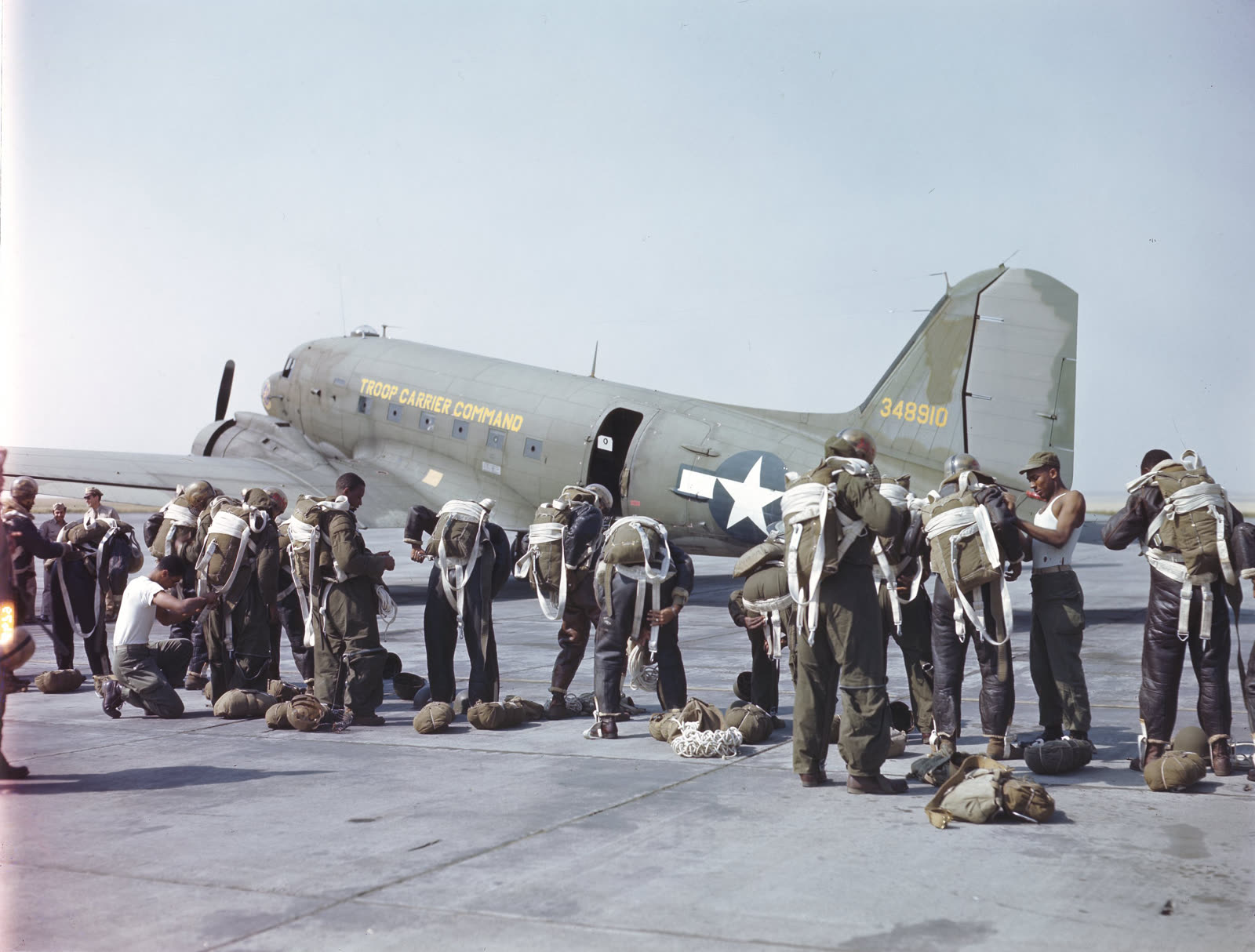
The cover photograph belongs to this second education. It is not a portrait of Morris; it is a 1945 color record of the mission his path helped make possible. Members of the 555th tighten harnesses beside a C-47 before being dropped near an Oregon fire. Their gear includes the adaptations demanded by trees rather than battlefields: protective clothing, helmets, face guards, and long let-down ropes for escaping a suspended parachute.[7]
This work was dangerous even when no enemy bomb was present. National Archives unit records count 36 missions involving 1,255 jumps. More than thirty men were injured. On August 9, a medic died while trying to lower himself from a tree in Oregon's Siskiyou National Forest.[3] Those totals should not be inflated into a claim that the battalion extinguished 36 balloon fires. They measure an airborne firefighting season conducted under the umbrella of a balloon-defense plan.
Morris's Mt. Baker mission
One operation puts Morris back at the center of the unit history. At 5 p.m. on August 21, 1945, the battalion received a call from Mt. Baker National Forest in Washington. The next morning, Second Lieutenant Morris led two officers and thirty-four enlisted men into a meadow about 1,000 yards from the fire. Three men were injured in the drop.[3]
The first task was not cinematic attack but evacuation. After the injured men were moved out, Morris and twenty-five others left for the fire line at noon on August 24. Pack animals carried rations to the meadow. Rain helped cool the fire, and the men finished a fire line on August 25. They were relieved the following evening.[3]
Then came the exit that parachute photographs usually omit. Starting at 6:30 a.m. on August 27, the group marched twenty-three miles to the end of a trail, boarded a bus for Paine Field near Everett, and flew back to Pendleton the next morning.[3] The mission lasted nearly a week. The jump occupied seconds.
That ratio explains why Project Firefly was a meaningful test of more than nerve. The men had to land, absorb injuries, navigate, dig, improvise logistics, endure weather, and walk out. Morris's after-hours conditioning had challenged the idea that Black soldiers could not pass an elite entrance test. Mt. Baker demonstrated something broader: they could command and sustain the unglamorous work that followed the jump.
What the demonstration changed
The press silence surrounding the balloon campaign worked strategically. Japan received little evidence that its weapons were reaching North America. But the National Archives notes a second effect: the blackout also reduced contemporary coverage of the 555th's mission.[3] Secrecy was not the only reason the unit's story receded—Black wartime service was routinely minimized, and the battalion never acquired the combat record it had trained to earn—but it narrowed the public archive at the moment the work occurred.
The unit returned east in October 1945. It was later attached to the 82nd Airborne Division, and when the 555th was inactivated on December 15, 1947, most of its personnel transferred into the 82nd's 3rd Battalion, 505th Airborne Infantry. That reassignment was an integration milestone, not the desegregation of the entire Army. President Harry Truman's Executive Order 9981 followed seven months later, and implementation still required years of institutional pressure.[3][4]
Morris left the Army after the war and worked as a bricklayer and construction supervisor. He lived to see the Triple Nickles publicly commemorated and died in October 2013 at ninety-two.[2] Looking back in 2000, he reduced the unit's claim to ten words: “the color of a man had nothing to do with his ability.”[3]
The line is powerful because it is modest. Morris did not claim that one unit ended segregation or won the war. The Triple Nickles were denied the overseas test they wanted; the weapon they were sent to counter produced no consequential forest-fire campaign; and much of their actual work remained secret. Yet those limits make their accomplishment more precise, not smaller.
Morris turned the Army's own training standard against its racial assumption. The men he led then carried that proof from a guarded school in Georgia to burning forests in the West. They trained for one war and jumped into another, showing that ability could be demonstrated quickly even when an institution took much longer to accept what the demonstration meant.
Sources
- Library of Congress, Veterans History Project, “Walter Morris Collection” (AFC/2001/001/2946) — primary oral history, transcript, service summary, and personal photographs.
- U.S. Army, “Triple Nickles Smokejumpers honored in Fort Leavenworth Ceremony” (October 25, 2021) — Morris's birth, after-hours conditioning, parachute selection, officer training, postwar life, and death.
- Greg Bradsher and Sylvia Naylor, U.S. National Archives, “Firefly Project and the 555th Parachute Infantry Battalion (‘Smoke Jumpers’)” (February 12, 2015) — record-group-based chronology, mission reports, jump and injury totals, press blackout, and postwar transfer.
- U.S. Army Center of Military History, “555th Parachute Infantry Battalion” — official constitution, activation, redesignation, assignment, and inactivation chronology.
- U.S. Forest Service, National Smokejumper Training Guide (2016), unit 1 — the 1939 experimental program and the first operational fire jump in 1940.
- National Museum of the United States Air Force, “Balloon Bombs: Japan's Answer to Doolittle” — Fu-Go launch scale, trans-Pacific mechanism, voluntary press silence, Bly deaths, and damage boundary.
- U.S. National Archives, “Photograph — Operation Fire Fly” (1945), NAID 148728114 — color transparency of 555th paratroopers preparing beside a C-47 for an Oregon fire mission, used as the article image.