At roughly 32,500 feet, Jacques Piccard and Don Walsh heard a dull crack. A shock passed through Trieste's cramped steel sphere. The bottom of Challenger Deep was still thousands of feet below them, invisible even to the echo sounder. They stopped the oxygen injector and every humming instrument they could silence, then listened. The bathyscaphe remained in trim. Its gasoline float was not leaking. The descent continued at the same measured rate.[2]
They went on.
That decision can look like an explorer's wager against pressure. Reconstruct the full dive of 23 January 1960, however, and a different logic appears. Trieste was not simply a capsule dropped toward a record. It was an underwater balloon whose pilots continuously exchanged buoyancy, ballast, time, and daylight. Its crucial feature was not that it could go down. It was that the way up had been designed into every decision on the way down.[2][3]
The day, in pressure and clock time
The surviving sources differ by a minute or two at the edges. The U.S. Naval Undersea Museum's transcription of the original dive log records “DOWN 0822 / UP 1658.” Piccard's near-contemporaneous account gives 8:23 a.m. for submergence and 4:56 p.m. for resurfacing. Those are normal discrepancies between an operations log and a participant's narrative, and they do not alter the sequence.[1][2]
- 1958: the U.S. Navy bought Trieste. A modification program later fitted a new pressure sphere designed for dives to 36,000 feet and enlarged the gasoline float.[3]
- 8 January 1960: Piccard and Walsh reached about 23,000–24,000 feet in Nero Deep, the last major proving dive before Challenger Deep.[2][4]
- 19 January: the tug Wandank began towing Trieste from Guam toward the dive site. The four-day passage ended in heavy weather.[2]
- About 8:22–8:23 a.m., 23 January: Trieste submerged with Piccard as pilot and Walsh as observer.[1][2]
- 11:30 a.m.: at 26,000 feet, Piccard reported that six tons of shot ballast had already been released to control the accelerating descent.[2]
- 12:56 p.m.: the echo sounder first showed the bottom, about 300 feet below.[2]
- 1:06 p.m.: the guide rope settled and Trieste completed its soft landing at the seafloor.[2]
- About 1:26 p.m.: after 20 minutes on the bottom, the men released more shot and began ascending.[1][2]
- About 4:56–4:58 p.m.: Trieste surfaced. Emptying the damaged entrance tube safely took another quarter hour.[1][2]
The dive lasted about eight and a half hours. Almost five were spent descending, only 20 minutes at the destination, and roughly three and a half returning. The proportions tell the story: reaching the bottom was a brief interval inside a much longer exercise in controlling vertical motion.
Before the descent, the sea damaged the machine
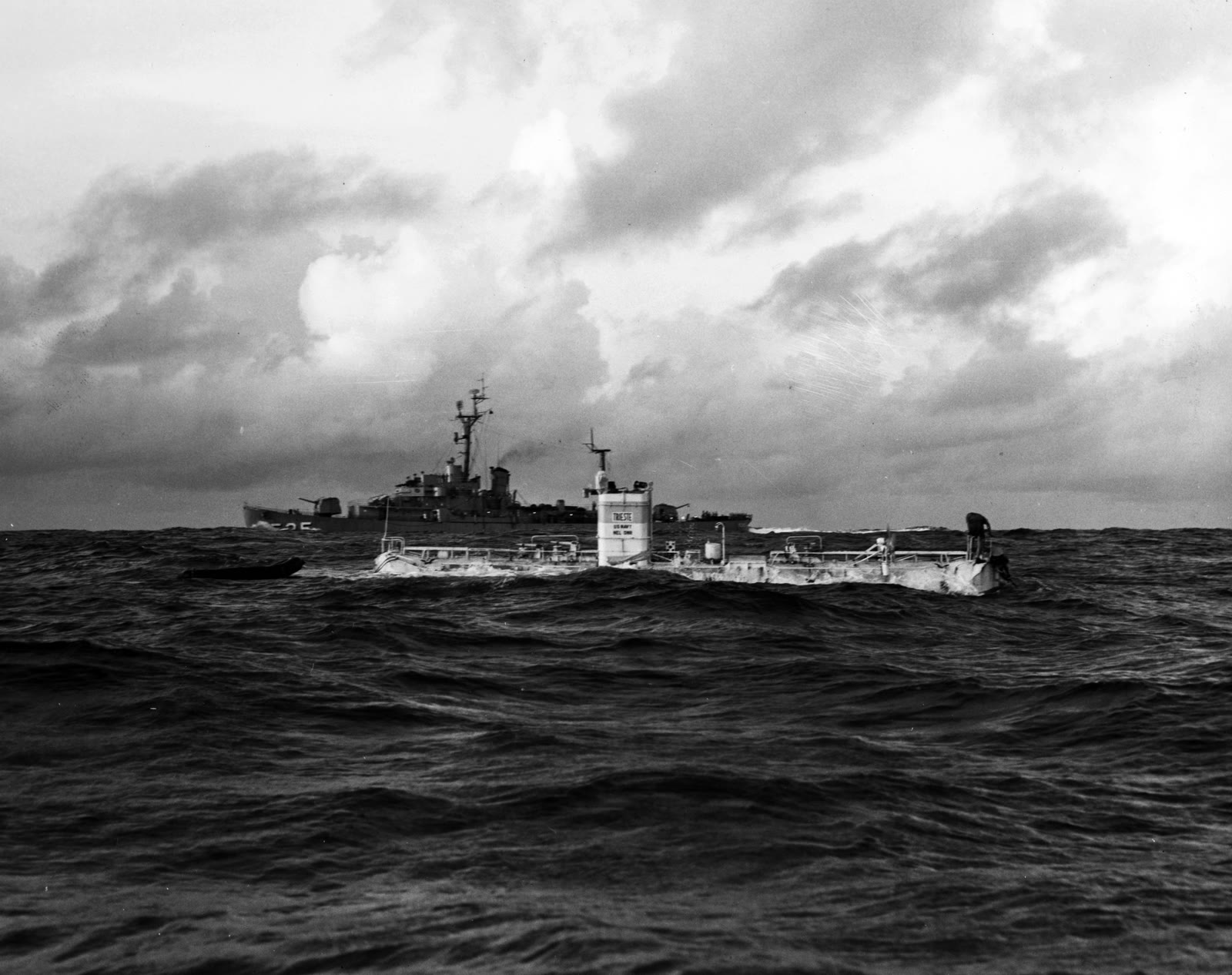
The cover photograph does not show a polished laboratory waiting on calm water. It shows Trieste low among waves, a rubber boarding raft beside it and the destroyer escort Lewis behind. The Navy caption identifies the scene as immediately before the record dive.[8] Piccard remembered that the tow had torn away the surface telephone, destroyed the descent-and-ascent tachometer, and partly broken a current meter. Waves kept sweeping the deck while the crew checked which losses were inconvenient and which were mission-ending.[2]
The distinction mattered because the bathyscaphe would soon leave ordinary rescue behind. Walsh later recalled that a cancellation message arrived as the dive was beginning and that project scientist Andreas Rechnitzer delayed answering until Trieste was already reported below 10,000 feet.[4] That colorful episode comes from an oral history recorded more than five decades later, not from the terse dive log, so it is best treated as Walsh's memory of the program's improvisational culture rather than a minute-perfect command record. It still clarifies the institutional stakes: this was a small Navy team operating a singular machine beyond any practical recovery depth.
At the surface, the broken telephone forced Piccard to substitute a visible signal. Once he entered the sphere, he could briefly turn the deck propellers; if the crew above saw them move, they were to halt the dive. No signal came. The hatch closed, the vertical entrance tube flooded, and the violence of the waves disappeared as the float slipped beneath them.[2]
A balloon with an iron escape route
Trieste did not work like a submarine that could drive itself through the water column. Its long float held aviation gasoline, which was lighter than seawater and supplied buoyancy. The two men occupied a pressure-resistant steel sphere slung beneath it. Flooded spaces and iron shot made the vehicle heavy enough to sink. Releasing shot made it lighter and allowed the gasoline float to pull it upward.[3]
The shot was held in hoppers by electromagnets. Cut the electrical current and gravity released the pellets. A total power failure therefore tended to start an ascent instead of imprisoning the crew at depth. This was not a complete guarantee—hoppers could jam, and an ascent once committed offered limited control—but it made the craft fail toward positive buoyancy.[3]
The system also explains why descent and return could not be planned separately. Gasoline compresses more than seawater. As Trieste went deeper and its gasoline contracted, seawater entered the float and the craft became heavier, increasing its downward speed. Piccard and Walsh had to release shot to slow the fall, but every pellet spent on braking was one less pellet available to initiate or adjust the ascent. The machine converted judgment into mass.[2][3]
The first obstacle was only 300 feet down
Ten minutes after submerging, Trieste stopped at about 300 feet. It had entered colder, denser water, which made the craft relatively more buoyant. Similar thermocline layers stopped it again near 335, 425, and 530 feet. The pilots could wait for the gasoline to cool and contract, or release some expendable gasoline to make the craft heavier and keep the schedule.[2]
Waiting was safer for the buoyancy budget but costly in daylight. Piccard believed the calculations left enough reserve, so he vented small amounts of gasoline. Below roughly 650 feet the bathyscaphe began its long, steady fall. As compression accelerated it, he metered out shot to hold about three feet per second, then slowed to two feet per second below 26,000 feet and about one foot per second below 30,000. The slow final approach preserved time for the echo sounder to find a slope or an unexpectedly early bottom.[2]
This was exploration as inventory control. Gasoline bought downward motion through the cold layers. Shot bought braking and, later, ascent. Daylight constrained how much time could be exchanged for either.
The crack was not in the pressure sphere
The noise near 32,500 feet tested that logic. Piccard and Walsh did not yet know what had cracked. They checked the evidence available inside the sphere: no change in balance, no gasoline loss, no abnormal instrument reading, and no interruption in the steady descent. They turned off noisy equipment to listen. Finding no sign of a failing pressure boundary, they continued.[2]
Only after landing did the rear searchlight reveal the damage. A large Plexiglas pane in the flooded entrance tube had cracked. It was not one of the pressure sphere's viewing ports and carried no pressure difference at depth; Piccard attributed the fracture to the pane and its steel frame contracting differently in the cold.[2]
That distinction removes the false drama of a crew calmly watching its cabin window fail. The immediate threat was not implosion. The operational threat waited at the surface. To leave the sphere, the men had to force seawater out of the entrance tube with compressed air. A badly fractured pane could make that impossible or could fail if they pressurized the tube too quickly. In rough seas, divers might need daylight to fit a spare cover. The crack therefore changed the schedule even though it did not end the descent.[2]
Twenty minutes at the bottom—and one claim that did not survive
At 12:56 p.m., the echo sounder picked up the floor 300 feet below. A guide rope touched first, unloading the last few pounds of effective weight so that Trieste settled at 1:06 p.m. rather than striking hard. The two men recorded water near 38°F, virtually no current, and no positive radiation reading. Walsh tried the acoustic telephone and, unexpectedly, received a faint reply from Wandank through nearly seven miles of water.[2]
Piccard also reported seeing a sole-like flatfish. His near-contemporaneous account presented the sighting as proof that a bony fish could live at full ocean depth.[2] Later biological evidence did not support it. Alan Jamieson and Paul Yancey compared the sighting with known fish depth limits, later trench observations, the narrow viewing opportunity, and the physiological effects of pressure; they concluded that it was a misidentification or an erroneous report.[7] The shrimp and jellyfish observations are far more plausible. The important boundary is simple: the dive directly established human presence and functioning equipment at the seafloor, not every biological inference made through a small window.
After 20 minutes, Walsh used the rear light and identified the cracked entrance-tube pane. Ten minutes had been planned for further work, but daylight now had safety value. Piccard released shot to begin the ascent. The pellets struck the bottom and raised a bright sediment cloud in front of and above the rising craft.[2] The cloud is often made to sound like the reason the visit ended; in Piccard's own sequence, it followed the decision to leave. The cracked pane and the surface deadline were the controlling facts.
The record required correction before it required celebration
The raw gauge reading was 6,300 fathoms, or 37,800 feet. Subsequent calibration and calculations by oceanographers John Knauss and John Lyman produced the long-accepted figure of about 35,800 feet.[5] A 2021 reconstruction notes that the gauge had been calibrated in fresh water and later corrected for salinity, temperature, and gravity; it also says the original instrument and full correction analysis could not be located.[6] The triumph did not make the instrument self-validating.
Modern bathymetry adds another boundary. A 2021 peer-reviewed reconstruction lists Trieste's landing in Challenger Deep's western basin at about 10,910 metres, while estimating the deepest measured point—at a different coordinate in the eastern basin—at 10,935 metres, plus or minus 6 metres.[6] That newer maximum does not relocate the 1960 vehicle or diminish the first human descent. It shows why “the deepest point” is a measurement problem spread across an uneven trench, not a permanent brass marker waiting on a flat floor.
The corrections matter because they separate achievement from legend. Trieste did not need a perfectly calibrated gauge or a flatfish to have succeeded. It needed to land, communicate, release ballast, rise, and return two people to the air.
The dive ended above the surface
As shot fell away, the gasoline float lifted Trieste. Expansion accelerated the ascent: Piccard recorded about one and a half feet per second near the bottom, rising toward five feet per second close to the surface. Warm upper water slowed the craft as expected. It broke through the waves within minutes of the planned time.[2]
The crew still could not simply open the hatch. They fed compressed air into the flooded entrance tube slowly, watching the damaged pane while the water level fell. A process that ordinarily took two or three minutes took nearly 15. Only then did Walsh and Piccard climb onto the deck.[2]
That last quarter hour completes the event. The record is usually pictured as a vertical line ending at Challenger Deep. Operationally, it was a loop that did not close until the entrance tube was dry. Thermoclines, expendable gasoline, iron shot, the unexplained bang, the shortened bottom stay, the expanding float, and the cautious dewatering were not complications around the achievement. They were the achievement.
Trieste reached the deepest ocean not because descent was irresistible, but because the machine and its pilots kept a return possible all the way down.
Sources
- U.S. Naval Undersea Museum, “Trieste Dive Log, 1953–1963,” collection item NMNW.2014.020.001 — transcription of the primary operations log, including Dive 70's date, coordinates, crew, support ships, corrected depth, and down/up times.
- Jacques Piccard, “Man's Deepest Dive,” National Geographic, August 1960 — near-contemporaneous first-person reconstruction of the tow, thermoclines, crack, landing, bottom stay, ascent, and exit; reproduced by Deepsea Challenge.
- Don Walsh, The Bathyscaph TRIESTE: Technological and Operational Aspects, 1958–1961, U.S. Navy Electronics Laboratory Report 1096, 27 July 1962 — primary technical account of the gasoline float, pressure sphere, shot ballast, electrical fail-safe, and operating sequence.
- Office of Naval Research, “‘It Was Just a Longer Day at the Office’: An Oral History with Don Walsh,” Future Force, Summer 2016, pp. 28–30 — retrospective account of Project Nekton, the prior test dive, cancellation message, and program aftermath.
- NOAA Ocean Exploration, “Man at the Deepest Depth” — institutional history of the 23 January 1960 descent and the correction of the onboard 37,800-foot reading to about 35,800 feet.
- Greenaway et al., “Revised depth of the Challenger Deep from submersible transects,” Deep-Sea Research Part I 178 (2021), DOI 10.1016/j.dsr.2021.103644 — modern pressure-derived bathymetry distinguishing Trieste's western-basin landing from the eastern-basin maximum.
- Alan J. Jamieson and Paul H. Yancey, “On the Validity of the Trieste Flatfish: Dispelling the Myth,” The Biological Bulletin 222, no. 3 (2012) — peer-reviewed reassessment of the claimed sole-like fish sighting; University of Western Australia research record.
- U.S. Navy, “Bathyscaphe Trieste with USS Lewis (DE-535) over the Marianas Trench on 23 January 1960,” Naval History and Heritage Command photograph USN 710619 — archival photograph used as the article image, mirrored by Wikimedia Commons.