By 1971, the women campaigning for Kelly’s Bush had tried the ordinary doors of government. The thirteen residents who called themselves the Battlers for Kelly’s Bush had written letters, lobbied councillors and state politicians, built a telephone tree, staged publicity events, and argued that the remnant bushland on Sydney Harbour should remain open space. The state nevertheless rezoned the land for housing. A. V. Jennings controlled the proposed development. The residents held neither the title nor a statutory veto.[1]
Then construction workers declined to turn the development proposal into buildings. Jennings walked away without laying a brick.[2][4]
The name was still shifting. The June 1971 action began as a “black ban,” the established language of industrial refusal; “green ban” soon distinguished community and environmental action and was applied retrospectively to Kelly’s Bush.[1][4][6]
That reversal is often condensed into a heroic story about Jack Mundey or a victory of environmental feeling over greed. Neither version explains how the refusal worked. Residents could establish a public claim but could not enforce it; the New South Wales Builders Labourers’ Federation (NSWBLF) could disrupt construction but needed a defensible reason to do so. A Green Ban joined those incomplete powers. A community meeting supplied legitimacy, a rank-and-file vote converted the request into a union rule, and coordinated withdrawal of labor made proceeding costly.
The result was not a new planning law. It was a temporary, two-key veto over production—powerful because residents and workers had to turn it together, and fragile because the mechanism lasted only while organized workers in critical trades continued to honor the same ban.
The missing power at Kelly’s Bush
The 1970s dispute unfolded on Wallumedegal Country, at a place with histories much older than either the developer or the residents’ campaign.[1][4] From the late nineteenth century, a smelting company occupied part of the waterfront site, while the surrounding bush served as a buffer and was used informally for recreation. After the works moved in 1967, Jennings pursued several residential schemes. In September 1970, Betty James and twelve neighbors formally organized as the Battlers. In 1971, after official lobbying had failed, the state changed the zoning from reserved open space to residential.[1]
The campaign’s problem was therefore not an inability to speak. It was an inability to stop a development advanced through official channels. Publicity could raise the political price of development, but the developer could wait for attention to fade. A council vote could be reversed or bypassed. Even a large rally could remain advisory.
The union possessed the missing capacity because buildings are unusually dependent on coordinated work at a fixed place. The NSWBLF represented about 11,000 workers by the early 1970s, including laborers and specialist groups such as riggers, scaffolders, hoist drivers, and steel fixers. A developer might control land and have rezoning in its favor, but neither asset could excavate, lift, pour, or assemble anything by itself.[2]
The labor key was not necessarily one union acting alone. Mark Haskell’s 1977 study found that other unions supported particular bans even though cooperation across the building-union movement was inconsistent. Different trades could therefore strengthen the production stoppage—or weaken it by declining to participate.[6]
Ed Atkins calls this kind of leverage workers’ structural power: the ability to withdraw labor at a point where production depends on it. Applied to an environmental dispute, the leverage did not come from winning an argument inside the planning office. It came from withholding the activity that would make the contested plan irreversible.[3]
The veto needed two keys
Industrial leverage alone did not explain why a construction union should decide the fate of a park or neighborhood. The NSWBLF’s answer was procedural. At Kelly’s Bush, the union asked the Battlers to demonstrate local support at a public meeting. More than 600 people attended and formally requested a ban. State Library and Dictionary of Sydney accounts describe the broader rule in similar terms: an affected community had to support the action, and the union’s rank and file had to approve it.[2][4]
This created two separate tests.
The community key defined the harm and authorized the request. Residents knew whether a proposed tower meant eviction, whether open land functioned as a neighborhood park, or whether an alternative plan would answer their objection. Requiring a public meeting also made it harder for a union official to impose a private aesthetic preference under the name of community interest.
The workplace key established whether members would bear the costs and risks of refusal. A ban was not a press release issued on their behalf. It depended on workers actually declining jobs, resisting pressure on site, and treating the decision as binding across crews. Rank-and-file approval turned a civic appeal into collective industrial conduct.
Neither key was sufficient by itself. Community authorization without worker solidarity produced another petition. Worker solidarity without community authorization risked becoming an external command imposed on the people supposedly being protected. The distinctive mechanism was the relay between them.
That procedure did not make Green Bans equivalent to universal elections. An “affected community” could be disputed, organized residents could be more audible than future residents, and the first Sydney campaign arose in an affluent suburb. The democratic claim was narrower: decisions normally dominated by owners and planning authorities now had to clear two additional assemblies—one in the neighborhood and one in the workforce. Later bans extended beyond bushland to working-class housing in The Rocks and Woolloomooloo, heritage, public parks, and other community claims.[2][4]
One threatened tree could stop another building
Kelly’s Bush also revealed why a ban could survive an attempt to hire around it. Jennings said it would use non-union labor on the site. Workers responded not only at Kelly’s Bush but at a half-finished Jennings office project in North Sydney. If the developer touched the bush, they warned, the office building would remain unfinished. Jennings abandoned the housing plan.[2]
This was the mechanism’s crucial escalation. The economic unit was no longer the disputed parcel; it was the developer’s portfolio. Hiring a replacement crew at Kelly’s Bush might overcome a picket there, but it could expose a much larger investment elsewhere. Union organization allowed workers to transmit the cost of one contested decision across sites, trades, and construction schedules.
The ban therefore changed the developer’s calculation without itself undoing the rezoning or planning process. Before the ban, delay depended mainly on residents sustaining political pressure. After it, proceeding could strand work already under way. The threatened loss became immediate, concentrated, and legible to the firm that could prevent it.
This distinction explains both the force and the limit of the word veto. A Green Ban could block the conversion of finance, planning progress, and land into a finished asset. It could not by itself transfer ownership or permanently reserve the land. At Kelly’s Bush, Jennings eventually sold to Hunters Hill Council, but residential zoning remained. Radioactive contamination later cast further doubt on housing there; the state announced in 1977 that development would not proceed and in 1983 set the site aside for permanent public access. The labor refusal had bought time, but ownership, contamination, and government action all shaped the durable outcome.[1]
Repetition made a movement
After Kelly’s Bush, resident action groups across Sydney sought the same relay. The request could concern a different object—low-income homes, a historic street, a public garden—but the sequence was repeatable: demonstrate community support, secure a membership decision, withdraw labor, and hold the interruption until the plan was abandoned, altered, or replaced.
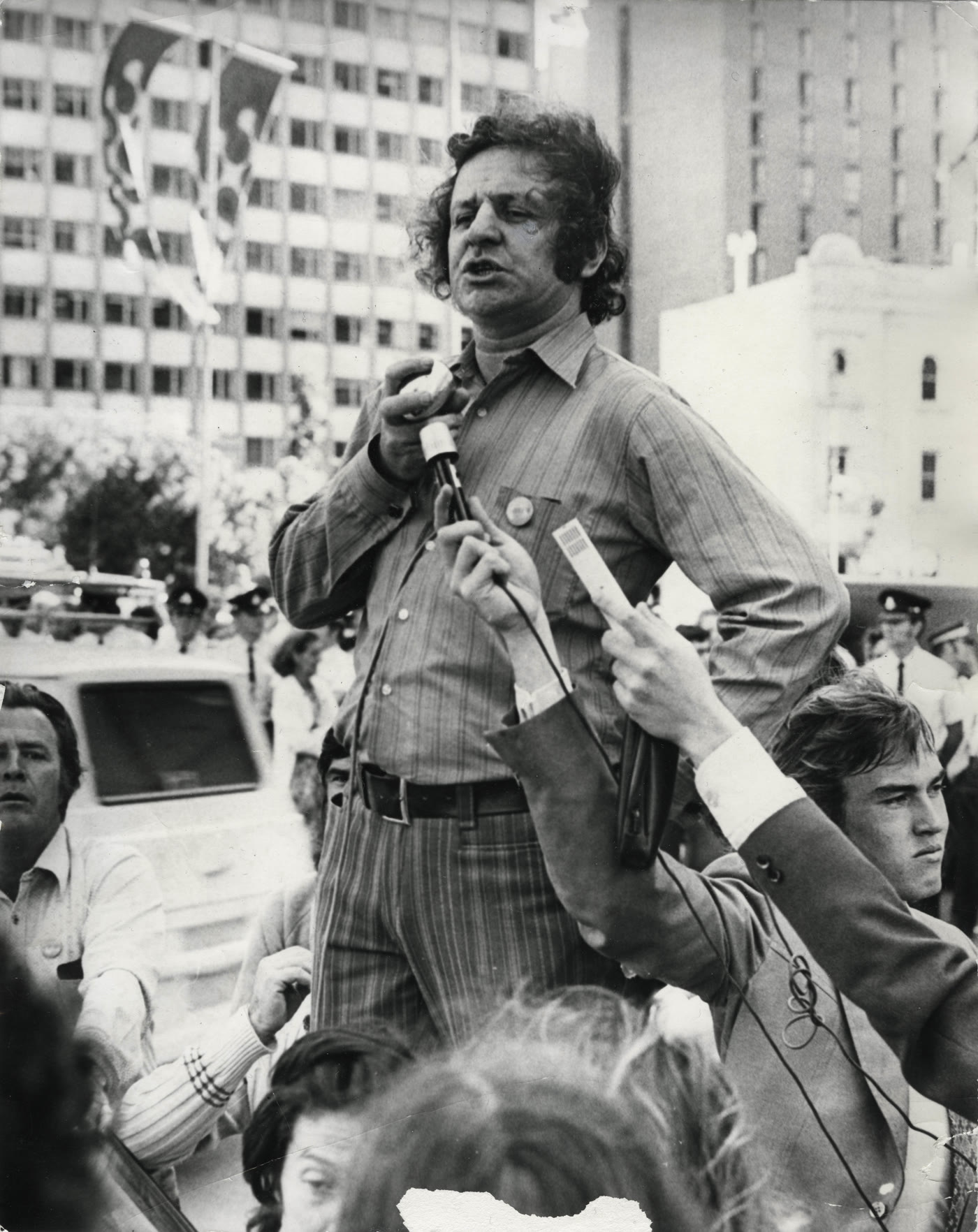
By 1973, Green Bans had become public events as well as workplace decisions. The photograph above, made at an October 25 demonstration in central Sydney, shows Mundey speaking into a thicket of reporters’ microphones while a crowd fills the street behind him.[4] Its composition captures one part of the mechanism that a bare “refusal to work” misses. A ban needed workers at the production choke point, but it also needed a visible account of whose request they were enforcing and why.
The outcomes were not identical. A proposed sports complex in Centennial Park was abandoned. Plans for The Rocks were revised in ways that preserved much of the historic precinct. On Victoria Street, another company later submitted a scheme with substantially reduced height and bulk, but the amended plans did not satisfy every demand.[4] The National Film and Sound Archive’s account of Rocking the Foundations, a 1985 documentary built largely from participant interviews and historical footage, likewise emphasizes that the bans defended parks, harbor foreshores, residential areas, and historic buildings rather than one uniform class of object.[5]
It is therefore too simple to count every ban as a permanent “save.” Refusal produced several possible effects: cancellation, delay, redesign, negotiation, or time for a public authority to adopt another plan. The shared causal step was interruption. What happened during the interval depended on the strength of the resident campaign, the availability of alternatives, government action, and how long labor solidarity held.
Why the mechanism broke
The same logic that explains the bans’ power explains their collapse. Their leverage depended on the NSW branch remaining an effective organizer of essential building labor and on workers across the necessary trades recognizing its ban decisions. According to the Dictionary of Sydney’s historical synthesis, federal BLF officials intervened in the branch in late 1974 after developers had become determined to break the bans. Over the following months, employers gave preference to workers holding new federal union tickets while workers loyal to the state branch were denied jobs; construction resumed on banned sites.[2]
The decisive change was not an overnight disappearance of community concern but a transfer of effective union authority. Haskell identifies the employment-preference agreement between the federal branch and the Master Builders Association as the proximate cause of the state branch’s dissolution. On March 24, 1975, its leaders recommended that members join the federal branch rather than face immediate lockout.[6] A community request and state-branch vote could no longer guarantee that work would stop. Rocking the Foundations places the NSWBLF’s demise in 1975, making the organizational endpoint visible alongside the movement’s physical successes.[5]
Two interpretations can coexist here. To supporters, the bans democratized planning by giving residents and workers leverage against decisions dominated by developers. To critics, an unelected union had coercively obstructed projects moving through official channels.[4] The evidence does not dissolve that political disagreement, but it clarifies what must be judged. This was not an official replacing a planning authority by personal decree. It was a double act of collective refusal, authorized through community and workplace meetings. Nor was it a comprehensive public planning system: its reach depended on where a mobilized community met an organized workforce able to make refusal stick.
That contingency is not a footnote to the achievement. It is the achievement’s shape. The Battlers made an ignored preference public; a mass meeting turned it into a community request; members turned the request into a workplace commitment; coordinated crews made the commitment expensive to defy; and the resulting delay opened time for other decisions. At Kelly’s Bush, those links prevented irreversible construction long enough for a sale, an environmental hazard, and later government decisions to change the site’s future. The veto was temporary. The park became permanent.
Sources
- Heritage NSW, “Kelly’s Bush Park” — official State Heritage Inventory record for the site’s land-use history, the Battlers’ campaign, rezoning, and the 1977 and 1983 preservation decisions.
- Meredith Burgmann and Verity Burgmann, “Green Bans movement,” The Dictionary of Sydney — history of the NSWBLF’s membership, community-meeting rule, Kelly’s Bush escalation, later campaigns, and federal intervention.
- Ed Atkins, “The structural power of workers in influencing energy transitions: Examples of the Green Bans (Australia) and the Lucas Plan (United Kingdom),” Energy Research & Social Science 96 (2023) — peer-reviewed analysis of labor withdrawal at points of environmental harm.
- Jim Colman, “Jack Mundey’s Sydney,” State Library of New South Wales (2025) — account of the bans’ community and rank-and-file approval process, case outcomes, and source of the 1973 Fairfax photograph used above.
- Susan Lambert, curator’s notes for Rocking the Foundations (1985), Australian Screen / National Film and Sound Archive of Australia — synopsis and archival context for the documentary’s participant-led history of the NSWBLF through 1975.
- Mark A. Haskell, “Green Bans: Worker Control and the Urban Environment,” Industrial Relations 16, no. 2 (1977) — contemporary scholarly analysis of inter-union support, deregistration, federal intervention, and employment preference as the mechanism of the NSW branch’s defeat.