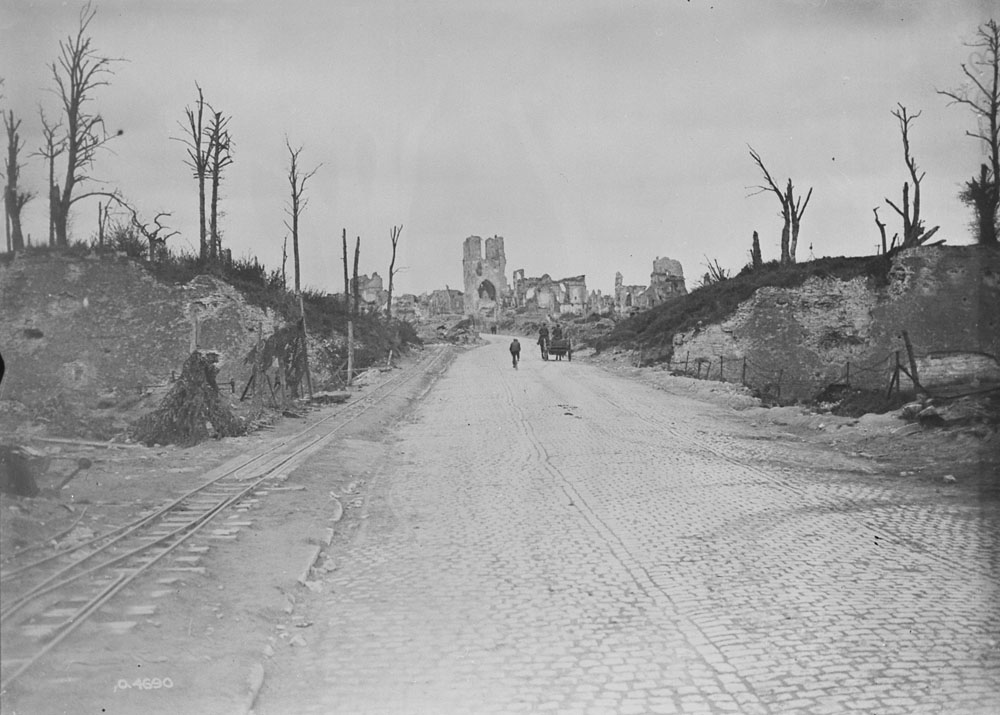
The Menin Gate in Ypres is powerful because it refuses to let absence stay abstract. Many First World War memorials stand where bodies are buried, where a battle turned, or where a nation wanted to stage victory. The Menin Gate does something more difficult. It marks a road out of town, names men whose graves were unknown, and then returns the dead to public hearing every evening at eight.
That combination is the historical core of the place. The Commonwealth War Graves Commission records that the Ypres (Menin Gate) Memorial now bears the names of more than 54,000 officers and men with no known grave, designed by Sir Reginald Blomfield with sculpture by Sir William Reid-Dick and unveiled by Lord Plumer on 24 July 1927.[1] But the memorial's force is not only numerical. Its deeper work is architectural and ritual: it gives the missing a location, then gives that location a clock.
The cover image matters because it shows the site before the solution hardened into stone. The Library and Archives Canada photograph, dated April-May 1919, shows the Menin Gate at Ypres in the immediate aftermath of war, before Blomfield's memorial transformed the damaged gateway into a formal chamber of commemoration.[6] The photograph keeps the later monument honest. This was not an empty symbolic site waiting for a clean design. It was a wounded urban threshold through which soldiers, civilians, ruins, and memory had already been moving.
The Road Out Became The Memorial
The gate was not chosen at random. The Australian War Memorial explains that the road out of Ypres passed through the old wall defences toward Menin, and that during the war the gate became symbolically charged because troops saw it as they moved toward the front line.[5] That matters because the Menin Gate does not remember the Ypres Salient from a detached national capital. It remembers it from a local exit point.
The site therefore holds two directions at once. For soldiers, the road led out toward danger. For later visitors, the same threshold leads inward toward names. The memorial makes a wartime route reversible: what had been a passage to the front becomes a place where the missing are brought back into civic space.
That reversal is essential to the article's question: how do you commemorate people whose bodies cannot be located? A grave offers proximity through burial. A battlefield offers proximity through terrain. A wall of names offers proximity through inscription. The Menin Gate uses all three imperfectly. It stands near the old route to the fighting, but it is not a grave; it names individuals, but it cannot restore bodies; it takes the shape of a gate, but it no longer functions only as passage.
Names Had To Do The Work Of Graves
Dominiek Dendooven's 1914-1918 Online article is especially useful because it treats the Menin Gate as a new memorial problem rather than a familiar monument with extra names. He notes that when the decision was made in 1921, the British government withdrew an earlier hope to preserve the ruins of Ypres's Cloth Hall and Cathedral as a memorial, and the Menin Gate became the chosen site for commemorating those with no known grave.[4]
That shift matters. Preserved ruins would have made Ypres itself the memorial object. The Menin Gate made absence the memorial object. Its stone panels do not say: here is where these men lie. They say: here is where their names can be held when burial cannot do the work.
Dendooven also stresses why that form belonged to the First World War. Industrial artillery, static trench warfare, repeated bombardment, and later fighting could destroy bodies, obliterate graves, or make burial locations unknowable.[4] The memorial to the missing was not only an emotional form. It was evidence of how the war had been fought. The missing were not missing because remembrance failed; remembrance was forced to adapt because the battlefield had made ordinary recovery impossible.
That is why the names are not decorative. They are substitutes for a physical certainty that families were denied. A name on the Menin Gate does not repair the loss of a grave, but it changes the terms of absence. It says that disappearance will not also become administrative erasure.
An Arch That Does Not Quite Triumph
The Menin Gate's form is deliberately uneasy. Dendooven describes Blomfield's design as ambiguous: externally a triumphal arch, internally and laterally a funerary monument.[4] That ambiguity is not a flaw. It is the memorial's intelligence.
A straightforward triumphal arch would have been morally too simple for Ypres. The city and the salient had become associated with repeated slaughter, mud, gas, shellfire, and attrition. A purely mournful enclosure, on the other hand, would have missed the fact that the site was still a gate in a living town. People pass through it. Traffic has to be stopped for the ceremony. The memorial belongs to urban routine as well as mourning.
The arch therefore keeps victory language under pressure. It has mass, height, order, and imperial form, but its inner surface is crowded with names of men denied known burial. The shape may recall public honor; the content refuses triumphalist ease. That tension explains why responses have never been uniform. Dendooven notes both Siegfried Sassoon's fierce condemnation and Stefan Zweig's admiration.[4] The disagreement is itself revealing. The Menin Gate is not neutral stone. It asks whether public commemoration can honor the dead without making the war seem cleaner than it was.
The best answer is not in the masonry alone. It is in what happens to the masonry every night.
The Last Post Gives The Monument A Clock
The Last Post ceremony began on 2 July 1928, according to the Last Post Association, and the association describes itself as an independent, voluntary, non-profit organization of local people from Ieper responsible for the daily act of homage.[2] Every evening at exactly 8 p.m., traffic is halted under the Menin Gate so buglers can play the tribute.[2] The practice turns the memorial from an object into a habit.
That daily repetition matters because commemoration often weakens when it depends only on anniversaries. Anniversaries are important, but they let memory gather around a few official dates. At the Menin Gate, public memory is built into ordinary time. The day ends, the street pauses, the sound rises inside the arch, and the town briefly reorganizes itself around the missing.
Tourism Ypres gives the practical texture of the ceremony: it is free to attend, standing-room only, usually brief, includes silence and wreath laying when appropriate, and is observed without applause.[3] Those details are not mere visitor information. They are part of the ritual's restraint. The ceremony does not turn the dead into spectacle by demanding emotional display from the crowd. It creates a disciplined pause and then releases the city back to movement.
The same source notes the memorial's date boundary: the Menin Gate lists missing soldiers from the beginning of the war until 15 August 1917, while later missing are listed at Tyne Cot in Passchendaele.[3] That boundary is important because it shows the impossibility of totality. Even a vast gate could not contain every name originally meant for it. The memorial's authority comes not from completeness, but from making one form of incompleteness visible and repeatable.
Why The Ritual Still Works
The Menin Gate endures because it solves three problems at once without pretending to solve grief itself. First, it locates the missing at a meaningful threshold, the road from Ypres toward the front. Second, it turns unknown graves into known names. Third, it binds those names to a nightly civic action that local people maintain in public.
Each element would be weaker alone. A gate without names could become architectural symbolism. Names without ceremony could become an archive in stone. Ceremony without place could drift into abstraction. Together, they make a working system of remembrance: road, wall, sound, silence, return.
That system also keeps interpretation bounded. The Menin Gate cannot tell every story of the Ypres Salient. It does not stand for all combatants equally, and it does not remove the political arguments around empire, sacrifice, command, or the meaning of the war. What it can do is narrower and still profound: it refuses to let the missing disappear from public time.
This is why the 1919 photograph is the right way to enter the article.[6] It shows the threshold before the names, before the nightly ritual, before the finished stone had made absence legible. The later memorial did not erase that damaged landscape. It formalized one answer to it. Where a road once carried soldiers outward, a city now stops each evening so the missing can arrive by name and sound.
Sources
- Commonwealth War Graves Commission, "Ypres (Menin Gate) Memorial" - official memorial record with name count, designer, sculptor, and unveiling date.
- Last Post Association, "Home" - official description of the daily Last Post ceremony, its 1928 start, voluntary local stewardship, and 8 p.m. traffic pause.
- Tourism Ypres, "Last Post" - visitor-facing account of ceremony conduct, silence, wreath laying, name count, and the Tyne Cot date boundary.
- Dominiek Dendooven, "Ypres Menin Gate," 1914-1918 Online: International Encyclopedia of the First World War (2014) - scholarly overview of the memorial decision, architecture, missing-grave context, and contested reception.
- Australian War Memorial, "The Menin Gate Memorial" - institutional account of the wartime road symbolism, Australian missing, 1927 unveiling, and evening Last Post practice.
- Wikimedia Commons, "File:A004618-v8.jpg" - source page for the Library and Archives Canada archival photograph of the Menin Gate at Ypres, April-May 1919, used as the article image.