Ashoka's Major Rock Edict XIII is often remembered as the moment an emperor looked at conquest and recoiled. That memory is not wrong, but it is too smooth. Read closely, the Kalinga passage is not a private confession and not a clean renunciation of political force. It is a public inscription in which a ruler makes conquest answer to the grief it creates, then tries to replace one kind of victory with another.
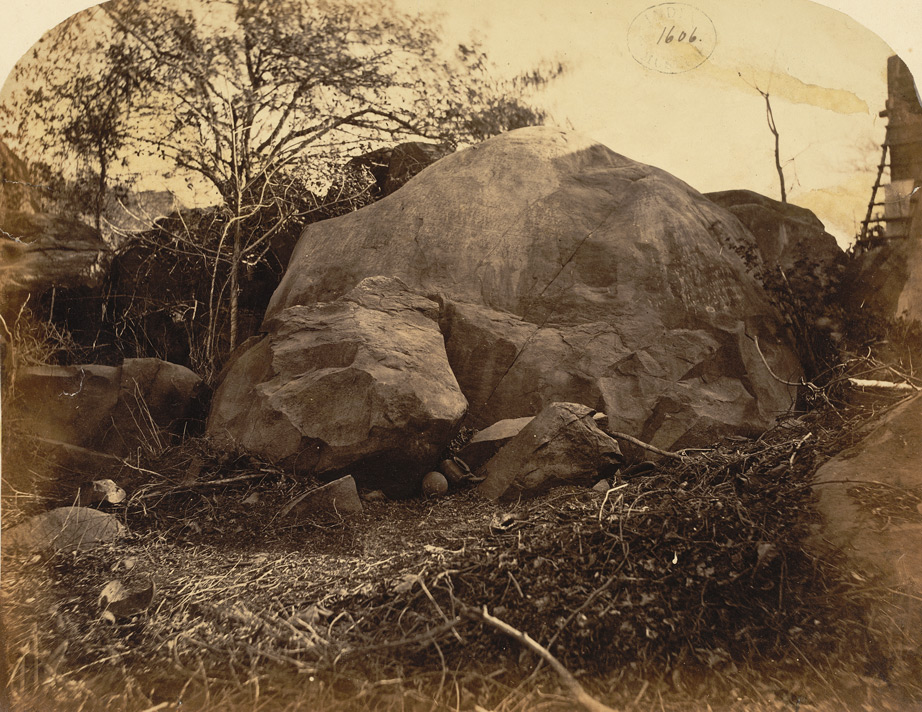
The document belongs to the mid-third century BCE world of Mauryan rule. PBS's Story of India gallery places the Battle of Kalinga at about 261 BCE and identifies the thirteenth major edict as the inscription in which Ashoka memorialized that turning point.[5] The official Gujarat Tourism page for Junagadh's Ashok Edicts supplies the local material setting for the cover image: fourteen edicts carved on a large stone on the route toward Mount Girnar Hills.[4] Rock Edict XIII should be read inside that public communication system.
The close-reading question is simple: what does the edict do after it admits that conquest has broken human lives?
Image context: the cover image is a real 1869 photograph by D. H. Sykes showing Ashoka's inscription on rock near Girnar Hill, close to Junagadh. It matters because this article is reading the edict as a physical act of rule: a message carved into a public landscape, meant to outlast the moment of command and keep the king's moral claim visible to later readers.[1][4]
The Shock Is Counted Before It Is Moralized
The Kalinga passage begins with a chronology and a body count. In the eighth year after his coronation, the ruler called Beloved-of-the-Gods conquered the Kalingas; the accessible translations agree on the terrible scale: 150,000 deported, 100,000 killed, and many more dead from other causes.[2][3] The numbers may be royal inscriptional rhetoric, but the rhetoric matters. A conqueror is placing the cost of conquest inside the record rather than letting victory stand alone.
That sequencing is the first important move. The edict does not begin by announcing a new ideal and then giving a vague example. It begins by naming conquest as an event that produced deportation, death, and secondary suffering.[2][3] A modern reader should resist turning this too quickly into biography. The text is not a diary entry. It is a state inscription. The king is teaching subjects, officials, and successors how to understand a war that had already happened.
The close reading depends on the order: conquest, count, remorse, instruction. Each step limits the next. Remorse is not free-floating emotion. It is anchored to political action.
Grief Expands Beyond The Battlefield
The edict's most subtle move comes after the numbers. Ashoka's pain is not restricted to the dead and deported. The translations describe Brahmans, ascetics, householders, servants, employees, friends, relatives, and acquaintances being injured, killed, separated, or made to suffer through the suffering of others.[2][3] The text widens war damage from casualties to social rupture.
That matters because it changes the moral object. The edict is not only saying: many people died. It is saying: conquest tears apart the relations that make ordinary life coherent. A person who survives can still be damaged by the loss, removal, or fear imposed on someone nearby. War becomes a chain of secondary injuries.
This is why the passage still reads with force. Ancient royal inscriptions often celebrate victory by making the defeated disappear into tribute, order, or divine favor. Rock Edict XIII makes the defeated reappear as households, religious communities, kin networks, and dependents. It is still royal speech, and it still frames the king as moral center. But it refuses to let conquest remain only a trophy.
Dhamma Does Not Mean The State Vanishes
The famous turn is from military conquest to conquest by dhamma. Livius and Access to Insight both render the core shift as the king preferring conquest through dhamma after Kalinga.[2][3] In context, dhamma is not a narrow policy memo. It is Ashoka's public ethic of restraint, non-injury, respect, generosity, proper conduct, and religious tolerance, developed across the edicts.[2][3]
Yet the same passage prevents an easy pacifist simplification. The edict also mentions forest peoples within the king's domain. They are to be entreated and reasoned with, but they are also told that the king retains the power to punish if necessary.[2][3] That clause is uncomfortable, and it should stay uncomfortable. It shows that the edict does not abolish coercive power. It tries to discipline power by placing remorse, restraint, forgiveness where possible, and light punishment above raw expansion.
That boundary is historically important. Rock Edict XIII is not Ashoka saying the state has become harmless. It is Ashoka saying that the state must re-describe success after seeing what conquest does. The text still speaks from above. It still assumes a king who commands provinces, officials, messengers, and frontier peoples. Its innovation is not the disappearance of sovereignty. Its innovation is making sovereignty account for suffering in its own public language.
The Edict Thinks Past Kalinga
After Kalinga, the edict's map opens outward. It names Greek rulers to the northwest and west, and southern peoples such as the Cholas and Pandyas, as part of the horizon across which dhamma has been heard or carried.[2][3] The safest reading is not that every named region was transformed by Ashoka's policy. The safer and stronger reading is that the inscription imagines moral instruction as a form of reach.
The Junagadh setting helps explain why this matters materially. Ashoka's edicts were not single private memoranda. At Girnar, the official local site account describes the edicts as a large stone inscription on a route toward Mount Girnar, carved in Brahmi script and attached to a place where visitors still meet the text as landscape.[4] The edict's own final note also stresses scale: not all edicts occur everywhere because the king's domain is vast, and the messages exist in shorter and longer forms.[2][3] Rock Edict XIII's geography therefore belongs to both text and medium. The king's claim travels by words, routes, and stone.
This makes the edict a media object as much as a moral text. The empire does not merely possess territory. It tries to create a repeating public voice. At Girnar and other rock-edict sites, that voice had to be read against local landscapes, languages, officials, and memories of rule.[2][3][4] The inscription's physical spread is part of its argument: conquest by dhamma must be visible enough to compete with the older fame of conquest by arms.
The Successor Clause Is The Real Test
The final movement turns toward the future. The edict says it has been written so that sons and great-grandsons should not think of new conquests, or, if military conquests occur, should pursue forbearance and light punishment, and preferably consider dhamma-conquest alone.[2][3] This is where the passage becomes more than remorse. It tries to convert memory into a rule for successors.
That future-facing grammar matters. Ashoka cannot undo Kalinga. The edict does not pretend otherwise. What it can do is keep Kalinga from becoming merely a precedent for expansion. The king turns his own conquest into an example that later power should hesitate before repeating.
The strength of the passage is also its limitation. A carved warning to successors is not the same as institutional guarantee. It depends on memory, royal self-presentation, moral pressure, and the survival of the inscription. But that is exactly why the stone matters. The edict gives remorse a public body. It makes the lesson harder to confine to a passing mood.
Why This Stone Still Has Teeth
Rock Edict XIII remains powerful because it does not let readers keep conquest clean. It counts bodies before it praises virtue. It follows death outward into families, servants, religious communities, and acquaintances. It offers dhamma as a better conquest while admitting that punishment and frontier rule remain part of the king's world. It addresses the future because the past cannot be repaired.
That makes the edict neither propaganda to dismiss nor sainthood to admire without scrutiny. It is a tense document. Its moral language is inseparable from royal authority; its remorse is inseparable from a conquest already completed. But the tension is precisely why it is worth close reading. In the eighth regnal year, Kalinga became a victory. In the later inscriptional record, that victory became evidence against the moral innocence of victory itself.[2][3]
Ashoka's Kalinga edict did not end violence by carving grief into stone. It did something narrower and more durable: it made a conqueror's public voice say that conquest damages more than enemies, and that future power should be judged by whether it can learn from that damage before repeating it.
Sources
- Wikimedia Commons, "Ashoka Inscription on rock at the foot of Girnar Hill, near Junagadh, photo by D. H. Sykes, 1869" - source page for the archival photograph used as the article image.
- Livius, "Ashoka's Rock Edicts" - accessible English translation of the major rock edicts, including Rock Edict XIII on Kalinga, dhamma-conquest, Greek rulers, and the successor warning.
- S. Dhammika, "The Edicts of King Asoka," Access to Insight - translation note and English rendering of the edicts, including the Kalinga passage and its cautions about translation variation.
- Gujarat Tourism, "Junagadh - Ashok Edicts" - official visitor and location context for the Mount Girnar route setting, fourteen edicts, carved stone, and Brahmi script.
- PBS, The Story of India, "Edicts of Ashoka" - concise historical context on Rock Edict XIII, the Battle of Kalinga, and the edict's remembered place in Ashoka's rule.