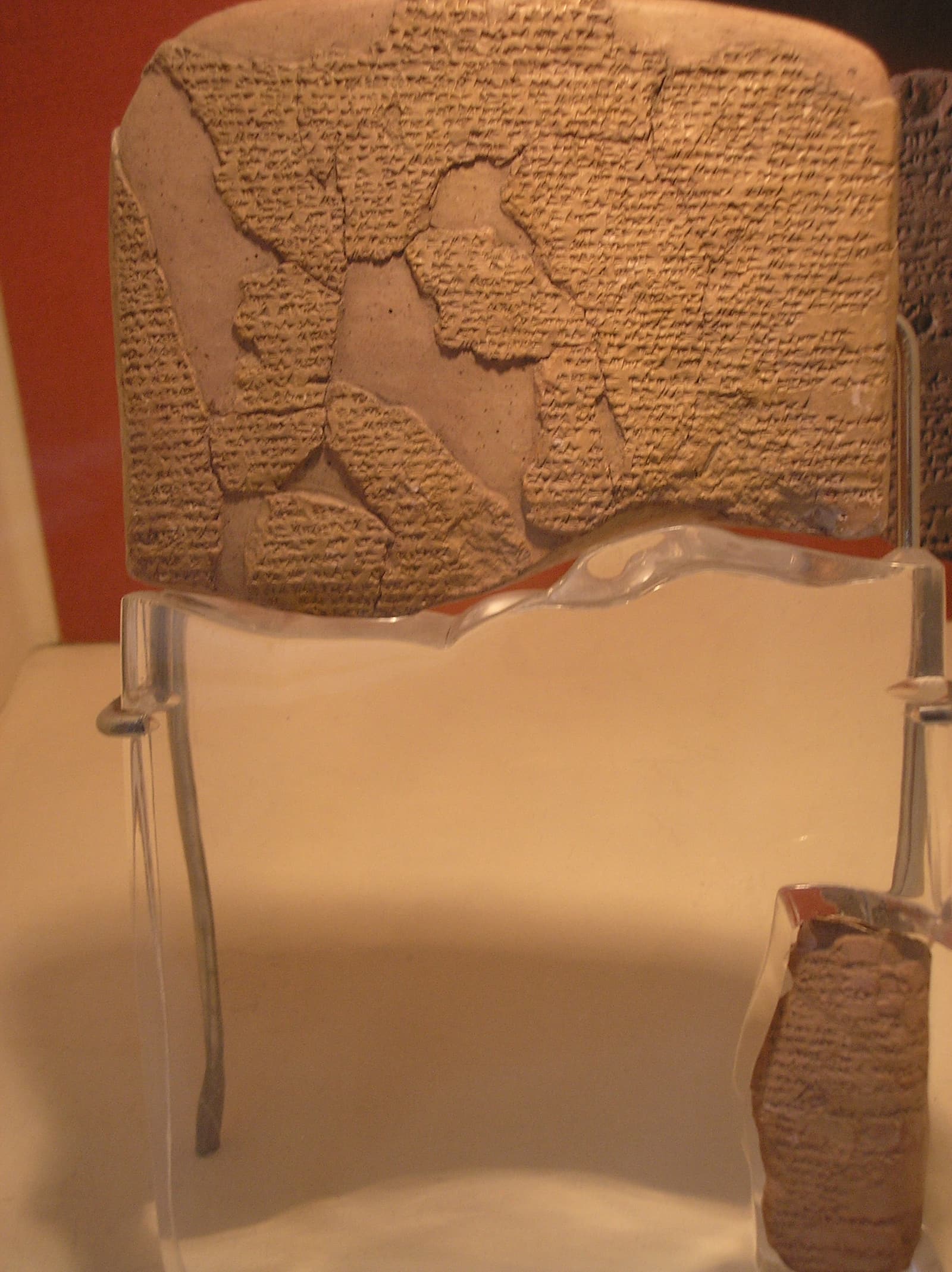
The Egyptian-Hittite treaty after Kadesh is often introduced as the first great peace treaty. That label is useful, but it can make the document sound gentler than it is. Read closely, the treaty is not a hymn to peace for its own sake. It is a hard diplomatic device that turns two exhausted great powers into "brothers" because brotherhood was the language that could make restraint, aid, extradition, succession politics, and divine punishment feel binding.
The background was not sentimental. In 1274 BCE, Ramesses II marched toward Kadesh in Syria and met the Hittite forces of Muwatalli II in a battle that Egyptian monumental language later inflated into triumph, even though the military result did not deliver Egypt's main objective.[6] Years later, in Ramesses's twenty-first regnal year, the treaty was set down in the diplomatic language of the Late Bronze Age. The Hittite text survived on clay tablets found at Hattusa; the Egyptian version was carved at Karnak and the Ramesseum; the lost formal exchange was remembered as silver tablets carried between courts.[2][3][4][5]
That material history matters. The treaty did not live as one neutral modern text. It circulated through versions, translations, media, and political audiences. The photograph above shows the point at once: a damaged cuneiform tablet in a museum case, not an abstract idea of peace. The object reminds us that diplomacy had to be made portable, legible, and authoritative before it could be remembered.[1][2]
Peace Begins By Flattening Rank
The first striking feature is the treaty's insistence on parity. Ramesses and Hattusili are not described as a victor and a defeated king signing terms after surrender. They are "great king" facing "great king," each addressed as brother. The language of "good peace" and "good brotherhood" is repeated because the repetition is doing political work.[3][4][5]
This is not empty politeness. In the Late Bronze Age royal world, "brother" was a rank term as much as an emotional one. It placed Egypt and Hatti in a narrow club of powers that could recognize each other without one becoming the other's vassal. The treaty's first move, then, is to solve a status problem. Ramesses could accept peace without sounding subordinate. Hattusili could obtain recognition without appearing to ask for mercy.
The Egyptian version makes that balance less smooth. Langdon and Gardiner noted that the Egyptian framing uses courtly formulas that make the Hittite ruler appear to have sent a tablet to seek peace from pharaoh; they also warn that this formula can mislead readers about the treaty's real character.[4] That is the first close-reading boundary. The treaty is symmetrical in obligation, but not symmetrical in presentation. Each court needed the agreement to look honorable at home.
Nonaggression Is The Center, Not The Whole
The core promise is simple: neither side will attack the other's land to seize territory.[3][5] That clause matters because it converts the unresolved Kadesh problem into a rule of restraint. The treaty does not need to narrate the battle in detail. It needs to prevent another cycle of Syrian campaigning from becoming the normal way each king proves strength.
But the treaty is not only a nonaggression pact. It also turns peace into military cooperation. If an outside enemy attacks Hatti, Egypt is to help; if an outside enemy attacks Egypt, Hatti is to help.[3][5] The same logic extends inward, where rebellion or internal disorder can trigger a request for support. This is why calling the text merely a peace treaty understates it. It is also an alliance.
That dual structure explains why "brotherhood" is stronger than it first appears. A brother does not simply refrain from stabbing you. A brother answers when summoned. The treaty turns the old rival into a reserve of legitimacy and force. The two kingdoms are not merged, and no modern collective-security system is born. But the document makes one important move: it defines peace as an active relationship, not only the absence of chariot war.
Hattusili Needed Recognition As Much As Ramesses Needed Quiet
The treaty's politics sharpen around Hattusili III. He had not come to power as an uncomplicated heir. He had displaced Urhi-Teshub, the legitimate successor in the earlier line, and that made recognition by another great king especially valuable.[5] A treaty with Egypt could do more than end pressure on Syria. It could help make Hattusili's throne sound settled.
That is why the succession language is so revealing. The Hittite side uses the agreement to press Ramesses toward accepting Hattusili's line and supporting his successor if internal opposition threatened it.[5] This is not a decorative clause. It shows a king using international diplomacy to stabilize domestic legitimacy.
For Ramesses, the bargain had a different use. After Kadesh, Egyptian monumental culture could keep presenting pharaoh as heroic, but repeated war in Syria had limits.[6] A treaty let Egypt preserve prestige while reducing the cost of inconclusive campaigns. Peace, in this reading, is not a sudden moral conversion. It is a way for both courts to transform an unwinnable rivalry into usable stability.
The treaty therefore works because it gives each side a different victory. Hattusili gets recognition and succession support. Ramesses gets a relationship he can display as pharaonic authority rather than retreat. Both get a rule against territorial raids and a partner against third-party threats.[3][4][5]
Refugees Make The Agreement Personal
The refugee and extradition clauses are easy to skim because they look administrative. They are among the treaty's most human sections. The agreement requires fugitives, high-ranking or ordinary, to be returned across the border rather than absorbed as useful defectors.[3] That provision protects kings from losing people, information, and political rivals into the other court's shelter.
Yet the same clauses also include a restraint on punishment. Returned people are not supposed to have their households destroyed or their bodies mutilated.[3] In a document built around kings, gods, armies, and dynastic lines, this detail matters. The treaty knows that interstate trust collapses if extradition is only a disguised death sentence. Return has to be made safe enough to be repeatable.
This does not make the treaty a modern asylum instrument. The individual is still caught inside royal security. But the clause shows a sophisticated mechanism: a border can be policed by return, and return can be stabilized by an amnesty promise. Peace reaches down from royal brotherhood into the management of actual bodies crossing actual frontiers.
The Gods Are The Enforcement System
The treaty's final force comes from witnesses and sanctions. The great gods of Egypt and Hatti, along with cosmic and natural witnesses, are invoked to bless obedience and punish violation.[3][4] In modern treaty language, enforcement often means institutions, courts, sanctions, or military costs. Here, divine witness supplies the ultimate enforcement horizon.
That does not mean the clause is only religious atmosphere. It is juridical theater. The gods make the oath public beyond the two kings. They turn breach into sacrilege as well as policy failure. In a world without a superior international court, the treaty ties political risk to sacred consequence.
The physical tablets helped complete that theater. Turkish Museums notes that the treaty was associated with silver tablets and that clay copies were found at Hattusa, while another version appeared in Egyptian temple walls.[2] The media are part of the argument. Silver, clay, and temple stone each carry authority differently. A portable tablet can be exchanged. A temple inscription can proclaim royal memory. A clay archive can preserve a court's diplomatic record.
Why The Treaty Still Reads Modern
The Egyptian-Hittite treaty endures because it is old and still recognizable. It does several things that later diplomacy keeps doing: it names equal parties, converts rivalry into formula, separates public prestige from practical compromise, stabilizes succession concerns, manages refugees, promises mutual aid, and creates an enforcement story larger than either ruler.[3][4][5]
Its limits are just as important. Korea, Manchuria, or Versailles are not hiding in this Bronze Age document; it belongs to a world of palace states, divine oaths, dynastic succession, and chariot-age strategy. It does not create popular consent, universal law, or permanent peace. It speaks for kings and through kings.
But that is precisely why the close reading is useful. The treaty's most durable achievement is not that it made ancient rulers kind. It made restraint honorable. By calling two rivals brothers, it gave them a language in which not attacking could sound royal, helping could sound obligatory, returning fugitives could sound orderly, and keeping the oath could sound cosmically supervised.
That is the treaty's real historical force. It did not erase conflict from the Late Bronze Age. It changed what two powerful courts could say about conflict after they had learned that victory was too expensive and too incomplete. Peace became a document, a performance, a promise, and a tablet that could travel.
Sources
- Wikimedia Commons, "File:Kadesh.jpg" - source page for the photograph of the treaty tablet at the Istanbul Museum of Archaeology used as the article image.
- Turkish Museums, "Do You Know World's First International Peace Treaty?" - museum overview of the Kadesh Peace Treaty, silver-tablet tradition, clay copies from Hattusa, and Istanbul Archaeology Museums context.
- Internet Archive, Ancient Near Eastern Texts Relating to the Old Testament, "Treaty between the Hittites and Egypt" and "Treaty between Hattusilis and Ramses II" - translated Egyptian and Hittite treaty texts and editorial notes.
- OpenAIRE record for Stephen Langdon and Alan H. Gardiner, "The Treaty of Alliance between Hattusili, King of the Hittites, and the Pharaoh Ramesses II of Egypt," The Journal of Egyptian Archaeology 6 (1920) - DOI and publication metadata for the comparative study of the Egyptian and Hittite-Babylonian texts.
- Biblical Archaeology Society Library, ""Good Peace": The Hittite-Egyptian Treaty" - explanation of the Akkadian treaty copies, exchanged versions, mutual aid clauses, and Hattusili's succession politics.
- American Research Center in Egypt, "The Battle of Kadesh" - lecture page summarizing the 1274 BCE battle background, Egyptian claims of victory, Hittite military position, and modern debate over outcome.