The missing boat matters. When men from the Dei Gratia boarded the deserted Mary Celeste in early December 1872, the small boat normally carried over her main hatch was gone.[7] So were the ship's papers and Captain Benjamin Briggs's navigational instruments. Those absences suggested an abandonment, however difficult its cause remained to explain.[1]
In Arthur Conan Doyle's 1884 story “J. Habakuk Jephson's Statement,” the boats are still aboard. His fictional newspaper report declares: “The boats were intact and slung upon the davits.” It is a small sentence with a large consequence. Remove the missing boat from the evidence, and the reader must imagine a disappearance without the most obvious means of departure.[2]
That change offers a way into the enduring mystery: ask first which ship a story describes. The historical Mary Celeste and Doyle's invented Marie Celeste carry different evidence.
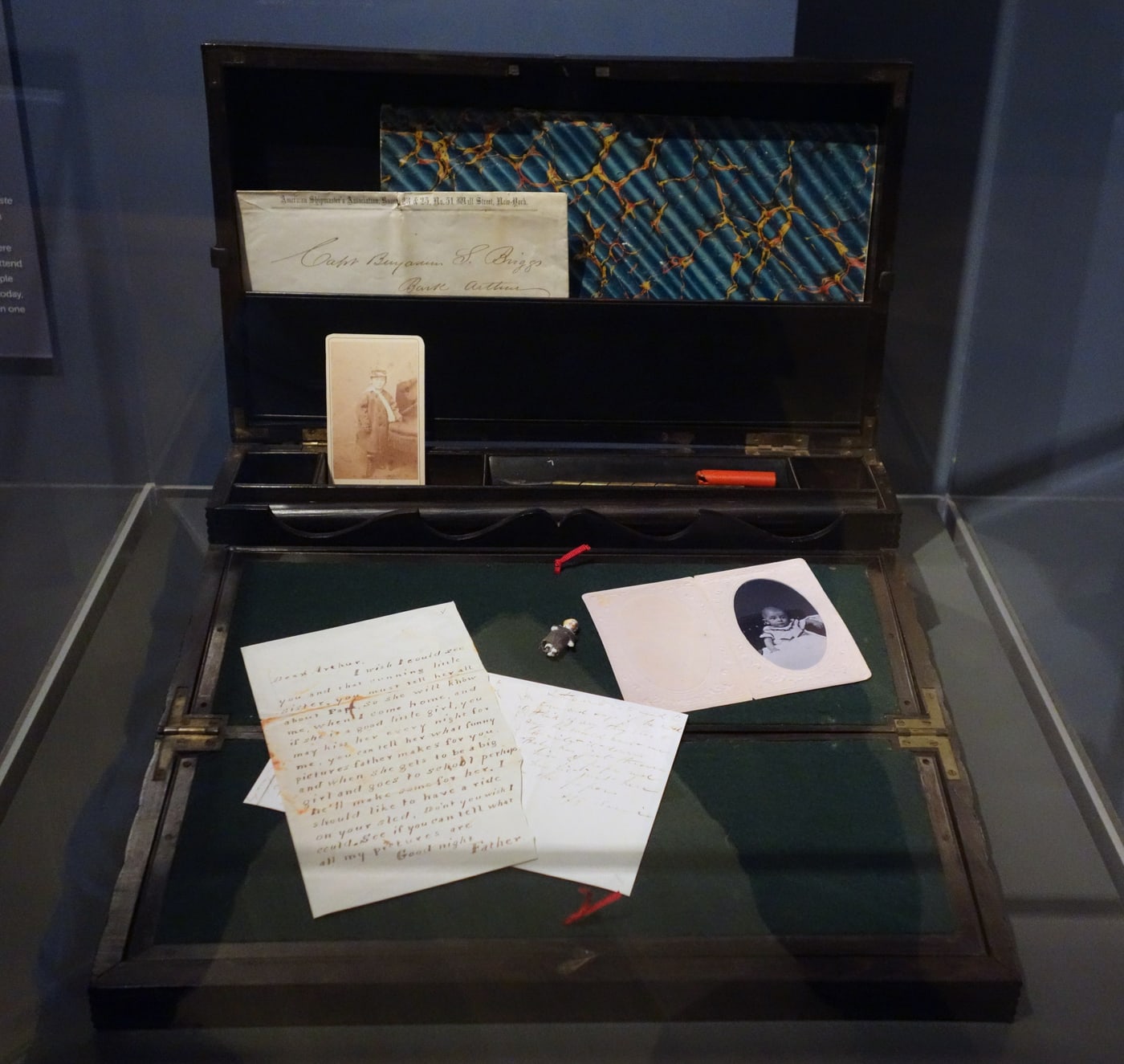
What the boarding party could see
The real voyage began at New York on 7 November 1872, bound for Genoa. Briggs traveled with his wife Sarah, their young daughter Sophia, and seven crewmen. The cargo was approximately 1,700 barrels of alcohol. The last recorded log-slate entry was for the morning of 25 November.[1]
Royal Museums Greenwich's reconstruction describes damaged sails and rigging, water inside the ship, and a partly dismantled pump. A sounding rod, used to measure liquid depth, lay on deck. Personal belongings remained. The rescuers found no obvious evidence of violence, and a small salvage crew eventually sailed the vessel to Gibraltar.[1]
This was enough to establish a troubling discrepancy: the people were gone, yet the vessel remained navigable. It was insufficient to establish what the people had believed about their safety when they left. A ship's survival afterward cannot tell us exactly how its condition appeared to a captain earlier.
Suspicion was recorded before it was tested
The inquiry produced documents that are more revealing than an inventory of eerie objects. Surveyor John Austin examined the vessel at Gibraltar on 23 December 1872. His report repeatedly argued that intact fittings and dry belongings counted against the ship having endured exceptionally violent weather. He also described marks on the bows that he thought had been cut with a sharp instrument, and a sword whose blade appeared to have been smeared with blood and wiped.[4]
Those observations help explain why violence attracted official suspicion. They also show why a report must be read as an argument made by a particular observer. Austin inspected the ship after its passage to Gibraltar. His conclusions about earlier weather and the origin of marks went beyond simply recording their appearance.
Dr. J. Patron's subsequent report supplies a crucial check. He tested suspicious stains from the deck, rail and sword, using soaking, heating and microscopic examination. Despite initially finding the sword stains suggestive, he concluded that the tests did not establish blood.[5]
The source chain here is explicit: Austin's report is available online as a transcription taken from Charles Edey Fay's study, itself transcribed from a photostat; Patron's report is reproduced on the same specialist history site.[4][5] These are readable documentary texts, not a claim to have inspected the original case file.
Patron's negative result weakened a specific prop of the murder theory. It did not identify another cause of abandonment. That distinction disappears whenever a retelling keeps the suspicious sword but drops the examination that followed.
A survivor made out of print
Doyle supplied precisely what the historical investigation lacked: someone who could tell the whole story from inside the ship. His Jephson presents himself as a physician finally disclosing a terrible experience. The account opens with an apparent newspaper extract, moves through a journal, and ends with the survivor's explanation.[2]
The documentary manner makes the inventions unusually persuasive. A newspaper has supposedly questioned witnesses; the narrator offers professional credentials; dated entries seem to preserve events before their meaning was understood. Read as fiction, these are effective devices. Read as evidence, they manufacture a witness.
The alterations are extensive. Doyle moves the episode into 1873, substitutes a Boston-to-Lisbon voyage, renames the captain Tibbs, and loads the ship with tallow and American clocks. His plot turns on a murderous conspiracy, a racialized revenge fantasy built around an invented passenger. None of that is testimony about Briggs and his company.[2]
Most consequentially for the puzzle, the boats remain hanging from their davits. The practical possibility suggested by a missing boat has been written away. Royal Museums Greenwich identifies the tale as a major source of confusion, including the persistent spelling Marie.[1]
Doyle's story is therefore valuable historical evidence of another kind: it lets us watch a maritime uncertainty being rebuilt into a solvable narrative. Its authority belongs to the history of the legend.
The explanation still missing
Two substantial ways of explaining an emergency departure remain in discussion. The alcohol cargo has encouraged theories that escaping vapors, or fear of an explosion, drove everyone into the boat. A different reconstruction, developed by documentarian Anne MacGregor and oceanographer Phil Richardson and reported by Smithsonian in 2007, emphasizes rough weather, navigational uncertainty and possible pump obstruction by coal dust or refitting debris.[6]
The latter proposal tries to explain why Briggs might have feared flooding even though the ship stayed afloat. MacGregor also challenged the explosion scenario: her reading of the discovery evidence included a secured main hatch and no reported smell of fumes. These are competing interpretations of incomplete evidence; the pump blockage and the captain's response remain hypotheses.[6]
Evidence capable of changing that assessment would have to discriminate between the explanations: a reliable contemporary observation of fumes or an explosion, for example, or documentation establishing the pump's condition when the decision was made. Showing that a sequence is possible does not establish that these people experienced it.
The missing boat gives the historical problem a shape. It supports departure from the ship without revealing the reason, the intended destination, or what happened afterward. Restoring that clue makes the mystery more precise. Briggs's company still deserves an explanation; an invented survivor cannot provide one.
Sources
- Andrew Choong Han Lin, “The mystery of the Mary Celeste.” Royal Museums Greenwich — voyage, discovery, salvage and fictional afterlife.
- Arthur Conan Doyle, “J. Habakuk Jephson's Statement,” first published in The Cornhill Magazine, January 1884; text in The Captain of the Polestar, and Other Tales, Project Gutenberg — especially the opening fictional newspaper report.
- Crawdad Blues, “Lap desk of Captain Benjamin Briggs from the Mary Celeste (PEM M6557) 01.” Wikimedia Commons — photograph, attribution and notice that some displayed personal items are reproductions.
- John Austin, survey report describing his inspection of 23 December 1872, reproduced from Charles Edey Fay's transcription. The Mary Celeste — Facts not Fiction, especially paragraphs 1–4 and 44.
- J. Patron, report on suspected bloodstains, Gibraltar, January 1873. Transcription at The Mary Celeste — Facts not Fiction — examination of deck, rail and sword samples and negative conclusion.
- Jess Blumberg, “Abandoned Ship: The Mary Celeste.” Smithsonian, November 2007 — Anne MacGregor and Phil Richardson's reconstruction and its evidentiary limits.
- Charles Edey Fay, “Common Errors and Misconceptions,” excerpted from his 1942 Peabody Museum study. The Mary Celeste — Facts not Fiction — item 2 identifies court testimony, consular correspondence and insurance records supporting the missing boat.