The Lincoln Memorial can look timeless enough to hide its own history. A seated marble Lincoln, Greek columns, two engraved speeches, and a long set of steps facing the Reflecting Pool make the place feel as if its public meaning arrived fully formed in stone.[1][5] Yet the memorial's historical force was built in stages. The dedication in 1922 presented it as a shrine to reunion and national healing, but it did so inside a segregated civic order.[1] Marian Anderson's Easter Sunday concert in 1939 changed that balance by turning the steps into a federal answer to racial exclusion.[3][5] The March on Washington in 1963 made the shift unmistakable: the memorial became a national platform where Black citizenship claims could be voiced before the entire country.[4][5]
That sequence is what makes the site so important in memory-and-commemoration history. The Lincoln Memorial did not simply preserve Abraham Lincoln's words. It kept acquiring new meanings as different publics occupied its architecture.[1][3][4][5] The key historical question is therefore not only why the memorial was built, but how the uses of its steps changed what the monument stood for.
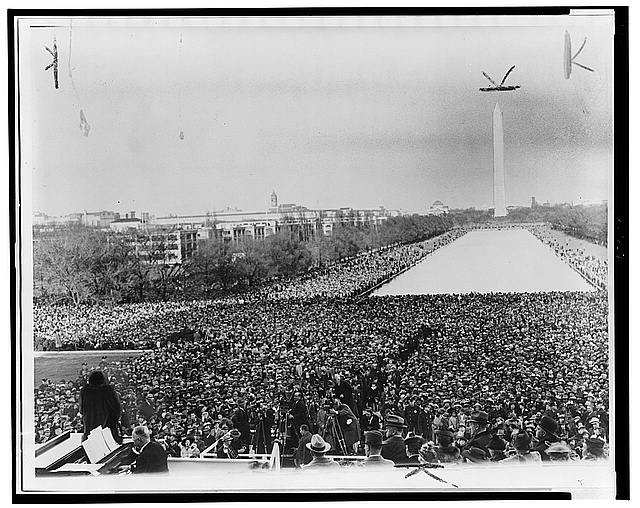
Image context: the cover uses the Library of Congress photograph of Marian Anderson at the Lincoln Memorial in 1939.[2] It is the right image for this article because it catches the memorial at the hinge point of its public life. The building is still the same marble structure dedicated in 1922, but the crowd, the open-air setting, and Anderson's placement on the steps show that the site had already begun to function as a civic stage rather than only a commemorative chamber.
Timeline anchors
- May 30, 1922: the Lincoln Memorial is dedicated before a crowd of more than 50,000, with Black attendees seated in a separate section and Robert Moton addressing the contradiction directly.[1]
- April 9, 1939: after the Daughters of the American Revolution bars Marian Anderson from Constitution Hall, she performs an Easter Sunday concert at the memorial before an integrated crowd of about 75,000 people, with far more listening by radio.[2][3][5]
- August 28, 1963: more than 250,000 demonstrators gather for the March on Washington for Jobs and Freedom, ending in a three-hour program at the Lincoln Memorial where Martin Luther King Jr. delivers "I Have a Dream" and Marian Anderson leads the National Anthem.[4]
These dates matter because they show the memorial moving through three different public scripts: reunion, protest-backed inclusion, and mass democratic petition.
In 1922, the memorial staged reunion more easily than equality
The National Park Service account of the dedication is striking because it makes both sides of the ceremony visible at once.[1] The building was conceived as a monumental act of national reunification, a temple meant to honor Lincoln while symbolizing the restoration of the Union after the Civil War.[1] Former president and Chief Justice William Howard Taft participated, President Warren G. Harding accepted the memorial, and the audience included Civil War veterans from both North and South.[1] Broadcast by radio to a national audience, the ceremony was designed to declare that the republic had repaired its sectional fracture.[1]
Yet the dedication also exposed the limits of that reconciliation. Robert Moton, the president of Tuskegee Institute, delivered the main address while Black attendees were seated in a separate section.[1] The memorial was therefore born with a split meaning. It honored the president of emancipation while the event around it still obeyed segregation. That contradiction is essential to the memorial's later history. If the site had already embodied full democratic inclusion in 1922, the later appropriations of its steps would not have carried such force.
This is why the dedication belongs in a memory history rather than in a purely architectural account. The memorial was not a neutral shell waiting to be discovered. It was launched with a powerful but incomplete civic script. Lincoln could be invoked as a figure of unity before the nation had decided how fully that unity extended to Black Americans in public life.[1]
Anderson changed the memorial by turning exclusion into a public audience
Marian Anderson's 1939 concert altered the memorial's meaning because it moved a discrimination dispute from a private auditorium to federal open space.[3][5] The Franklin D. Roosevelt historic-site account traces the sequence clearly. Constitution Hall, owned by the Daughters of the American Revolution, barred Black performers from its stage; after public protest and intervention from Harold Ickes and the Roosevelt circle, Anderson instead sang at the Lincoln Memorial on Easter Sunday.[3] The crowd was integrated, the audience reached roughly 75,000, and the performance was broadcast beyond the Mall.[3]
That change of venue mattered as much as the concert itself. Constitution Hall was a controlled interior. The Lincoln Memorial steps were visible, national, and symbolically loaded.[3][5] Once Anderson stood there facing the Washington Monument and the long stretch of the Mall, the site ceased to be only a monument to completed reunion. It became a place where the federal landscape could be used to answer exclusion in the capital itself.[2][3][5]
The photograph used here shows why this moment stays central to the memorial's afterlife.[2] Anderson is small in the frame; the crowd is vast. The image does not present the singer as an isolated genius framed by marble. It presents the memorial as an amplifier. The steps convert a denied indoor recital into a public claim on national space. In that sense, commemoration changed direction. People were no longer only coming to the memorial to remember Lincoln. They were using Lincoln's memorial to press the country closer to the equality his image promised.
In 1963, the steps became a national platform, not only a monument base
The March on Washington fixed this transformation at mass scale.[4][5] The National Archives page for the official program matters because it keeps the event tied to sequence rather than legend. The march began with a rally at the Washington Monument, moved down the Mall, and ended in a three-hour Lincoln Memorial program before more than 250,000 people.[4] That framing matters. The memorial was not merely a backdrop for one speech. It was the destination point of a coordinated democratic petition.
The program itself reveals how thoroughly the site's meaning had shifted.[4] Marian Anderson, whose 1939 concert had already altered the memorial's public role, returned to lead the National Anthem.[4] Martin Luther King Jr.'s speech then used the memorial's symbolic charge without treating it as frozen stone. The steps became a platform from which civil rights leaders could speak to Congress, the presidency, television audiences, and the nation at once.[4][5]
The National Park Service's steps page compresses the longer lesson into one architectural fact: these broad steps have become a stage for American history.[5] That is the right emphasis. A monument chamber can preserve inscription and sculpture; a staircase can hold bodies in motion, crowds, processions, and acts of address. The Lincoln Memorial mattered in 1963 because its architecture could be occupied by a movement while still carrying the authority of Lincoln's name.
What commemoration changed
Seen across these three moments, the memorial's history is not a story of stable meaning but of civic reassignment.[1][3][4][5] In 1922, the site was presented as a national shrine whose strongest public theme was reunion, even as segregation framed the ceremony.[1] In 1939, Anderson's concert pulled the monument into a new role by making federal space answer a color line.[3] In 1963, the March on Washington made that role durable. The memorial's steps became one of the republic's most legible stages for petitions about citizenship, labor, and equality.[4][5]
That is why the Lincoln Memorial belongs in commemoration history rather than in static monument history. What changed the site was not only interpretation from above. It was repeated public occupation from below. People kept testing whether Lincoln's memorial could carry claims larger than its original dedication script, and each successful use widened the monument's meaning.[1][3][4][5]
The strongest conclusion is therefore narrow and concrete. The Lincoln Memorial became a civic stage by changing who could stand for Lincoln in public. A segregated dedication, an integrated Easter concert, and a quarter-million-person march mark the steps by which the monument moved from reconciliation theater toward democratic claim-making.[1][3][4][5]
Sources
- U.S. National Park Service, "The Dedication of the Lincoln Memorial" - on the 1922 ceremony, the crowd of more than 50,000, Moton's address, segregated seating, and the memorial's reunion theme.
- Library of Congress, "(Marian Anderson, (lower left), standing on the steps of the Lincoln Memorial with back to camera, facing the Washington Monument and a crowd of thousands)" - source page for the archival photograph used as this article's image.
- U.S. National Park Service, "Marian Anderson" - on Constitution Hall's exclusion policy, the April 9, 1939 Lincoln Memorial concert, and the integrated crowd of about 75,000.
- National Archives, "Official Program for the March on Washington (1963)" - on the August 28, 1963 march route, the three-hour Lincoln Memorial program, the crowd of more than 250,000, and Marian Anderson's role in the program.
- U.S. National Park Service, "Lincoln Memorial Steps" - on the steps as a stage for American history, especially Marian Anderson's 1939 concert and King's 1963 speech.