Executive Order 9981 is often remembered as if one presidential signature simply switched the U.S. military from segregation to integration on July 26, 1948.[3] That memory is too clean for the document itself. Read closely, the order does something more interesting and more limited. It announces a presidential policy of "equality of treatment and opportunity" in the armed services, tells the services to move "as rapidly as possible," and then creates a committee to examine rules and practices that stood in the way.[3][5] In other words, the text does not behave like a self-executing abolition decree. It behaves like a standards order backed by an implementation machine.
That distinction matters because the real history sits in the gap between declaration and compliance. The armed forces were not desegregated because one sentence floated above the services and instantly dissolved their racial arrangements. They changed because the order reversed the presumption under which they operated, the Fahy Committee interpreted that reversal aggressively, and the Korean War later exposed how wasteful the segregated Army's personnel system had become.[4][5][7] The sharpest reading, then, is narrow: Executive Order 9981 mattered because it made segregation answer to a new federal standard, not because it made resistance disappear overnight.
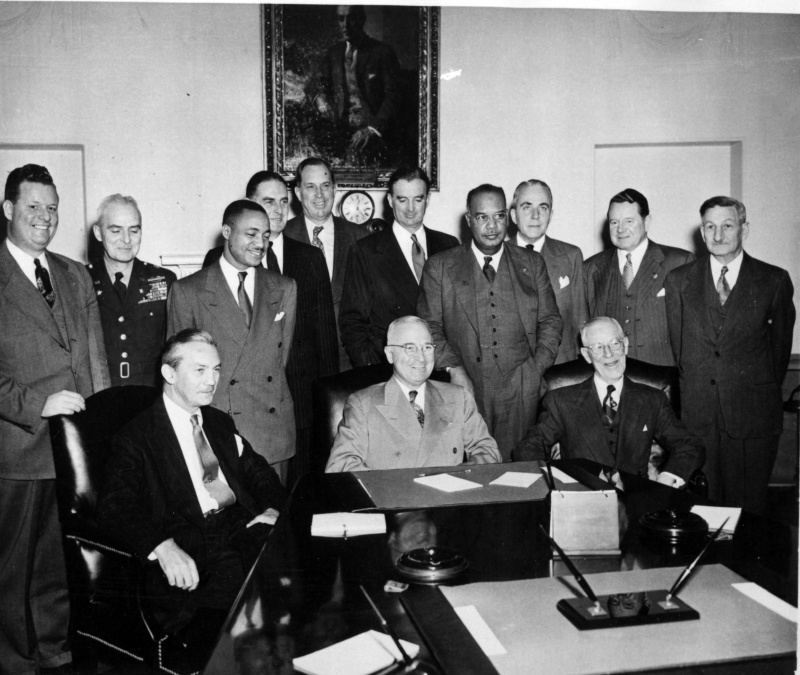
Image context: the cover uses the January 12, 1949 White House photograph of Truman with the President's Committee on Equality of Treatment and Opportunity in the Armed Services.[8] It is the right image for this article because the order's afterlife was administrative and argumentative. The story is not just Truman at a desk; it is the committee process that translated a policy sentence into pressure on Army, Navy, and Air Force procedures.
Timeline anchors
- October 29, 1947: the President's Committee on Civil Rights publishes To Secure These Rights, recommending explicit bans on discrimination and segregation in military recruitment, assignment, and training.[1]
- February 2, 1948: Truman's civil-rights message to Congress says he has instructed the Secretary of Defense to eliminate the remaining instances of discrimination in the armed services as rapidly as possible.[2][4]
- July 26, 1948: Truman signs Executive Order 9981, declaring a policy of equality of treatment and opportunity and creating the President's Committee on Equality of Treatment and Opportunity in the Armed Services.[3][4]
- January 12-13, 1949: Truman meets the new Fahy Committee and the committee begins hearings; the services reveal sharply different attitudes toward integration.[4][8]
- January 16, 1950: after months of committee pressure, the Army issues a policy for utilizing Black manpower without regard to race in qualified assignments to regular units.[5]
- Late 1950 to 1953: Korean War replacement needs accelerate practical integration, especially in the Army; by the end of the war most of the military is integrated in practice, though the final all-Black Army unit is not abolished until September 30, 1954.[3][7]
The prehistory matters because the order did not emerge from nowhere
The strongest clue sits before the order itself. To Secure These Rights, published in 1947, did not ask the federal government to admire equality in the abstract. It argued that discrimination in the armed forces was especially intolerable because people were being asked to risk death for a democracy that still denied them equal standing, and it recommended that discrimination and segregation be expressly banned in military recruitment, assignment, and training.[1] That is important because it gives Executive Order 9981 a concrete ancestry. The order did not invent the problem; it adopted and compressed an existing civil-rights argument into presidential language.
Truman's February 2, 1948 civil-rights message pushed the same issue toward executive action.[2][4] In that message he told Congress that he had already instructed the Secretary of Defense to eliminate the remaining instances of discrimination in the armed services as rapidly as possible.[2][4] The phrase "as rapidly as possible" appears again in the later order, which shows continuity rather than improvisation. Truman was already moving toward a standard that linked equality to executive responsibility before the July order was signed.[2][3]
That continuity helps explain why the order reads the way it does. It is not a philosophical essay. It is a short operational document written by a President acting as commander in chief after Congress had not supplied the broader civil-rights program he wanted.[2][3]
What the order says, and what it carefully leaves open
The National Archives transcript gives the core language in six brief sections.[3] Section 1 declares that "there shall be equality of treatment and opportunity for all persons in the armed services without regard to race, color, religion or national origin."[3] That line matters because it changes the official standard. No service can any longer defend racial separation as the default administrative posture once the President has announced equality as policy.
Yet the same section also says the policy shall be put into effect "as rapidly as possible," with "due regard" for the time required to make changes without impairing efficiency or morale.[3][5] That qualifier is where the fight moved. The order does not say, in direct terms, that every segregated unit is abolished on the spot. It leaves room for service secretaries and commanders to argue about pace, readiness, and what equality requires in practice.[3][4][5]
Section 2 and Section 3 reveal that Truman understood this problem.[3] He did not merely issue the principle and walk away. He created an advisory committee empowered to inspect rules, procedures, and practices and recommend changes necessary to carry out the order.[3] The order therefore contains its own admission that military segregation lived not only in sentiment but in paperwork, assignment systems, quotas, school access, promotion tracks, and unit structure.
The immediate reaction proved how consequential that ambiguity was. Truman Library chronology notes that on the very day the order was issued, Army staff officers told reporters anonymously that Executive Order 9981 did not specifically forbid segregation in the Army.[4] The next day, Army Chief of Staff Omar Bradley said desegregation would come only when it became fact in the rest of American society.[4] Those responses are historically useful because they show senior officials reading the same order and trying to narrow it. The order had changed the standard, but it had not yet won the interpretation.
The Fahy Committee turned a principle into pressure
This is where the committee became the real instrument of change. Truman's desegregation collection shows that when the committee first met him on January 12, 1949, he told them plainly, "I want the job done."[4] The next day hearings opened, and the services exposed their differences: the Navy and Air Force indicated movement toward integration, while the Army defended segregation much more stubbornly.[4]
The final report, Freedom to Serve, is revealing because it explains the committee's self-understanding.[5] The members wrote that the problem was not merely one of simple justice. It was also one of military efficiency.[5] That formulation mattered enormously. It prevented opponents from monopolizing the language of readiness. Instead of accepting the claim that equality endangered efficiency, the committee argued that inequality had itself contributed to inefficiency.[5]
That argument let the committee attack the Army where it was most vulnerable: personnel administration. The Truman Library's record guide for the Fahy Committee shows the body was built to examine regulations, collect evidence, and pressure the services toward policy revisions rather than merely issue moral appeals.[6] In Freedom to Serve, that pressure becomes visible in the Army section. After consultation with the committee, the Army's January 16, 1950 policy declared that qualified Black personnel would be assigned to any regular unit without regard to race or color, and a March 27, 1950 message opened enlistments within overall quotas without regard to race.[5] Those are administrative moves, not rhetorical gestures. They mattered because they began breaking the machinery that kept Black manpower sorted into separate channels.
The contrast with earlier Army resistance is stark. The Truman chronology records Army Secretary Kenneth Royall telling the committee in March 1949 that the Army "was not an instrument for social evolution."[4] The committee's answer, in effect, was to stop treating the question as optional social reform and to recast it as a problem of how a modern military should use people, schools, specialties, and replacements.[4][5]
Korea did not replace the order; it proved why the order had to win
The final step in the story came from war. The order established policy. The committee translated policy into administrative demands. The Korean War then tested whether a segregated personnel system was compatible with combat needs.[3][5][7]
The Army's own anniversary account is blunt on this point. Integration in the Army accelerated during the Korean War as commanders in Eighth Army filled losses in white units with Black replacements arriving in Japan, a practical move that undercut the segregated structure from inside.[7] The National Archives summary makes the same larger point more concisely: there was substantial resistance after 1948, but by the end of the Korean conflict almost all of the military was integrated.[3]
This is the right boundary to keep in view. Korea did not mean the order had been irrelevant. It meant the order had changed what counted as the legitimate answer once war exposed the waste of maintaining separate channels.[3][5][7] A segregated system could no longer present itself as normal administration once the President's policy, the Fahy Committee's recommendations, and battlefield manpower needs all pointed in the opposite direction. Formal cleanup still took time, which is why the Army notes that the last all-Black unit was not abolished until September 30, 1954.[7] But by then the presumption had decisively shifted.
The bounded conclusion
Executive Order 9981 deserves to be remembered as a powerful but incomplete document.[3][5] Its force did not lie in magic words that automatically erased segregation on July 26, 1948. Its force lay in three linked moves: it announced equality as presidential policy, created a committee empowered to attack discriminatory rules and practices, and supplied a standard by which later resistance could be judged inadequate.[3][4][5][6]
That is why a close reading helps. The order's most important phrase was not a total program by itself. "Equality of treatment and opportunity" had to be argued into school quotas, assignment rules, enlistment policy, and unit manning.[3][5] The Fahy Committee did that work, and the Korean War made delay harder to defend.[4][5][7] Executive Order 9981 changed American military history not because it finished the job in one stroke, but because it made unfinished segregation answer to a federal rule it could no longer honestly satisfy.
Sources
- Harry S. Truman Library & Museum, To Secure These Rights - 1947 civil-rights report recommending explicit bans on discrimination and segregation in military recruitment, assignment, and training.
- Harry S. Truman Library & Museum, "Special Message to the Congress on Civil Rights" - Truman's February 2, 1948 message linking civil-rights policy to action against discrimination in the armed services.
- U.S. National Archives, "Executive Order 9981: Desegregation of the Armed Forces (1948)" - transcript and background for the order's text, committee creation, and later integration outcome.
- Harry S. Truman Library & Museum, "Desegregation of the Armed Forces" - chronology covering the order, immediate Army reactions, Fahy Committee hearings, and service-level policy conflict.
- Harry S. Truman Library & Museum, Freedom to Serve - the Fahy Committee's May 22, 1950 final report, including its reading of EO 9981 and the Army's January and March 1950 policy changes.
- Harry S. Truman Library & Museum, "Records of the President's Committee on Equality of Treatment and Opportunity in the Armed Services" - scope and function of the Fahy Committee's records and mission.
- U.S. Army, "Army commemorates 60th anniversary of Armed Forces Integration" - official Army summary of Korean War integration pressures and the abolition of the last all-Black unit in 1954.
- Harry S. Truman Library & Museum, "President's Committee on Equality of Treatment and Opportunity in the Armed Services" - source page for the January 12, 1949 White House photograph used as this article's image.