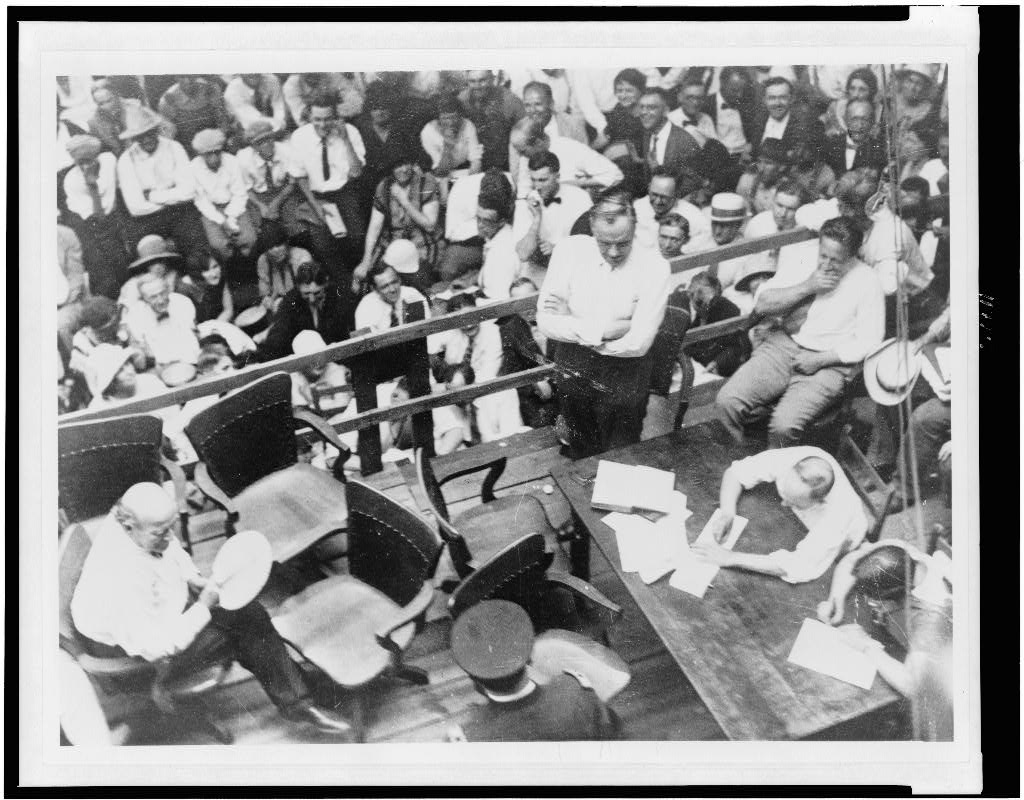
The Scopes trial is often remembered in one of two flattened ways. In the first version, Dayton becomes the place where modern science publicly humiliated religious provincialism once and for all. In the second, the whole affair shrinks into a civic publicity stunt, a made-for-newspapers performance in which no one really doubted the ending and little of substance was at risk.[1][2][5] Both versions keep one important fact in view, then lose the rest. The case was indeed engineered as a test, yet the law under test was real, the conviction was real, and the educational chill that followed was real as well.[2][3]
That combination is what makes Scopes worth reading in myth-vs-evidence mode. Evidence shows that Dayton business leaders wanted attention, that the ACLU wanted a constitutional vehicle, and that John Scopes agreed to serve as defendant in a case built for appeal.[1][2][5] Evidence also shows that the courtroom itself never became the clean science-versus-theology forum later memory prefers. Judge John T. Raulston sharply limited expert scientific testimony, the jury returned a guilty verdict in under ten minutes, and the Tennessee Supreme Court later reversed only because the judge, rather than the jury, imposed the $100 fine.[1][3] The Butler Act survived that reversal.[3]
The cover photograph helps hold those two truths together. It shows Clarence Darrow and William Jennings Bryan in the outdoor proceedings of July 20, 1925, when heat and crowding pushed the court outside.[1][6] The image records a spectacle, but not an empty one. The scene is theatrical because the case had become national theater; it is historically consequential because the theater was built around a live state power over curriculum.[1][3]
Timeline anchors
- March 1925: Tennessee passes the Butler Act, barring the teaching of human evolution in the state's public schools.[2][3]
- May 4-5, 1925: the ACLU advertises for a Tennessee teacher willing to challenge the new law, and Dayton organizers move quickly to turn John Scopes into that defendant.[1][2][5]
- July 10-21, 1925: the trial runs in Dayton, growing into a radio-broadcast media spectacle; on July 20 the proceedings move outdoors and Darrow questions Bryan from the witness chair.[1][2][3][6]
- January 1927: the Tennessee Supreme Court reverses Scopes's conviction on a technicality while leaving the Butler Act intact.[3]
- 1967: Tennessee finally repeals the Butler Act.[1][3]
1) The case was arranged on purpose
The evidence for staging is unusually direct. The Library of Congress summary for May 5 says several Dayton residents deliberately worked up a prosecution because they thought a trial would bring publicity and commerce to a struggling town.[1] The ACLU source confirms the other side of the arrangement: once Tennessee enacted the Butler Act, the organization openly offered to defend any teacher willing to serve as a test case.[2] Smithsonian reporting adds a detail later heroic retellings often smooth away: Scopes himself did not clearly remember teaching evolution in the strong, martyr-like sense later legend assigned to him, though he did regard the law as unjust and agreed to stand trial.[5]
That matters because it keeps us from mistaking theatrical origin for historical emptiness. A staged case can still become a real constitutional and cultural event. Dayton's organizers wanted hotel rooms filled, restaurant tables occupied, and reporters in town.[1][5] The ACLU wanted a case that could travel upward on appeal.[2] Those motives do not cancel the seriousness of the law; they explain why this particular law reached a courtroom so quickly and so visibly.
The publicity side also helps explain the strange tonal mixture that surrounded the trial. By the time proceedings opened on July 10, 1925, the town had become a temporary carnival of banners, vendors, journalists, ministers, and tourists.[2][5] Radio carried the case live, an innovation the ACLU notes gave it an audience unlike any earlier American courtroom battle.[2] The atmosphere made later generations treat Scopes as pure show business. Yet a show built around a criminal prosecution remains a prosecution. The defendant still faced conviction under an enforceable statute, and school systems across the region were watching to see how aggressively the state would defend its curricular authority.[3]
2) The courtroom never cleanly staged "science versus religion"
This is the second major distortion. Popular memory, especially memory filtered through later dramatizations, imagines the trial as a sustained intellectual contest over whether evolutionary science or biblical creation would govern public truth.[3] The evidence says the legal frame was narrower and more awkward. The Tennessee Encyclopedia notes that Judge Raulston largely blocked expert testimony on the scientific status of evolution and on whether evolution and religion could coexist.[3] The prosecution concentrated on the elementary point that Scopes had violated the statute. The defense wanted a larger constitutional stage and could not fully get it inside the trial itself.[2][3]
That narrowing is why the famous Darrow-Bryan confrontation on July 20 matters so much. Once the judge closed off a broader evidentiary route, Darrow's questioning of Bryan became the most visible way to shift the trial from statutory violation toward cultural argument.[3] In that outdoor session, the legal issue and the symbolic issue briefly occupied the same space. Darrow's questioning damaged Bryan's authority in the eyes of many national observers, but it did not erase the governing fact that the jury was still deciding a statutory violation under Tennessee law.[1][3][6]
The transcript record makes the closing sequence clearer than later myth usually allows. The trial ends in a strikingly compressed way: a short final phase, a rapid guilty verdict, and even a prayer as the court adjourns.[4] This was never a long scientific inquiry that reached a reasoned verdict on evolution's truth. It was a criminal case whose most famous intellectual exchange occurred partly because the formal legal path had already narrowed.
3) The guilty verdict and the reversal point in different directions
The evidence is clearest when it comes to the legal outcome. Scopes was convicted, and the fine was set at $100.[1][2][3] That fact alone complicates the easy story of modern science simply winning in Dayton. If one reads only the courtroom result from July 21, 1925, the state law worked. The prosecution did not need to prove Bryan's worldview in full. It only needed a court willing to enforce the Butler Act against a teacher who had agreed to become the test defendant.[2][3]
The later reversal complicates the opposite myth, the one that treats the trial as an uncomplicated fundamentalist triumph. In January 1927, the Tennessee Supreme Court threw out the conviction because the state constitution required a jury, not the judge, to levy a fine above fifty dollars.[3] But the same court left the Butler Act standing. The law's constitutionality survived, while the particular conviction did not.[3] That is a much narrower victory than the science-triumph legend prefers and a much narrower defeat than the anti-modern crusade desired.
This split outcome is one reason Scopes stayed culturally alive. The case delivered symbolic embarrassment to Bryan's camp in the national press and still left anti-evolution law on the books.[2][3][5] Myth prefers a single winner. Evidence gives a divided result: legal endurance for the statute, reputational damage for some of its most famous defenders, and no final constitutional settlement on the merits in 1925 or 1927.[3]
4) The afterlife shows why the stakes were real
If the trial were only a prank inflated by reporters, its effects would have faded with the tents and microphones. The record shows something more durable. Tennessee Encyclopedia notes that anti-evolution measures spread beyond Tennessee in the following years, while textbook publishers and teachers pulled back from the subject even where no formal ban existed.[3] Smithsonian's account likewise emphasizes that references to evolution were cut back for decades, not because the trial had settled the science, but because it had shown how politically exposed the topic had become.[5]
This is the strongest evidence against the "mere stunt" reading. A case can be contrived in origin and still alter institutional behavior. Dayton's businessmen could not control the full consequences of the attention they sought.[1][5] They won publicity, but Tennessee also became internationally associated with a courtroom fight over whether a public-school teacher could discuss human evolution.[1][3] The Butler Act remained in force until 1967, long after the carnival details had become period color.[1][3]
The media afterlife mattered too. The Library of Congress and ACLU both stress how enormous the trial's press reach became.[1][2] Once that happened, Scopes no longer belonged only to Dayton or to Tennessee law. It became a repeatable national shorthand for conflicts over schools, expertise, religion, and state power. That shorthand is useful, but it also tempts readers into choosing between two lazy simplifications: all theater or all enlightenment. The record supports neither.
The bounded conclusion
The safest conclusion is also the most interesting one. The Scopes trial was staged in the narrow sense that a willing defendant, civic boosters, and civil-liberties lawyers all helped create a case designed for publicity and appeal.[1][2][5] Yet the case was not therefore hollow. The Butler Act had coercive force, Scopes was convicted under it, the 1927 reversal was technical rather than sweeping, and the law's cultural effect reached well beyond Dayton's brief season as a carnival town.[1][3]
That is why Scopes still holds. It was a performance, a prosecution, and a policy signal at the same time. The outdoor courtroom photograph survives because it looks like a national argument in miniature.[6] The law behind the photograph survived because performance alone was never the whole story.[3]
Sources
- Library of Congress, "Today in History - May 5" - overview of Scopes's arrest, Dayton's publicity motive, the outdoor courtroom, the quick guilty verdict, and the law's 1967 repeal.
- American Civil Liberties Union, "ACLU History: The Scopes 'Monkey Trial'" - the ACLU defense offer, test-case framing, radio broadcast, defense strategy, and later technical reversal.
- George E. Webb, "The Scopes Trial." Tennessee Encyclopedia - the Butler Act issues, exclusion of expert testimony, Bryan's examination, the 1927 Tennessee Supreme Court ruling, and the trial's curricular afterlife.
- The Clarence Darrow Digital Collection, Scopes Trial (1925) PDF - transcript and documentary compilation covering the trial's closing sequence, adjournment, and immediate aftermath.
- Kimbra Cutlip, "The Scopes Trial Redefined Science Journalism and Shaped It to What It Is Today." Smithsonian Magazine - the Dayton business plot, Scopes's uncertain recollection, and the media/science-journalism dimension.
- Library of Congress, "Scopes trial lawyers" - source page for the archival courtroom photograph used as this article's cover image.