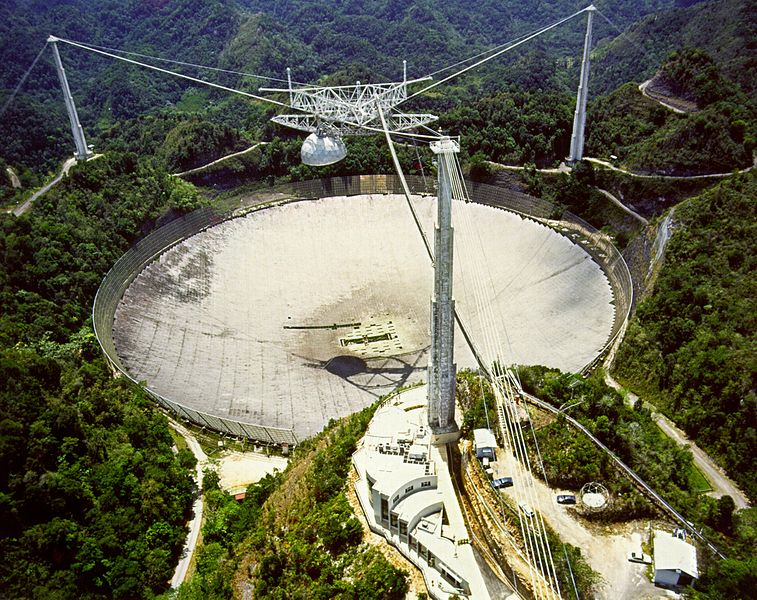
The Arecibo message is usually remembered as Earth's first postcard to aliens: 1,679 binary bits sent from Puerto Rico toward Messier 13 on November 16, 1974.[1] That description is true, but it puts the drama in the wrong place. The message mattered less because anyone expected a reply than because a rebuilt telescope, a public ceremony, and a cleverly compressed self-portrait made one fact undeniable: humans had learned to turn a planetary radar instrument into a beam that could carry intention beyond the solar system.
The causal chain is therefore not "scientists tried to chat with extraterrestrials." It is more precise: Arecibo's early-1970s upgrade created the technical capacity; the rededication created a stage; Frank Drake's binary design gave the stage a decipherable object; and later argument over active SETI turned the symbolic act into a governance problem.[2][3][4] The greeting was real. The demonstration was the mechanism.
The instrument came first
Arecibo opened in 1963 as a giant fixed spherical reflector built into Puerto Rico's karst landscape. Cornell's later historical summary stresses that it began under U.S. Air Force sponsorship for ionospheric radar work, then became a major radio and radar astronomy instrument as its scientific uses broadened.[3] By the early 1970s, the observatory was no longer just an enormous receiver. It was being rebuilt into something more precise and more forceful.
That first major upgrade is the practical beginning of the message story. Cornell records that the original wire-mesh surface limited operation below 600 MHz; the replacement surface used 38,788 shaped aluminum panels and let the telescope work at much higher frequencies.[3] At the same time, a high-powered transmitter was installed for planetary radar.[3] The message did not float out of a general space-age mood. It came from a specific hardware transition: a dish with a new surface, a transmitter able to project power, and an institution ready to show what that new combination could do.
This matters because it changes how to read the famous target, Messier 13. The globular cluster was about 25,000 light-years away, but the choice was constrained by where the telescope could point during the dedication window.[2] Arecibo's fixed dish used the sky's motion and a movable feed system; it could not simply aim anywhere like a steerable optical telescope. The destination was part aspiration, part scheduling. The ceremony needed a target overhead. The instrument supplied the path.
The ceremony made capability public
The message was sent during the dedication of the Arecibo upgrade on the afternoon of November 16, 1974.[2] Cornell's 1999 anniversary account is unusually useful because it quotes Donald Campbell, then associated with the observatory, saying the event was "strictly a symbolic event" meant to show that Arecibo could do it.[2] That is not a dismissal. It is the key to the whole episode.
Symbolic events can do real technical work in public. They bind a difficult capability to a memorable gesture. Arecibo's 2,380 MHz signal, shifted by about 10 Hz to encode binary ones and zeros, lasted only about three minutes.[2] The underlying engineering was hard to feel from the ground, so the organizers translated the radio-frequency message into audible tones over speakers.[2] People at the ceremony could not see the narrow beam leaving Earth, but they could hear a proxy for it and look up at the structure that made it possible.
That is why "message" is almost too narrow a word. The event was a proof-of-presence for a scientific machine. It told astronomers, funders, visitors, and the wider public that Arecibo's radar power was not an abstraction. Cornell's account says the newly installed transmitter later supported extensive solar-system radar work, including mapping the Moon and Venus.[2] The interstellar gesture was spectacular, but the everyday scientific payoff remained closer to home.
The code worked because it was small
The binary picture designed by Drake and collaborators succeeded as public history because it was compact enough to remember. The Icarus paper by the staff of the National Astronomy and Ionosphere Center describes a 1,679-bit picture sent at 2,380 MHz with an effective bandwidth of 10 Hz toward M13.[1] Arranged correctly as 73 rows by 23 columns, the bits represented a counting scheme, key biological atoms, DNA components, a double helix, a human figure and height, Earth's population, the solar system, and the Arecibo telescope itself.[1][2]
That list is often presented as charmingly naive, but the economy is the point. The message had to be simple enough that its structure could plausibly announce itself. The number 1,679 factors into 23 by 73, pushing a receiver toward a rectangular picture instead of an arbitrary stream.[2] The content then moves from arithmetic to chemistry, biology, planetary address, and transmitting instrument. In other words, it tries to solve three problems at once: how to arrange the signal, who sent it, and where the senders think they are.
The design also shows the limits of the exercise. A picture of a human body, DNA, and a solar system relies on assumptions about perception, representation, and what counts as shared scientific ground.[1][4] Those assumptions are not fatal to the message as ceremony. They are fatal only if the message is treated as a universal language with no cultural or biological assumptions inside it. A better reading is that the Arecibo message was a disciplined demonstration of communicative intent, not a final theory of interstellar semantics.
The controversy followed the beam
Criticism arrived almost immediately. Cornell's anniversary account notes that some observers worried about attracting hostile attention.[2] Campbell's response in that same account was pragmatic: the probability of detection was extremely small, because the message was sent once, in a narrow beam, toward a distant cluster.[2] That narrow technical point did not end the wider argument. It opened it.
By 2011, later active-SETI discussions were treating Arecibo as a precedent for a governance problem. Atri, DeMarines, and Haqq-Misra wrote that since the 1974 message, other METI broadcasts had grown in content and complexity, while the lack of an established protocol risked messages that were disorganized or hard to interpret.[4] Their proposed protocol foregrounded encoding, length, content, anthropocentrism, transmission method, and periodicity.[4] Those categories are a measure of how much had changed since 1974. The question was no longer whether one telescope could send a signal. It was who should decide what Earth says, how often, and under what standards.
That later debate can make the Arecibo moment look reckless or quaint. It was neither. It belonged to a particular institutional and technological moment: the optimism of radar astronomy, the authority of a large research observatory, the public charisma of cosmic communication, and the Cold War-era habit of treating spectacular demonstrations as proof that a system worked. The message's weakness as diplomacy was also its strength as history. Nobody had to negotiate a planetary constitution before a three-minute ceremonial transmission could happen.
The lasting mechanism
The Arecibo message keeps its force because each part reinforced the next. A rebuilt reflector and transmitter supplied capability.[3] A dedication ceremony supplied an audience.[2] A 1,679-bit binary picture supplied a memorable artifact.[1] Later active-SETI debate supplied the afterlife, turning one symbolic broadcast into a reference case for responsibility and protocol.[4] Remove any one of those parts and the episode shrinks: a technical upgrade with no myth, a publicity stunt with no machine, a clever code with no transmitter, or an ethical debate with no founding example.
The aerial photograph of Arecibo is therefore more than scene-setting.[5] It shows the historical mechanism in physical form: a giant dish embedded in terrain, powerful partly because it could not move freely, iconic partly because its constraints made its acts feel monumental. On November 16, 1974, that machine did not begin a conversation with M13. It made capability audible, encoded a small human self-portrait, and gave future generations a concrete case to argue with.
That may be a stronger legacy than a reply. Replies belong to science fiction or to civilizations separated by tens of thousands of years. Mechanisms belong to history. Arecibo showed how technology, ceremony, code, and public imagination can lock together so tightly that a three-minute transmission becomes an event still worth explaining half a century later.
Sources
- The Staff at the National Astronomy and Ionosphere Center, "The Arecibo message of November, 1974," Icarus, Volume 26, Issue 4, December 1975 - DOI permalink for the original technical description of the transmission frequency, bandwidth, target, and encoded content.
- Bill Steele, "It's the 25th anniversary of Earth's first attempt to phone E.T.," Cornell Chronicle, November 12, 1999 - anniversary account of the dedication ceremony, symbolic intent, target, designers, and transmission details.
- Cornell Chronicle, "Some facts (and a little history) about Arecibo," June 19, 1997 - observatory history and upgrade details including the aluminum-panel surface and transmitter context.
- Dimitra Atri, Julia DeMarines, and Jacob Haqq-Misra, "A Protocol for Messaging to Extraterrestrial Intelligence," arXiv / Space Policy, 2011 - later protocol framework for METI message construction and governance concerns.
- Wikimedia Commons, "Arecibo Observatory Aerial View.jpg" - 2012 aerial photograph by H. Schweiker/WIYN and NOAO/AURA/NSF used as the article image.