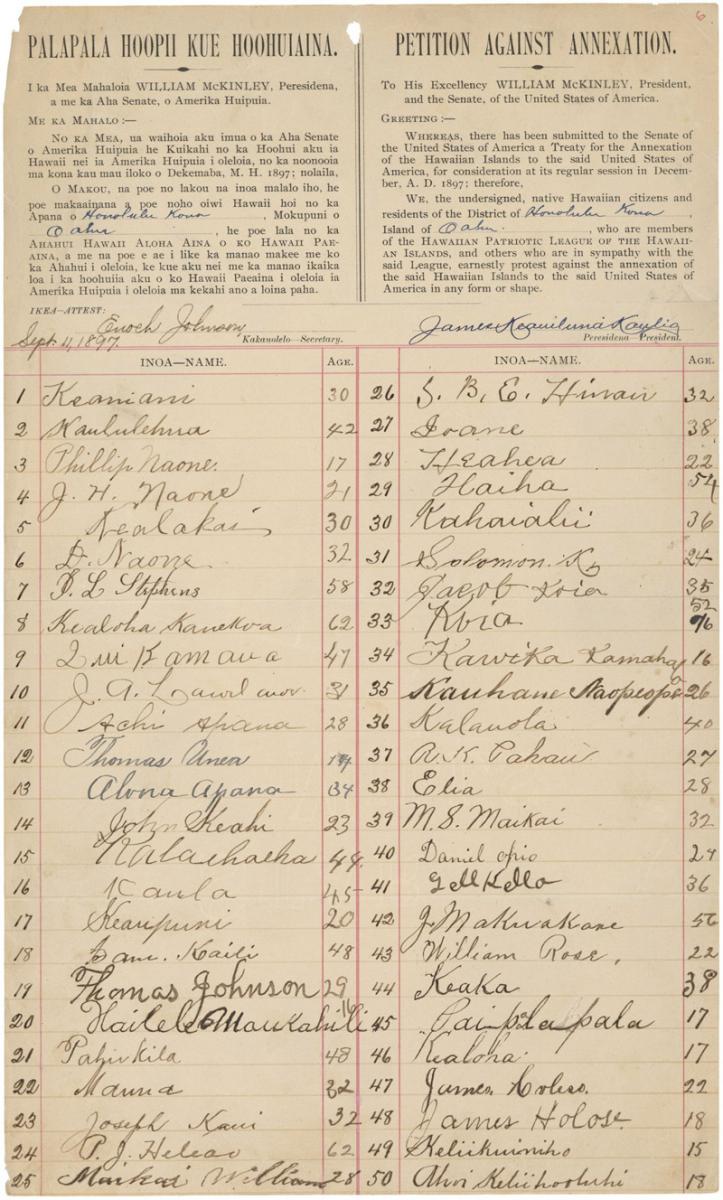
The declaration occupies the top of the sheet. Below it, names gather in columns, each beside a space for an age. Hawaiian and English share the printed heading; handwriting supplies the people. The 1897 petition against annexation asks its reader to hold those two kinds of evidence together: a common statement and the individuals prepared to put their names beneath it.[1]
Its closing words refuse annexation “in any form or shape.” That phrase gives the document a reach beyond the immediate treaty before the United States Senate. The signers oppose the transfer itself. Reading the petition beside the resolution Congress passed the following year exposes the central conflict: whose consent would count when Hawaiʻi's future was decided?[1][4]
A respectful address, an unqualified refusal
The English text addresses President William McKinley and the U.S. Senate. Its opening recital identifies the proposed annexation treaty and the Senate's coming December 1897 session. This is a document aimed at a particular decision, delivered to the officials with the power to prevent it.[1]
The political emergency had a recent history. Queen Liliʻuokalani was overthrown on 17 January 1893. In June 1897, McKinley signed an annexation treaty with representatives of the Republic of Hawaiʻi, the government that had succeeded the monarchy. Hawaiian opponents now had to carry their objection into the American ratification process.[1]
The petition uses that process's formal manners. An honorific and a greeting precede its argument; a recital of the pending business explains why the appeal is being made. Yet the courtesy offers no compromise on the outcome. It neither proposes a better price for annexation nor asks for a delay until more favorable terms can be negotiated. Its operative demand is refusal.[1]
There is also a careful expansion of who may speak. The text identifies members of the Hawaiian Patriotic League and includes others sympathetic to it. Organizational membership provides a starting point without becoming the outer boundary of opposition. The printed form leaves room to identify a district and island. The same declaration can therefore travel, acquire a local address, and return with names attached.[1]
That is my reading of the form's political work: it lets separate communities make an aligned statement while retaining the places from which they speak. The petition's repetition is useful. Each sheet renews the objection; each set of signatures prevents the repeated language from becoming anonymous.
The people below the paragraph
The campaign brought together the men's and women's Hui Aloha ʻĀina and the separate Hui Kālaiʻāina. These were distinct organizations cooperating against annexation. Historian Noenoe K. Silva's account, based on Hawaiian-language newspapers and other records, restores the organizing work behind the surviving sheets.[2]
One example is Laura Mahelona's journey through Kona and Kaʻū. She left blank petitions with local chapter leaders and instructions to have them signed before her ship returned. At subsequent harbor stops, the completed sheets were waiting. The shared form depended on a network capable of distributing it, explaining it and collecting it again.[2]
The final Hui Aloha ʻĀina petition carried 21,269 signatures. That number measures the scale of an organized refusal, but it needs care. Kamehameha Schools' account notes that the signers included some children and non-Hawaiian citizens as well as Native Hawaiian men and women. Calling the total a count of adult Native Hawaiian voters would change what the evidence records.[1][3]
A petition is also different from a referendum. It records the position of those who signed; it does not provide a complete register of everyone entitled to vote, including those who abstained or favored the other side. Its force here lies in documented participation. Thousands of people made their opposition available for inspection, with names that could be read rather than preferences merely attributed to them.
Why only one petition went forward
The coalition had collected two kinds of appeal. Hui Kālaiʻāina's petition called for restoration of the monarchy; Hui Aloha ʻĀina's opposed annexation. In Washington, the delegates and Liliʻuokalani chose to submit the latter so their immediate demand would appear united. Senator George Hoar presented its text to the Senate on 9 December 1897.[2]
That choice helps explain the final phrase. A refusal of annexation could unite people around stopping the pending transfer without requiring the American Senate to settle every question of Hawaiʻi's future government. The petition's narrow demand was politically capacious. Its brevity left room for a coalition.
The treaty failed to secure the necessary support. This should be described as a failure to obtain ratification, without inventing a successful final roll-call vote against it. The petition and the delegation's lobbying formed part of the resistance that blocked the treaty route.[1][3]
The consent in the next document
The Spanish-American War strengthened American arguments for controlling Hawaiʻi as a Pacific naval and supply position. Annexation's supporters then used a joint resolution, requiring ordinary majorities in both houses of Congress rather than the Senate's two-thirds treaty threshold. McKinley signed the Newlands Resolution on 7 July 1898.[4]
Its opening locates consent in “the Government of the Republic of Hawaii.” That government, the resolution declares, has agreed to transfer sovereignty and public property. Congress accepts the cession. The document proceeds from an agreement between governments to a sweeping change in authority over the islands.[4]
Read next to the petition, that opening is arresting. One document assembles people who object; the other identifies a government whose assent will authorize the transfer in the congressional text. The resolution does not reconcile those competing claims to speak for Hawaiʻi. It gives one of them operative force.
This comparison establishes a distinction the outcome can obscure. Annexation went ahead, but the signatures remain evidence of an opposition that had been organized, explicit and delivered to Washington. Political defeat did not turn the signers' refusal into agreement. At the bottom of the surviving sheet, the names still belong to the sentence above them.
Sources
- National Archives, “The 1897 Petition Against the Annexation of Hawaii” — archival petition image, signature total, presentation to Congress and historical background.
- Noenoe K. Silva, “The 1897 Petitions Protesting Annexation,” 1998, University of Hawaiʻi at Mānoa Library — the three organizing bodies, Mahelona's collection route and the delegates' choice of petition.
- Kamehameha Schools, “ʻŌiwi leadership and aloha ʻāina: Responses to the overthrow of Liliʻuokalani,” 20 January 2021 — community organizing, the inclusion of children and non-Hawaiian citizens, and the treaty's failure to obtain ratification.
- National Archives, “Joint Resolution to Provide for Annexing the Hawaiian Islands to the United States (1898)” — transcript of the 7 July 1898 resolution and background on the change from treaty to joint resolution.