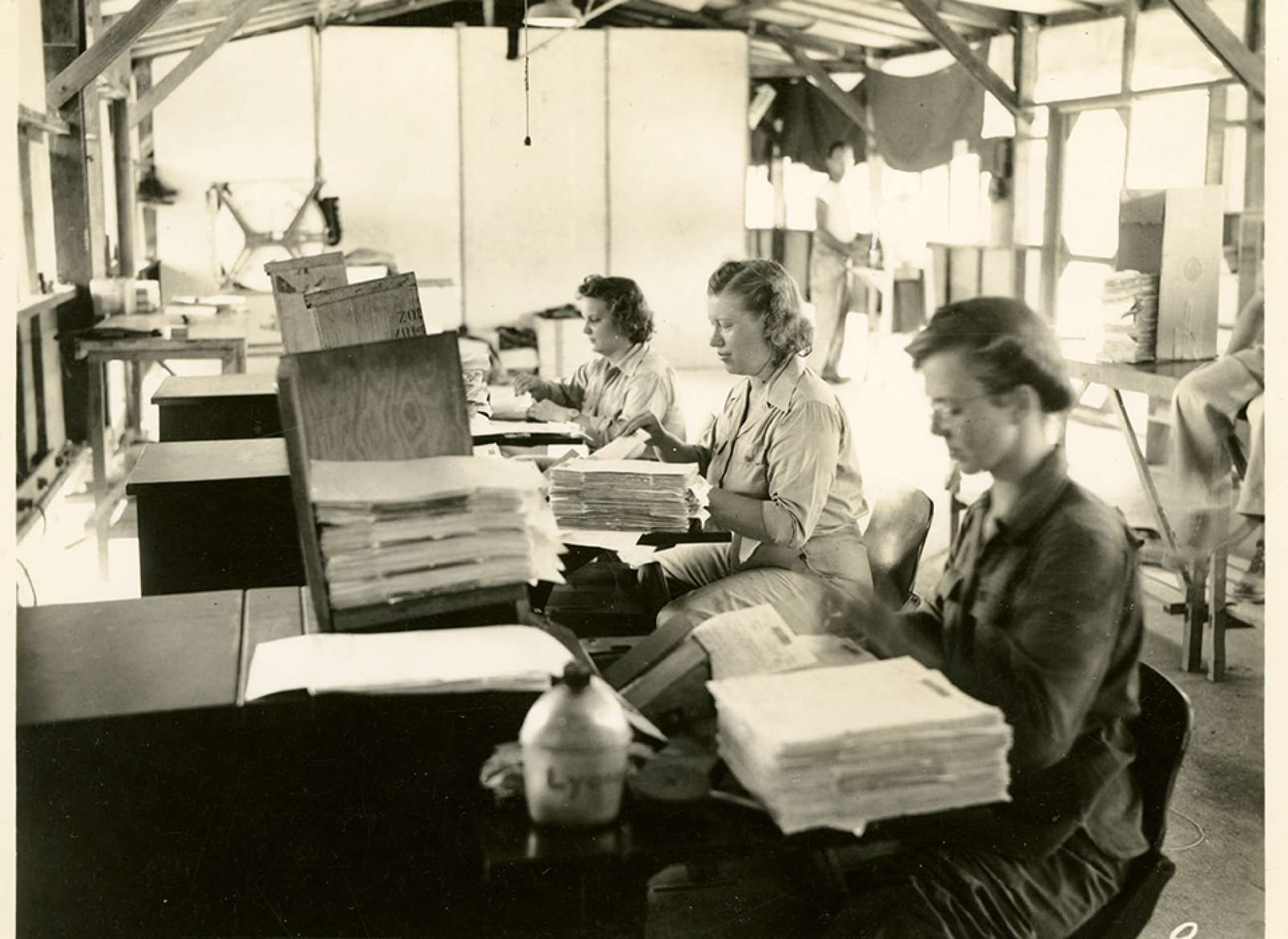
A letter sent home from Port Moresby in 1944 could cross the Pacific without its original sheet of paper. At the local V-Mail station, operators photographed correspondence onto film. At the receiving end, another group of workers turned those tiny images back into letters that could be folded, enveloped, and delivered.[1]
The handwriting survived the journey; the paper did not need to make it. That separation was the useful invention inside Victory Mail. It allowed an intimate object to become compact freight for the longest part of its trip, then return to a familiar form at the other end.
A letter had to compete for a place aboard
The Postmaster General's annual report for the fiscal year ending June 30, 1942, placed military correspondence inside a transport emergency. Ships and aircraft carried messages as well as supplies. The report also treated communication with home as essential to morale. Postal officials therefore faced two obligations at once: keep letters moving and conserve capacity for the material demands of war.[2]
Britain had introduced its Airgraph service in 1941, using microphotography for the London–Cairo mail route. Thomas Wildenberg's account in Naval History describes the essential arrangement: a standardized sheet carried an address and a message, then folded into its own envelope. American V-Mail adapted that approach.[3]
The American service began on June 15, 1942. The contemporary postal report illustrated the saving with a dispatch of 150,000 single-sheet letters: 37 sacks weighing 2,575 pounds became one sack weighing 45 pounds after microfilming.[2] Those figures describe the report's example, rather than a guaranteed reduction for every consignment.
The important calculation concerned the crossing. Paper could remain in a processing station while a much smaller representation occupied scarce transport space. Receiving stations would supply fresh paper after the film arrived. V-Mail effectively moved part of the work of carrying a letter into the work of reproducing it.
The camera needed an orderly page
A writer's first contribution was to fit the message onto the special form. The Smithsonian's reconstruction of the process shows how much had to happen before filming: clerks sorted correspondence, checked addresses, and prepared sheets for the equipment. Censors blacked out sensitive passages. Cutting holes in a V-Mail sheet could prevent it from feeding through the Recordak machine.[4]
Even censorship had to respect the physical requirements of copying. The page was simultaneously a personal message, a postal address, and an item that machinery had to handle. A decision made at the kitchen table could affect what emerged from a photographic laboratory thousands of miles away.
After transport, the image was enlarged onto photographic paper and returned to ordinary delivery. Wildenberg describes a print of about four by five inches, folded and put into an envelope.[3] The recipient needed no projector or special terminal. The complicated equipment sat inside the postal system; what arrived at home could still be kept in a drawer.
That familiar ending helped make a radical change in the middle of the journey usable. Correspondents did have to adapt their writing, but they could still exchange recognizable handwritten letters.
Keep the original until the copy works
Compression also concentrated responsibility. A small roll could carry many people's messages, so a failed shipment or unreadable reproduction could affect an entire batch.
The safeguard was a paper trail. Clerks numbered the original sheets and retained them. If film was lost or a reproduction proved inadequate, the corresponding letters could be photographed again. Originals were destroyed only after the receiving station gave clearance. The Smithsonian's account also records the less glamorous requirements of the overseas laboratories: electrical power, specialized equipment, and suitable temperatures for photographic processing.[4]
This was a trade of resources. The system consumed labor, equipment, and storage on land to save carrying capacity between stations. Retaining paper temporarily was part of making that trade dependable. An office full of originals and a small outgoing package of film belonged to the same operation.
What could not be shrunk
Some sheets bypassed the camera. The National WWII Museum preserves examples sent in their original form because they were damaged or because processing facilities were unavailable. Its account also describes the difficulties of cramped writing in reduced prints and the problem of lipstick marks fouling the equipment. V-Mail carried handwriting more readily than all the physical traces a correspondent might want to send.[1]
This helps explain the service's limits. A smaller representation could preserve a message while losing something of the object through which affection had been expressed. And where photographic processing could not be completed usefully, forwarding the sheet kept the correspondence moving.
Regular post remained the principal channel for military letters, as Wildenberg emphasizes.[3] The National WWII Museum nevertheless records more than a billion V-Mail items processed between June 1942 and November 1945.[1] Both facts matter: the service had considerable reach while operating alongside a much larger conventional mail system.
The striking achievement was making a letter change material form twice without requiring its readers to become technicians. Behind the little photographic print stood clerks, censors, camera operators, laboratories, and stored originals. Their work made room aboard the transport—and left the recipient with something small enough to hold.
Sources
- Kim Guise, “Mail Call: V-mail,” The National WWII Museum, December 7, 2019 — processing, surviving letters, service dates, and Mary T. Lynes's 1944 photographs from APO 929.
- United States Post Office Department, Annual Report of the Postmaster General for the Fiscal Year Ended June 30, 1942, pp. 3–6 — morale, the June launch, and the contemporary cargo comparison; digitized report, PDF.
- Thomas Wildenberg, “You've Got V-Mail,” Naval History, June 2005 — British precedent, letter sheets, reproduction and delivery, and the continuing importance of regular post.
- Smithsonian National Postal Museum, V-Mail Service in Action, booklet transcript — archival photographs document sorting, censorship, numbered originals, retakes, and laboratory requirements, PDF.