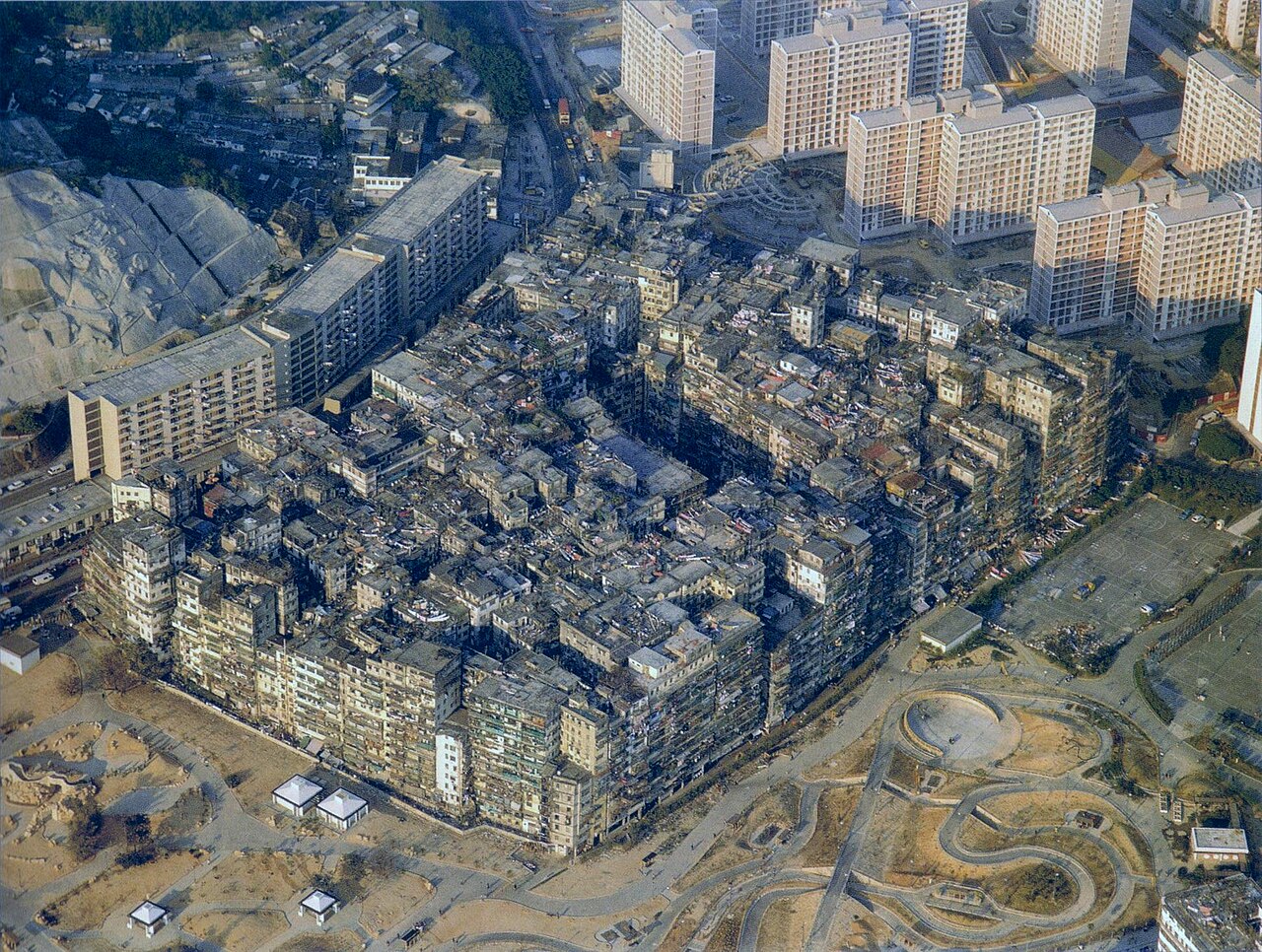
Kowloon Walled City is easy to flatten into an image: a dark block of concrete, illegal wiring, unlicensed dentists, rooftop children, triad legend, and airplanes descending toward Kai Tak. That image is not invented from nothing. The place did become famous as a jurisdictional anomaly and a dense postwar settlement where ordinary regulation was uneven, avoided, or absent. But the stronger history starts when the image is treated as evidence of memory, not as the whole story.[8][9]
The site in today's Kowloon City is not a ruin in the usual sense. It is a park built over a cleared city, and that makes it more complicated than preservation or erasure alone. Kowloon Walled City Park asks visitors to remember a vanished place through a restored Qing administrative building, South Gate stonework found during demolition, early-Qing garden design, official exhibition rooms, street names, photographs, and a bronze model. The result is not a neutral memorial. It is a controlled surface where several pasts compete: imperial frontier, colonial embarrassment, refugee housing, informal economy, crime story, neighborhood memory, and post-handover heritage.[1][2][3][4][9]
Image context: the cover is a real archival aerial photograph of Kowloon Walled City from 1989, not a diagram, chart, or generated reconstruction. Its value is spatial. The photo shows the Walled City as neither fantasy nor metaphor, but a tightly packed urban block pressed between roads, estates, and open ground before demolition changed the site into a park.[10]
The city began as a boundary problem
The official memory of the park begins before the famous concrete maze. The Antiquities and Monuments Office dates the Kowloon Walled City to 1847, when the Qing government built a garrison town and military outpost to reinforce coastal defense. The Yamen served as the administrative office, while the South Gate formed the main entrance in a granite-walled compound with watch towers and gateways.[5][6]
That early layer matters because it explains why the postwar settlement never became just another squatter district. The site's legal ambiguity came from imperial and colonial boundary-making. After the 1898 Convention for the Extension of Hong Kong Territory, Kowloon Walled City was treated as an exceptional Chinese enclave inside a British colony. In 1899, British forces entered and occupied it, but the question of jurisdiction never became emotionally simple. MAS Context's account describes the Walled City as a place where British, Chinese, and Hong Kong authority repeatedly met their limits, while Lai and Chua's planning history argues that the area had long been subject to plans, attempted clearance, and official schemes rather than existing outside planning altogether.[7][8]
This is the first correction to the usual memory. The Walled City was not born as pure anarchy. It became extraordinary because jurisdiction, housing pressure, refugee movement, border politics, and colonial planning failures accumulated in one small site. The later concrete block was a material answer to those pressures, not merely a setting for exotic lawlessness.
The park keeps the Qing layer in the center
Walk the park now and the curatorial choice is immediately visible: the Yamen sits at the center. LCSD calls it the only remaining building of the Walled City and describes it as a three-row, four-wing southern Chinese structure with brick, granite, China-fir roofing, and a later "almshouse" inscription over the front door. The same official page notes that the surrounding pavilions and paths carry names from Walled City streets used in the 1950s.[1]
This is not accidental. The Yamen lets the park give the site a recoverable shape: office, compound, gate, tablets, cannons, paths. It makes the Walled City legible as heritage before it asks visitors to face the postwar maze. The AMO page makes the same move in official monument language: after Qing officials departed in 1899, the building passed through charitable, educational, and medical uses, then survived the 1987 decision to demolish the Walled City and convert the site into an urban park. It was declared a monument in 1996.[5]
There is nothing false about preserving the Yamen. It is real fabric, and it deserves the attention. But centering it changes the argument. A visitor can leave with the impression that the site's deepest truth is imperial order interrupted by later disorder. The hard historical question is what happens to the tens of thousands who lived in the maze when the official focal point becomes the administrative building that preceded them.
The South Gate turned demolition into archaeology
The South Gate remains give the park its strongest physical contradiction. LCSD says that when the Walled City was torn down in 1994, two granite plaques bearing the characters for "South Gate" and "Kowloon Walled City" were unearthed, along with paving, foundations, a flagstone path, and a drainage ditch. The AMO account adds that archaeological investigations during demolition found the South and East Gate foundations particularly well preserved, leading the government to keep the South Gate remnants in place for public display. Those remnants were also declared monuments in 1996.[2][6]
That sequence matters. The gate was not simply waiting as a prepared monument. It reappeared during the act of clearance. Demolition, meant to remove the dense postwar city, exposed the earlier fortified city underneath. Memory then pivoted around what could be preserved: stone plaques, paving, foundations, and the Yamen could be named as monuments; the inhabited high-rise fabric could not be kept in the same way.[2][6][9]
Karma Hoi-Pan Kong's counter-memory study is useful here because it treats the park as a selective memory machine rather than a simple success story. The article argues that the park was initially staged as a positive new urban space that could cover a notorious slum memory, but that the same site also became a place where visitors, former residents, and later interpreters could challenge the official storyline.[9] The South Gate is exactly that kind of object. It supports the official Qing heritage narrative, yet it also reminds the visitor that the postwar city had to be destroyed for the deeper layer to become visible.
The garden makes beauty do political work
LCSD describes the park's design as based on Jiangnan garden style from the early Qing dynasty, chosen by Architectural Services Department architects after a visit to China. The design is divided into eight landscape features, with the restored Yamen as the centerpiece, and the project won recognition at the IGO Stuttgart EXPO 93.[3]
As a design solution, the garden is elegant. As a memory solution, it is pointed. It replaces the Walled City's vertical congestion with open paths, pavilions, floral walks, and controlled sightlines. It gives a formerly feared block a new public use. It also risks making the cleared city feel like a bad dream corrected by taste.
That is why the later exhibition infrastructure matters. LCSD's "A City of Thousand Faces" page says the exhibition opened on 19 April 2009 and uses an outdoor display area, exhibition rooms inside the former Yamen, models, images, and sound effects to recreate older days of the Walled City. The outdoor display includes a shadow wall, a cross-section of the pre-demolished city, and a bronze miniature of one Walled City building.[4]
The 2009 layer makes the park less tidy. The site no longer depends only on garden order and Qing monuments. It admits that the vanished city had a daily environment worth representing, even if that representation comes through models and images rather than preserved streets. Memory here becomes substitution: the block is gone, so the park offers scale models, names, photographs, and fragments.
The "lawless city" myth hides ordinary urban life
The most durable public myth is that Kowloon Walled City was a lawless exception sealed off from Hong Kong. MAS Context pushes against that isolation. It argues that the Walled City was porous rather than separate, shaped by refugee movement, informal work, unlicensed services, surrounding public housing, and the colonial government's recurring attempts to define it as an anomaly.[8]
That does not romanticize the place. Crime, drug use, fire risk, sanitation problems, and unsafe construction were real parts of the story. Official park text itself refers to a living maze where crime was rampant and where opium users kept lamps lit day and night.[1] The point is narrower: lawlessness is a poor total explanation. People also lived there because the city offered affordable rooms, work, services, and community under conditions Hong Kong's formal systems did not solve.
The park's memory problem is therefore not that it should have preserved every illegal stair and dangerous factory. That was not realistic. The problem is that public memory tends to swing between two simplifications: nightmare city or heroic self-organizing city. The evidence asks for a harder middle. Kowloon Walled City was made by state weakness and state pressure, by migrant necessity and entrepreneurial adaptation, by danger and mutual dependence, by official neglect and repeated official planning.[7][8][9]
What the park remembers best
Kowloon Walled City Park works best when read against itself. The Yamen remembers state authority. The South Gate remembers a fortified boundary. The Jiangnan garden remembers a desirable cultural order. The exhibition remembers the postwar maze through substitute media. The aerial photograph remembers the density before clearance. None of those layers cancels the others.
This is why the site is more historically interesting than the phrase "city of darkness" allows. A dark-city myth makes the Walled City feel self-contained, as if it grew from moral abnormality. The park shows the opposite. The place was produced by treaties, war, migration, planning disputes, housing pressure, colonial embarrassment, informal service economies, clearance politics, archaeological discovery, and heritage design.
By 1984, the Sino-British Joint Declaration had made Hong Kong's future sovereignty timetable explicit. By 1987, clearance of the Walled City was announced. Demolition began in 1993 and was completed in 1994; the park was completed in 1995 and its surviving monuments were formally declared in 1996.[5][6][9] That compact final sequence turned a long-running ambiguity into landscape architecture with monuments.
The park did not solve the memory of Kowloon Walled City. It gave that memory a place to keep disagreeing. That is its real historical value. The visitor does not stand on a clean replacement for a dirty past. The visitor stands on a layered argument: a Qing administrative site, a colonial anomaly, a postwar home, a clearance project, and a heritage park all occupying the same ground.
Sources
- Leisure and Cultural Services Department, "Kowloon Walled City Park - The Yamen" - official page on the restored yamen, original street names, tablets, cannons, photographs, and the building's post-1899 uses.
- Leisure and Cultural Services Department, "Kowloon Walled City Park - The Old South Gate" - official page on the 1994 South Gate archaeological finds and preserved plaques, paving, foundations, flagstone path, and drain.
- Leisure and Cultural Services Department, "Kowloon Walled City Park - Design of the Park" - official page on the early-Qing Jiangnan garden design, eight landscape features, Architectural Services Department design, and restored yamen centerpiece.
- Leisure and Cultural Services Department, "Kowloon Walled City Park - A City of Thousand Faces" - official page on the 2009 exhibition, outdoor display, cross-section wall, and bronze model.
- Antiquities and Monuments Office, "Former Yamen Building of Kowloon Walled City, Kowloon Walled City Park" - official declared-monument page on the 1847 garrison-town origin, Qing departure in 1899, 1987 demolition decision, and 1996 monument declaration.
- Antiquities and Monuments Office, "Remnants of the South Gate of Kowloon Walled City, Kowloon Walled City Park" - official declared-monument page on the garrison, granite walls, Japanese Occupation wall removal, demolition-period archaeology, and 1996 monument declaration.
- Lawrence W.C. Lai and Mark H. Chua, "The History of Planning for Kowloon City." Planning Perspectives, 2018 - bibliographic page for the planning-history article on jurisdiction, attempted clearance, public-garden schemes, and the argument that the Walled City had long been planned.
- MAS Context, "Kowloon Walled City: Heterotopia in a Space of Disappearance" - interpretive history of the enclave, jurisdictional ambiguity, refugee settlement, public myth, and porous urban ties.
- Karma Hoi-Pan Kong, "Visualizing Contestation of Storytelling: Kowloon Walled City Park as a Site of Counter-Memory." Culture: Policy, Management, and Entrepreneurship, 2025 - article on the park as official memory, counter-memory, and post-colonial urban space.
- Wikimedia Commons, "File:Kowloon Walled City - 1989 Aerial.jpg" - source page for Ian Lambot's real 1989 aerial photograph used as the article image.