Yosemite and Yellowstone are often folded into one origin story: Americans saw sublime western scenery, set it aside, and eventually invented the national park. That memory is useful, but it hides the most important institutional change between 1864 and 1872. Yosemite began as a grant to California, held under conditions of public use and inalienability. Yellowstone became a federal reservation because the land crossed territorial lines and could not be handed neatly to one state government.[1][4]
The comparison matters because the park idea did not arrive fully formed. It had to learn who would hold the land, who would police private claims, who would pay for access, and what "public" meant when scenery was no longer only local, commercial, or extractive. Yosemite answered those questions with a state trust. Yellowstone answered them with federal custody. Together they show preservation changing from a special grant into a national administrative problem.[1][3][4][5]
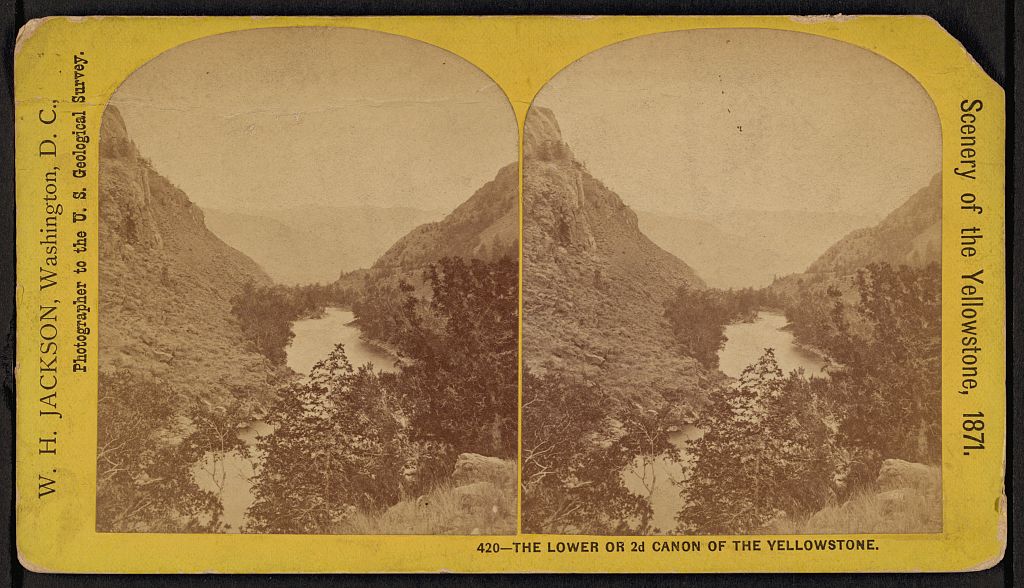
Image context: the cover is a real 1871 William Henry Jackson stereograph from the Library of Congress, not a diagram, chart, or generated image. It shows Yellowstone as photographic evidence from the survey era, when Jackson's photographs and Thomas Moran's art helped Congress imagine a distant landscape as something specific enough to reserve.[6][7]
Yosemite created a public trust without creating a national park
The Yosemite grant was radical partly because its legal mechanism was so narrow. Senate Bill 203 did not create a federal park service, a national management code, or a general scenic-preservation policy. It granted Yosemite Valley and the Mariposa Big Tree Grove to the State of California on explicit conditions: public use, resort, recreation, inalienability, limited leases, and reinvestment of lease income in preservation, improvement, roads, and protection.[1]
That structure reveals the first American solution to scenic preservation. Congress could remove exceptional land from ordinary disposal, but it still relied on a state to manage the place. California State Parks treats the June 30, 1864 act as the first instance of park land being set aside for preservation and public use by federal action, but also stresses the cession to California as the nation's first state park.[3] In other words, Yosemite was both a national precedent and a state custody experiment.
The state-trust form made sense in 1864. California was already a state. Yosemite Valley and the Mariposa Grove lay within its borders. A governor-appointed commission could be imagined as a practical local custodian, and California formally accepted the grant in 1866 after an interim proclamation in 1864. Galen Clark's appointment as guardian in 1866 gave the arrangement a human operator, even if the later professional ranger idea had not yet been built.[3]
But Yosemite also exposed the difficulty of managing public scenery as public property. The Library of Congress summary of Frederick Law Olmsted's 1865 preliminary report notes that Olmsted already saw a tension between preservation and recreation. He warned that small visitor impacts would become serious if repeated by millions, and his report did not reach the state legislature.[2] The administrative weakness is revealing. Yosemite had the legal language of a public trust before it had a durable public-management system equal to future pressure.
Yellowstone borrowed Yosemite's language and changed the holder
Yellowstone's founders did not start from a blank page. The National Park Service says directly that advocates for Yellowstone drew on the Yosemite Act of 1864 while promoting a bill in Washington in late 1871 and early 1872.[4] The legal family resemblance was real. Like Yosemite, Yellowstone was framed as land to be withdrawn from settlement and dedicated to public enjoyment rather than converted into private property.[4][5]
The difference was geography. Yosemite could be entrusted to California because the place sat inside one state. Yellowstone lay around the headwaters of the Yellowstone River across what were then territorial jurisdictions. The NPS explains that Congress may have preferred a Yosemite-style state park if a single state had been available, but arguments between Wyoming and Montana territories helped push the decision toward federalization.[4] The accident of borders changed the institution.
That detail is easy to miss because Yellowstone is remembered as "the first national park." The phrase is true, but the mechanism is more interesting. The National Archives identifies the March 1, 1872 act as making Yellowstone the first federally protected national park. The act reserved land from settlement, occupancy, or sale and placed it under federal control at a moment when public-land policy normally pushed land toward ownership, extraction, railroad development, grazing, or homesteading.[5]
Yellowstone therefore made the park idea harder to treat as a scenic exception. If Congress could reserve a vast public-domain landscape as a public park, then preservation was no longer only a conditional grant to a state. It was a claim that the federal government could keep land in national custody because the landscape itself had public value that private disposal would damage.[4][5]
Pictures supplied evidence, but law supplied custody
Both cases depended on visual persuasion. Yosemite reached eastern audiences through sketches, paintings, and photographs, including the famous early work of Carleton Watkins. Yellowstone's case was sharpened by the 1871 Hayden Expedition, whose artists and photographers gave Congress a more concrete sense of a place few legislators would ever see. The Library of Congress classroom guide frames William Henry Jackson's photographs and Thomas Moran's art as central to shaping national ideas of Yellowstone and the West.[6]
Yet images alone did not create parks. They made the claim visible; legislation made the claim durable. This is why Jackson's stereograph is a better cover image than a modern scenic view. It comes from the evidentiary moment before Yellowstone became settled national memory. The photograph says, in effect: this is not just a traveler's exaggeration. There is a canyon, a river, a set of geological forms, and a place that can be named, mapped, and legislated.[6][7]
The same distinction matters for Yosemite. The valley's visual fame could bring national attention, but the 1864 act translated wonder into conditions: public use, inalienability, limited leases, state management, and income tied back to preservation and improvement.[1][2] The park idea was not simply an aesthetic awakening. It was a legal technology for interrupting ordinary land transfer.
The public was imagined before mass visitation was solved
The two acts also show a revealing optimism about public access. Yosemite's language made public use and recreation central from the start, but it did not solve how roads, leases, guardianship, concession pressure, Indigenous displacement, tourism, and preservation would interact over generations.[1][2][3] The grant imagined public benefit; management had to catch up afterward.
Yellowstone had the same gap in federal form. The NPS notes that early promoters imagined the park could exist at no expense to the government, and Nathaniel P. Langford became an unpaid superintendent. That was not a stable model for a huge landscape. It was a sign that Congress had taken the decisive step of reservation before building the funding and enforcement machinery that reservation would require.[4]
This is the central comparison. Yosemite shows the public-trust idea in state hands, strong enough to interrupt sale but weak enough to depend heavily on local implementation. Yellowstone shows the same idea stretched across the public domain, strong enough to become federal but still underbuilt as an operating institution. In both cases, the United States reserved the land before it fully understood the recurring costs of preserving land for visitors.
Why the sequence matters
The common origin story makes Yellowstone sound like a sudden invention. The better history is sequential. 1864 supplied a legal precedent: exceptional scenery could be removed from ordinary land markets for public use. 1865 exposed the management problem: public recreation and preservation could collide. 1866 put Yosemite's state commission and guardianship into practice. 1871 made Yellowstone visible through survey reports, photographs, and art. 1872 federalized the model because Yellowstone's geography made state custody awkward. 1890 then partly closed the loop when Congress made Yosemite a national park after dissatisfaction with the state-park arrangement.[2][3][4]
That sequence changes the meaning of both places. Yosemite was not merely the warm-up act before the "real" national park. It was the first institutional test of how public scenery might be held outside private ownership. Yellowstone was not merely a prettier or larger version. It changed the custodian and thereby changed the future politics of parks.[1][4][5]
The two cases also caution against treating preservation as a purely moral impulse. The park idea became durable because it found administrative form. A valley could be granted on conditions. A territory-spanning public-domain landscape could be withdrawn from settlement. A photograph could help Congress believe a place was worth protecting, but a statute decided who would answer for it afterward.[4][5][6]
That is why the Yosemite-Yellowstone comparison remains useful. It shows the national park idea being assembled in stages: visual proof, public-use language, inalienability, state trust, federal reservation, and belated management capacity. The American park was not born only from awe. It was born when awe had to choose a custodian.
Sources
- National Park Service, "Yosemite Grant Act of 1864" - text of Senate Bill 203 granting Yosemite Valley and the Mariposa Big Tree Grove to California with public-use, inalienability, lease, and management conditions.
- Library of Congress, "Today in History - June 30" - overview of Lincoln's signing of the Yosemite Valley Grant Act and Frederick Law Olmsted's 1865 warning about preservation and mass visitation.
- California State Parks, "150th Anniversary" - state-parks account of the 1864 Yosemite grant, California's acceptance, the 1866 legislation, and Galen Clark's appointment as guardian.
- National Park Service, Yellowstone, "Birth of a National Park" - official account of the 1872 Yellowstone act, its debt to the Yosemite precedent, the territorial-border issue, and early superintendent arrangements.
- National Archives, "Act Establishing Yellowstone National Park (1872)" - milestone document page on the March 1, 1872 act and Yellowstone as the first federally protected national park.
- Library of Congress, "Explorations in American Environmental History: The Photographer, the Artist, and Yellowstone" - teaching guide on William Henry Jackson, Thomas Moran, the 1871 Hayden Expedition, and visual evidence in the creation of Yellowstone.
- Library of Congress, "The lower or 2nd canon of the Yellowstone" - source record for William Henry Jackson's 1871 albumen stereograph used as the article image.