The paired wartime decisions in Korematsu v. United States and Ex parte Endo, both decided on December 18, 1944, are often remembered in flattened form. One case is cast as the disgraceful opinion, the other as the corrective that ended the camps. That memory points in the right direction, but it hides the more revealing structure. The Supreme Court did not answer one general question about Japanese American incarceration. It split the state's machinery into stages and treated those stages differently.[2][3][6]
That split is the historical question worth reading closely. Why could the Court uphold Fred Korematsu's conviction for violating a race-based exclusion order and, on the same day, rule unanimously that Mitsuye Endo could not continue to be confined by the War Relocation Authority? The answer lies in what each case asked the Court to review. Korematsu tested exclusion from place. Endo tested continued detention by a civilian agency after exclusion had already happened.[2][3][4][5]
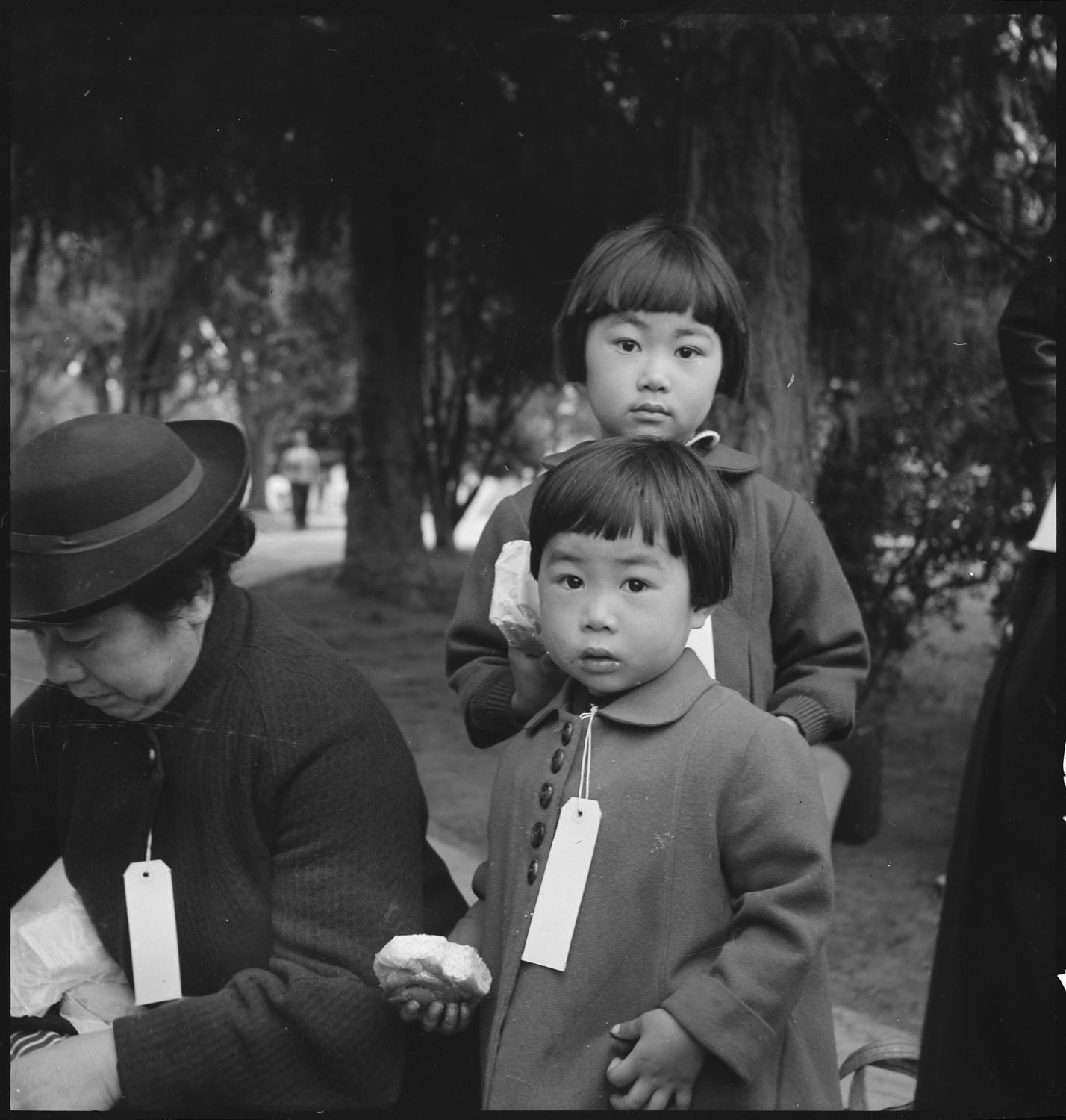
The cover image helps keep that distinction grounded. Dorothea Lange's May 8, 1942 photograph of the Mochida children in Hayward, California shows identification tags pinned to their coats as the family waits for removal under Executive Order 9066.[1][7] It is the right image because both cases grew out of that prior sorting operation. Before the Court split doctrine into narrower legal questions, the state had already marked entire families for movement on racial lines.
Timeline anchors
- February 19, 1942: Franklin D. Roosevelt signs Executive Order 9066, creating the framework for military exclusion from designated areas.[1][3]
- May 9, 1942: Civilian Exclusion Order No. 34 takes effect for the relevant West Coast military area; Fred Korematsu later violates that order by remaining in San Leandro.[2][4]
- May 30, 1942: Korematsu is arrested after refusing removal.[4]
- July 1942: Mitsuye Endo, an American citizen of Japanese ancestry removed from Sacramento, files a habeas petition challenging her confinement.[3][5]
- October 11-12, 1944: the Supreme Court hears argument in the paired wartime cases.[2][3]
- December 18, 1944: the Court upholds Korematsu's conviction but rules unanimously that Endo, as a concededly loyal citizen, cannot be detained by the War Relocation Authority.[2][3][6]
These dates matter because they show sequence. The constitutional stain did not begin in the courtroom. It began with mass removal in 1942, when more than 120,000 people of Japanese descent from the West Coast were detained through a federal confinement system.[1] By the time the Court ruled in 1944, exclusion, assembly centers, and camp confinement were already established facts.
Korematsu asked about exclusion, and the Court deliberately narrowed the frame
The Korematsu opinion is often cited for its notorious deference, and rightly so. But its internal logic turns on something more specific than a blanket endorsement of every part of incarceration policy. The Justia text of the syllabus states that Civilian Exclusion Order No. 34 was held constitutional as applied to Korematsu when he violated it, and then adds a crucial limit: the validity of the separate orders requiring reporting to assembly centers and providing for detention was "not in issue" in that proceeding.[2]
That narrowing did major work. Once the Court treated exclusion and detention as distinct legal acts, it could uphold the first stage without directly judging the full camp system. The opinion then moved through a familiar wartime argument: exclusion from the military area was justified as a protection against espionage and sabotage, even though no question had been raised about Korematsu's personal loyalty.[2] The Densho encyclopedia summary tracks the same point in more historical terms. Fred Korematsu became the test case because he refused to leave his home in San Leandro, and the Court ultimately upheld his conviction by 6-3 while downplaying the racial nature of the order.[4]
This is the first half of the comparison. Korematsu shows the Court at the geography stage of the policy. The question was whether the military could force a citizen of Japanese ancestry out of a designated zone. The answer was yes.[2][4]
Endo asked about detention, and the Court found the civilian power thinner
Endo came at the machinery from a different angle. Mitsuye Endo was not prosecuted for defying an exclusion order. She was already inside the confinement system and challenged her ongoing custody through habeas corpus.[3][5] The Endo syllabus states the holding with unusual clarity: the War Relocation Authority lacked authority, express or implied, to subject a concededly loyal and law-abiding citizen to its leave procedure, and the relevant wartime orders afforded no basis for keeping such a citizen in custody.[3]
That language matters because it did not openly repudiate the whole exclusion regime on constitutional grounds. Instead, it cut into the legality of continued confinement. The Densho encyclopedia summary says the Court held unanimously that the federal government could not confine indefinitely U.S. citizens of Japanese ancestry who were concededly loyal in War Relocation Authority camps, and that the ruling helped make possible the winding down of the camps and the lifting of exclusion from the West Coast.[5]
The National Archives' federal-courts overview sharpens the afterlife of that holding. Its summary for Endo states that the decision paved the way for the end of mass confinement, while also giving the federal government a shield against directly accepting responsibility for denying due process and constitutional rights to its own citizens.[6] That phrase is interpretively important. Endo won real freedom, but through a route narrow enough that the Court avoided the broadest possible constitutional reckoning.
Read together, the two cases show a legal split inside one policy machine
This is why the cases belong in one frame. Korematsu did not validate every piece of Japanese American incarceration in a single sweep. Endo did not cleanly reverse Korematsu. Together, they reveal a Court separating one policy machine into two legal questions. First: can the government exclude a racialized population from a military area during wartime? In Korematsu, the Court said yes.[2][4] Second: after that population has been removed, can a civilian authority continue confining a concededly loyal citizen without clearer authorization? In Endo, the Court said no.[3][5][6]
My inference from the paired opinions and the National Archives summary is that this split offered the judiciary an institutional off-ramp. The Court could sustain wartime exclusion at the front end while finding a narrower path to unwind detention at the back end.[2][3][6] The sources support that reading, but the boundary should stay visible: the Court did not explicitly describe its own reasoning as an effort to save governmental legitimacy. That is a historical interpretation built from how the two holdings fit together.
The comparison also clarifies why Endo should not be romanticized into a full constitutional cleansing. Endo mattered enormously because it broke the legal basis for continuing to hold loyal citizens in War Relocation Authority camps.[3][5][6] Yet the same day's Korematsu ruling preserved the earlier violence of removal by treating exclusion as separately justifiable.[2] Freedom arrived through a narrow administrative breach, not through a clean admission that the entire racial logic of the system had failed.
The harder conclusion
The most useful way to remember December 18, 1944 is therefore not that the Supreme Court contradicted itself in a simple way, or that one case canceled the other. The Court split the Japanese American incarceration regime into stages and judged them unevenly.[2][3] Korematsu upheld exclusion. Endo broke detention. That distinction freed people, but it also limited the scope of official truth available at the moment of release.[6]
The Mochida children in Lange's photograph stand at the beginning of that chain.[1][7] They were tagged before there was a doctrinal distinction between where the state could move them and how long it could keep them. The paired cases show how law later tried to separate those acts. History is less forgiving. It has to hold the whole sequence together.
Sources
- National Archives, "World War II Japanese American Incarceration: Mass Removal and Incarceration" - overview of the 120,000-plus detainees and the federal machinery of removal and confinement.
- Justia U.S. Supreme Court Center, Korematsu v. United States, 323 U.S. 214 (1944) - syllabus and opinion text on exclusion, separate detention orders, and the Court's narrowed frame.
- Justia U.S. Supreme Court Center, Ex parte Endo, 323 U.S. 283 (1944) - syllabus and opinion text on the War Relocation Authority's lack of power to detain a concededly loyal citizen.
- Densho Encyclopedia, "Korematsu v. United States" - case background, Fred Korematsu's refusal to leave San Leandro, and the 6-3 Supreme Court ruling.
- Densho Encyclopedia, "Ex parte Mitsuye Endo (1944)" - background on Mitsuye Endo's habeas case and the ruling's role in lifting exclusion and winding down the camps.
- National Archives, "World War II Japanese American Incarceration: Federal Courts" - summaries of the Korematsu and Endo case records and the paired decisions' legal afterlife.
- Library of Congress, "Hayward, California, Two Children of the Mochida Family who, with Their Parents, Are Awaiting Evacuation." - Dorothea Lange photograph used as the article image.