The Bay of Pigs is often remembered through a single sentence: John F. Kennedy inherited a CIA plan, approved it, and watched it collapse on the beaches of southern Cuba in April 1961.[1][2] That sentence is true, but it is still too flat. The sharper historical question is not simply why the invasion failed. It is why failure arrived so quickly, even before the brigade had any chance to turn a landing into a broader political rupture.
This article argues that the operation carried an internal contradiction from the start. Washington wanted a landing strong enough to survive combat, hold a beachhead, and perhaps trigger either a rising against Fidel Castro or the installation of a provisional anti-Castro government.[1][4][5] At the same time, Kennedy wanted the action to remain deniable enough that the United States could avoid appearing to launch an open war against Cuba.[3][5] Those two requirements kept cutting into one another. Every military measure that might have made the landing more viable made U.S. responsibility harder to hide. Every step taken to preserve deniability reduced the margin for battlefield success.
Once that contradiction was locked in, the rest of the sequence became brutal. The preliminary air strikes on April 15, 1961 exposed the American hand without eliminating Castro's air force.[1][5] The landing site at Bahia de Cochinos had already been chosen in part because it looked more deniable than Trinidad, but that also left the invaders far from the Escambray Mountains and surrounded by swamp, coral, and a limited road network.[1][5] When surviving Cuban aircraft found the brigade's ships and the beachhead began losing fuel, ammunition, and time, the covert pose had already outlived the military design.
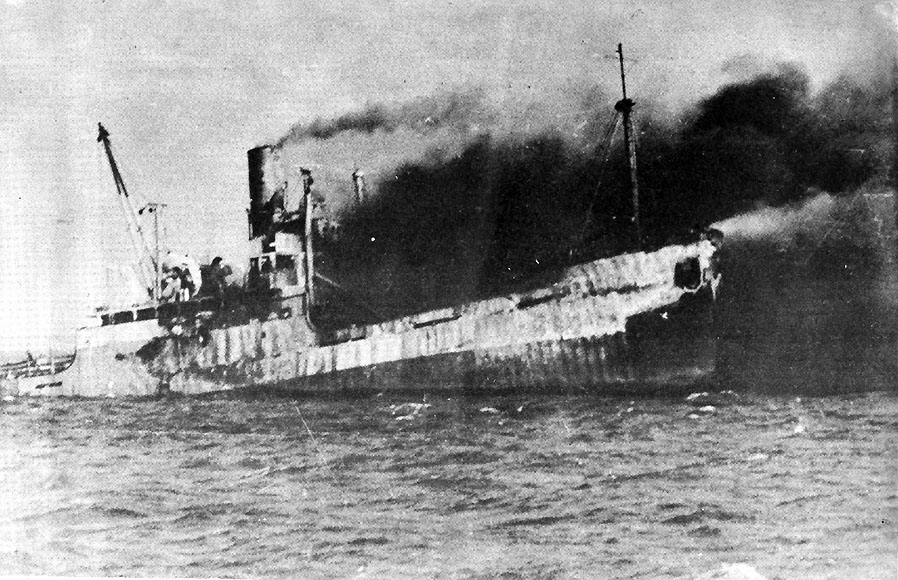
Image context: the cover uses an archival photograph of the supply ship Houston after it was damaged during the invasion.[6] It fits this essay because the article is about the moment when abstract planning assumptions turned into visible material loss. Smoke, exposed crewmen, and a ship already becoming a wreck tell the story more honestly than a map ever could.
Timeline anchors
- March 1960: President Dwight D. Eisenhower directs the CIA to develop a plan to overthrow Castro by training and supporting Cuban exiles.[2]
- April 6, 1961: Kennedy meets advisers on the projected Zapata operation and pushes for a plan that can still appear to be a Cuban action "supported from without" rather than a direct U.S. assault.[3]
- April 15, 1961: Brigade B-26 bombers strike Cuban airfields, but the cover story begins to unravel and a planned follow-up strike is canceled.[1][5]
- April 17, 1961: Brigade 2506 lands at Playa Larga and Playa Giron; Castro's surviving aircraft attack shipping, damaging the Houston and sinking the Rio Escondido.[1][5]
- April 19, 1961: a one-hour "air umbrella" by unmarked U.S. fighters arrives too late to protect brigade aircraft, and the invasion is crushed later that day.[1][5]
- After April 19: Castro's government emerges strengthened, the Kennedy administration orders a reassessment, and the road opens toward Operation Mongoose rather than regime change by exile landing.[2]
The plan asked covert politics and open warfare to coexist
The Bay of Pigs was not one simple plan left untouched from the Eisenhower years. It was revised repeatedly as Kennedy and his advisers tried to preserve both military plausibility and political concealment.[1][3][5] The CIA's preferred landing concept had originally centered on Trinidad, a town whose anti-Castro reputation, nearby port facilities, and access to the Escambray range made it better suited to a beachhead that might need reinforcement or a guerrilla fallback.[5] Kennedy rejected that site because it looked too noisy and too obviously sponsored.[5]
The replacement was Zapata, the Bay of Pigs area. Kennedy's concern was political: if U.S. fingerprints became too obvious, Washington would bear the full diplomatic cost of a failed anti-Castro war in the Caribbean.[3][5] But the military price of the more deniable site was severe. The JFK Library notes that the Bay of Pigs lay more than 80 miles from the Escambray refuge if anything went wrong.[1] The CIA's own retrospective adds another hard constraint: the bay was far from large civilian concentrations and surrounded by the biggest swamp in Cuba, which made any imagined spontaneous rising harder to convert into usable force.[5]
The April 6 White House meeting captures the contradiction in clean bureaucratic language. The FRUS record says Kennedy wanted the operation to proceed while doing "everything possible" to make it look like a Cuban enterprise rather than an American one.[3] That is the hinge of the whole episode. The invasion was being designed as a real amphibious landing, but judged politically as though it still had to behave like a covert action. Once those goals diverged, every later adjustment became a tradeoff rather than a solution.
April 15 exposed the hand without clearing the sky
The first air strikes on April 15 were supposed to solve the hardest tactical problem before the landing began.[1][5] Brigade pilots flew B-26 bombers disguised as aircraft from Castro's own air force and attacked Cuban bases in an effort to destroy the planes that could strafe ships, bomb the beach, and break the brigade before it could settle ashore.[1][5] In military terms, the idea was straightforward. In political terms, it depended on the fiction that the attacks came from Cuban defectors rather than from a CIA-backed operation.
That fiction unraveled almost immediately. The false-defector story did not survive inspection for long, and the air attacks instead advertised that something bigger was underway.[1][5] Worse, the strikes failed to eliminate Castro's air capability. The JFK Library and the CIA narrative both emphasize that enough aircraft survived to matter decisively once the landing began.[1][5] Kennedy, already alarmed by the exposure of U.S. involvement, then canceled the planned second strike that was meant to finish off the remaining planes.[1][5]
This is the point where the invasion's sequence turns vicious. The operation had now paid the political price of exposure without receiving the full military benefit of air superiority. The surviving Cuban aircraft were not a side note. They became the instrument that connected deniability to defeat. The internal CIA probe published later in Studies in Intelligence returned again and again to this structure: planners assumed an uprising would follow the landing, underestimated Castro's strength, and kept adapting the plan to political restriction rather than confronting how little margin for error remained.[4]
The beachhead collapsed as a logistics problem before it could become a political one
The brigade landed before dawn on April 17, but the remote shoreline did not function as the launching pad the plan required.[1][5] Coral reefs disrupted unloading. Equipment was lost in water and swamp. Paratroopers were scattered unevenly. The brigade did fight, and some road-blocking airborne units held their positions for a time.[5] But the core failure was not courage. It was that the beachhead had to survive as a military system long enough to become a political event, and it never had enough slack to do both.
Castro understood that quickly. According to the CIA's own public reconstruction, his first priority became the invasion shipping.[5] That mattered because the brigade's plan depended on afloat supply and on the ability to keep moving fuel, ammunition, and support into a narrow coastal position. Once Cuban aircraft hit the Houston and sank the Rio Escondido, the invaders lost far more than hulls.[1][5] They lost aviation fuel, stores, mobility, and confidence that the beachhead could stretch into the longer campaign the planners had imagined.[5]
The operation's political theory was now in ruins as well. The invasion had been justified in part by the expectation that Cubans would rally once an anti-Castro force secured a foothold.[1][4][5] Yet the landing zone had been chosen precisely because it looked isolated and deniable, which meant it was also badly placed for igniting a mass urban or regional rising.[1][5] The internal CIA probe later described this failure in harsher structural terms: the Agency kept enlarging the military project even after the assumption of a real indigenous rebellion had faded, until the invasion was expected to create the uprising it supposedly came to assist.[4]
That is why the Bay of Pigs should be read as an event reconstruction rather than a morality play about one canceled strike or one hesitant president. The cancellation mattered. So did the surviving aircraft. But the deeper failure was sequential. A beachhead that depended on air superiority, shipping survival, local political ignition, and continued U.S. restraint had almost no room to absorb bad news. Once two or three pieces went wrong together, the entire theory of victory began to fall apart at once.
April 19 showed that Washington still preferred deniability to rescue
By the third day, the choice in Washington was no longer between a clean covert success and a clean covert failure. It was between overtly widening the war or letting the brigade collapse.[1][4][5] Kennedy did authorize a limited one-hour protective patrol by unmarked U.S. fighters from the USS Essex, but the help was restricted and late.[1][5] The CIA account says the jets and brigade aircraft missed each other by roughly an hour, apparently because of a time-zone misunderstanding in the last-minute arrangements.[5]
Even without the timing error, the political ceiling remained in place. The fighters were not there to open a broader U.S. air war over Cuba.[5] Kennedy still refused the kind of direct intervention that might have saved the landing at the cost of making the conflict unmistakably American.[1][5] At that point the original contradiction had reached its endpoint. Washington had already compromised the operation enough to expose its sponsorship, yet it still would not cross the final threshold into open rescue.
The outcome followed fast. The JFK Library records that almost 1,200 members of Brigade 2506 surrendered and more than 100 were killed.[1] The Office of the Historian frames the defeat not just as a battlefield embarrassment but as a turning point that strengthened Castro's regime and pushed the Kennedy administration toward new covert programs rather than a frank reconsideration of regime-change policy itself.[2]
The bounded conclusion
The Bay of Pigs did not fail for one reason alone.[1][2][4][5] It failed because several weak assumptions were tied together and then exposed to real time: that a remote landing could still spark a political cascade; that deniability could survive a serious amphibious assault; that partial air strikes could preserve both secrecy and battlefield advantage; and that a narrow beachhead could hold long enough for Washington to avoid choosing between intervention and abandonment.[1][3][4][5]
Once the preliminary strikes exposed U.S. involvement without clearing the sky, the battle stopped being a controlled covert action and became a race between attrition and political nerve.[1][5] The damaged Houston is therefore more than an illustration. It is the operation's logic made visible. The Bay of Pigs failed when deniability outlived the beachhead.
Sources
- JFK Library, "The Bay of Pigs" - on the April 15 air strikes, the Bay of Pigs site's distance from the Escambray Mountains, Castro's counterattack, the late air umbrella, and the invasion's casualty and prisoner totals.
- Office of the Historian, U.S. Department of State, "The Bay of Pigs Invasion and its Aftermath, April 1961-October 1962" - on Eisenhower's March 1960 directive, Brigade 2506's defeat, the Taylor inquiry, and the move toward Operation Mongoose.
- Foreign Relations of the United States, 1961-1963, Volume X, Document 84 - on Kennedy's April 6, 1961 guidance that the operation should look like a Cuban action "supported from without" while still moving forward.
- CIA, "The CIA's Internal Probe of the Bay of Pigs Affair" (Studies in Intelligence, Winter 1998-1999) - on the operation's fading uprising assumption, the mismatch between planning and reality, and the beachhead's lack of margin for error.
- CIA, "The Bay of Pigs Invasion" - on the switch from Trinidad to Zapata, the preliminary strikes, surviving Cuban aircraft, the Houston and Rio Escondido losses, and the failed one-hour air umbrella on April 19.
- Wikimedia Commons, "2506-houston.jpg" - source page for the archival photograph of the damaged Houston used as this article's image.