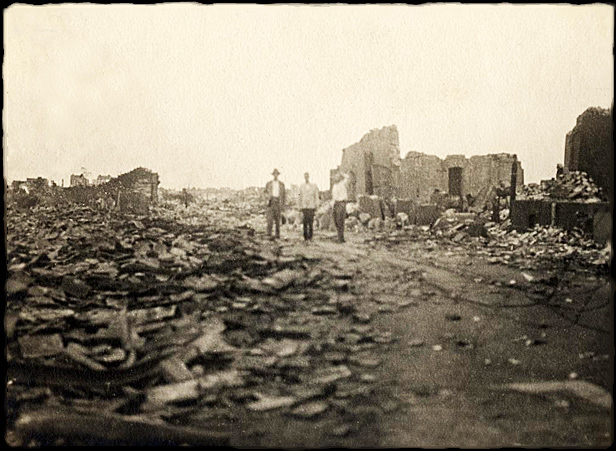
The 1923 Great Kanto Earthquake is easiest to summarize as a catastrophe of ground, fire, and city. At 11:58 a.m. on September 1, 1923, a major earthquake struck the southern Kanto region, centered on Tokyo and Yokohama. The National Diet Library's account emphasizes the sequence that made the disaster so lethal: houses and buildings collapsed, lunch-time stoves helped ignite fires, and residential districts burned into a broader urban conflagration.[1]
That account is necessary, but it is not sufficient. The historical debate begins when the fires stop being the whole story. In the hours and days after the quake, rumors spread that Korean residents were rioting, poisoning wells, or setting fires; Koreans, Chinese, and some Japanese were killed, and socialists were arrested amid the same panic.[1] A disaster that physically destroyed two cities also exposed the political wiring of empire, policing, class anxiety, and urban reform.
The strongest way to read the Kanto earthquake is therefore not to choose one interpretation and discard the others. The useful debate map has three live claims. One treats the event as an urban fire disaster, where wood construction, wind, timing, and flight patterns explain the scale of death. A second treats the aftermath as a colonial massacre, where rumor became a weapon because Korea had been under Japanese colonial rule since 1910 and Koreans in Japan were already racialized as suspect. A third treats the earthquake as a reconstruction struggle, where planners, officials, residents, and ideologues fought over whether Tokyo should be rebuilt as a different city or restored quickly to a usable one.[2][3][4]
Interpretation one: the city burned because the quake hit a combustible system
The disaster interpretation starts with material conditions. The National Diet Library's account foregrounds collapsed buildings, lunch-time stoves, residential fire, and catastrophic urban conflagration.[1] AP's centennial report gives the modern public shorthand: a 7.9-magnitude earthquake near noon triggered an inferno in a region of paper-and-wood homes.[5] This is not a minor engineering footnote. It explains why an earthquake became a fire disaster.
The time marker matters. A late-night earthquake would have found fewer cooking fires. A noon earthquake on the first day of September struck when households were preparing lunch. A city built heavily from wood and paper could absorb some tremor damage and still become unmanageable once fire moved faster than evacuation. The most horrific example is the former Army Clothing Depot site, where Japan's National Research Institute of Fire and Disaster says a whirlwind swept through an empty lot where people had sought shelter, causing about 38,000 deaths at that one site.[2]
This interpretation protects the event from moralized simplification. The earthquake was not punishment, fate, or a single governmental failure. It was a coupled system: geology, housing material, fuel, weather, water infrastructure, street capacity, and panic movement. The problem is that a purely infrastructural account can make human violence look secondary, as if massacre was an unfortunate social aftershock rather than part of the disaster's historical core.
Interpretation two: rumor did not merely spread; it organized violence
The massacre interpretation starts from the same chaos but asks who became legible as dangerous inside it. The National Diet Library states the baseline plainly: rumors about Korean residents spread shortly after the quake, and many Koreans, Chinese, and some Japanese were slaughtered.[1] That is already enough to reject accounts that remember only collapsed buildings and fires.
Kenji Hasegawa's study of Yokohama sharpens the issue. In his abstract for Monumenta Nipponica, he argues that the Kanto Massacre was largely a product of rumor, but not simply rumor as loose civilian talk. He examines how rumors were sanctioned and promoted through police-channel orders calling for watchfulness, rallying police and vigilantes toward violence in Yokohama.[3] That moves the explanation from "mob panic" toward a more disturbing model: rumor as an administrative and social connector.
This distinction matters because the official story could isolate violence as spontaneous disorder. Hasegawa's argument makes the boundary harder to draw. If police warnings, vigilante mobilization, protective-custody language, and colonial suspicion reinforced one another, then the massacre was not outside the disaster response. It was one of the ways response operated under panic.
The numerical record remains contested. AP's centennial report notes that there is no official number for the killings and that historians say as many as around 6,000 people were murdered, including Koreans, Chinese, Japanese people mistaken as Korean, and Japanese leftists or labor activists.[5] The point is not that a news account settles the total. The point is that archival recovery and public memory keep reopening the gap between official minimization, survivor testimony, local documents, and later scholarship.
Interpretation three: reconstruction became a fight over what kind of society had failed
The reconstruction interpretation begins after immediate rescue, but it does not leave the disaster behind. J. Charles Schencking's book, as described by Columbia University Press, treats the earthquake as a moment when citizens and elites debated not just how to rebuild Tokyo but what the disaster meant for Japanese society.[4] Some imagined a grander modern metropolis. Others wanted the quick return of familiar city life. Elites saw a chance to build state infrastructure and social discipline into the urban fabric.[4]
This is where the debate becomes more than urban planning. If the quake was read as proof that modern urban life had become morally or socially degraded, rebuilding could become a project of national correction. If it was read as a technical failure, the answer might be wider roads, firebreaks, parks, bridges, and more capable public works. If it was read through imperial anxiety, policing and surveillance could appear as reconstruction tools as much as emergency measures.
Schencking's framing also challenges the comforting idea that disasters create a blank slate.[4] Tokyo was not rebuilt by neutral necessity. Budgets, landowners, residents, bureaucrats, and political priorities all pushed back against sweeping plans. The city that emerged from the ashes carried both reform and compromise. A disaster can create urgency without creating agreement.
Where the interpretations collide
The three interpretations disagree less about whether the earthquake was devastating than about where causation should stop. The fire-disaster reading says the decisive mechanism was the built environment under seismic shock. The massacre reading says the decisive mechanism includes colonial rumor and official-vigilante coordination. The reconstruction reading says the disaster's meaning continued through policy, memory, and urban form.
Each reading can become too narrow. The infrastructure account can underplay racialized and political violence. The massacre account can flatten the physical disaster that made fear plausible and movement chaotic. The reconstruction account can become too elite-centered if it treats planners and officials as the main historical actors while victims, migrants, workers, and targeted minorities fade into the background.
The better synthesis is sequential. First, a noon earthquake broke a combustible metropolitan system on September 1, 1923.[1][2][5] Then fire, displacement, communications failure, and fear created a social field in which rumor could move quickly. But rumor did not need to invent prejudice from nothing; it drew on colonial rule, labor tension, nationalist suspicion, and police authority.[1][3][5] Finally, the ruined city became an argument about order, modernity, and national renewal rather than a purely technical rebuilding site.[4]
That synthesis also explains why centennial memory remains contentious. In 2023, AP reported that Japan marked 100 years since the quake with disaster drills and memorials, while also noting that thousands of ethnic Koreans were killed after baseless rumors and that the rampage has never been fully acknowledged by the government.[5] The afterlife of the event is therefore split between disaster preparedness and historical responsibility.
What would change the assessment
New evidence would not need to prove that fires mattered or that massacres happened; both claims are already well grounded. The open questions are about scale, coordination, and memory. More local police records, court files, survivor testimony, municipal correspondence, and Korean or Chinese community records could clarify how orders moved, how vigilante groups formed, where custody became danger, and how officials counted or concealed victims.
The stakes are not only moral. They are methodological. A history that stops at the earthquake can explain the ruins but not the killings. A history that starts only with rumor can explain the killings but not the disaster environment that accelerated panic. A history that celebrates reconstruction can explain boulevards and bridges but miss the people whose deaths or dispossession made the rebuilt city politically uneven.
The Kanto earthquake should be remembered as a disaster, but not only as one. It was a firestorm, a massacre, and a reconstruction struggle. The image of men standing in ruins is true; the danger is mistaking visible ruin for the full event. The historian's task is to keep following the chain after the camera stops: from broken streets to rumor routes, from police warnings to vigilante violence, from emergency governance to the long argument over what Tokyo's ashes were supposed to authorize.
Sources
- National Diet Library, "3-11 Great Kanto Earthquake of 1923," Modern Japan in archives, with official summary, diary context, and image captions.
- National Research Institute of Fire and Disaster, "Elucidating the phenomena of whirlwinds and fire whirls in urban fires," official research page discussing the 1923 Army Clothing Factory fire-whirl deaths.
- Kenji Hasegawa, "The Massacre of Koreans in Yokohama in the Aftermath of the Great Kanto Earthquake of 1923," Monumenta Nipponica 75, no. 1 (2020), article abstract and publication page.
- J. Charles Schencking, The Great Kanto Earthquake and the Chimera of National Reconstruction in Japan, Columbia University Press, 2013, publisher page.
- Mari Yamaguchi, "Japan marks 100 years since the devastating Great Kanto Quake, with disaster drills nationwide," Associated Press, September 1, 2023.
- Brown University Library Center for Digital Scholarship, "The Great Kanto Earthquake of 1923," project page describing the Dana and Vera Reynolds archival photograph collection used for the article image.