Elizebeth Smith Friedman is often introduced with the phrase "America's first female cryptanalyst," but that label can make her sound like an exception in a field that was already settled.[1][5] The sharper historical point is that the field itself was still being made. Friedman's career ran from a private Illinois laboratory in 1916, through Prohibition enforcement in the 1920s and 1930s, into World War II work against Axis communications in the 1940s.[1][4][5] At each stage, she turned a fragile skill into something institutions could use: pattern recognition became evidence, evidence became courtroom testimony, and secret wartime work became a capability that others later claimed.
This microhistory asks one question: how did a literature-trained woman working with pencils, intercepted radio traffic, and a small staff become useful to federal power before the United States had a mature codebreaking bureaucracy? The answer is not that Friedman was simply brilliant, though she was. It is that she translated cryptanalysis into institutional forms other people could act on. Coast Guard officers could seize ships. Prosecutors could explain conspiracies to juries. Diplomats could contest ownership claims. Wartime agencies could map clandestine networks in South America.[1][2][3][5]
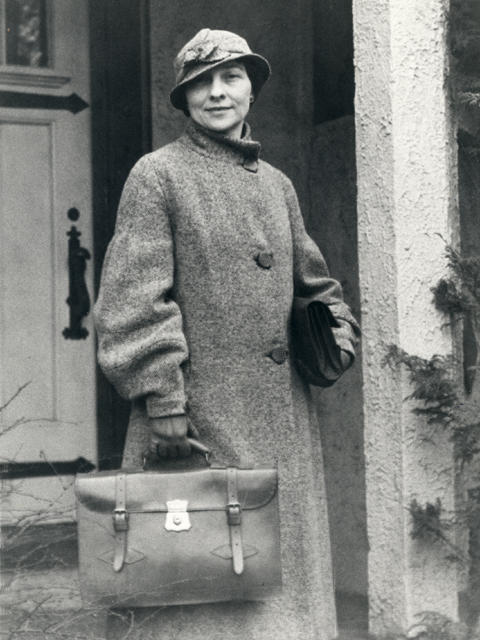
The cover photograph shows Friedman standing with a briefcase, not at a machine bank or a command table.[6] That visual restraint matters. Her most consequential work often looked unspectacular from the outside: paper, frequency logs, trial exhibits, and long sequences of letters tested until a system gave way.
Timeline anchors
- 1915-1917: Friedman finished college, entered George Fabyan's Riverbank Laboratories, met William Friedman, and by World War I helped direct an unofficial codebreaking team for the U.S. government.[1][4]
- 1921-1927: the Friedmans moved to Washington; Elizebeth worked across War, Navy, Treasury, and then Coast Guard-linked assignments as Prohibition turned smuggling into a radio-and-cipher problem.[1][2][4]
- 1929-1934: her decryptions shaped the I'm Alone dispute, the Consolidated Exporters Corporation prosecution, and other rum-running cases.[1][2][3]
- 1931: NSA's Hall of Honor account says she had convinced Congress of the need for a seven-person cryptanalytic section.[1]
- 1941-1944: after Pearl Harbor, her Coast Guard unit was detailed to the Navy; later accounts place her at the center of work against Nazi-linked communications in South America.[5]
- 1969-1980: the Friedman cryptologic library and papers went to the George C. Marshall Foundation, preserving the archive that later allowed historians to recover more of her role.[4][5]
These dates keep Friedman from becoming a single hidden-genius anecdote. Her career is better understood as a sequence of translations: from literary code hunting to military training, from maritime intercepts to court evidence, from wartime secrecy to archival recovery.
Riverbank gave her a false problem and a real method
Friedman's cryptologic life began in a setting that seems almost absurd in retrospect. The George C. Marshall Foundation's collection guide records that she went to Riverbank Laboratories in Geneva, Illinois, to work on the Shakespeare-Bacon authorship controversy, a project built around the idea that ciphers might prove Francis Bacon had written Shakespeare.[4] The conclusion eventually went the other way: the Friedmans' later Shakespeare work helped reject the cipher fantasy.[4] Yet the false problem was historically productive. It gave Elizebeth Smith a disciplined apprenticeship in symbols, pattern, repetition, and the danger of seeing messages where none existed.
That last danger mattered. Codebreaking is not only the art of finding hidden order. It is also the discipline of refusing attractive nonsense. By 1917, after she and William Friedman married, the United States needed people who could teach and perform cryptanalysis as war work.[4] NSA's account emphasizes that Elizebeth introduced William to the field, a useful correction to the older habit of treating her as a talented spouse orbiting a greater male cryptologist.[1] In the beginning, the expertise was shared, improvised, and in some respects built as they went.
The institutional landscape was equally improvised. The Marshall guide says the Friedmans acted as directors of an unofficial codebreaking team employed by the national government during World War I.[4] That phrase matters. "Unofficial" does not mean unserious. It means the United States was still assembling the habits, offices, and authorities that would later look obvious in an intelligence state. Friedman learned cryptanalysis before the field had a secure bureaucratic home.
Prohibition made codebreaking operational
Prohibition gave Friedman the problem that made her work visible. The Coast Guard's historian describes a service trying to police thousands of miles of coastline with limited ships and personnel while smugglers used radio transmitters, coded traffic, and international routes.[2] By the mid-1920s, the Coast Guard had accumulated hundreds of coded messages from rum runners and shore stations, and Friedman was brought back into federal work. In 1925, she received a Treasury special-agent badge because the Coast Guard still sat inside the Treasury Department.[2]
The scale was small before it was famous. The Coast Guard account says the entire cryptanalytic unit at first consisted of Friedman and a clerk, working with pencil and paper.[2] That detail should not be romanticized into a lone-hero story. It is more useful as a measure of institutional mismatch. Smuggling syndicates were using radios, vessels, money, and jurisdictional confusion. The federal response initially depended on two people converting streams of letters into actionable knowledge.
NSA's Hall of Honor page says Friedman solved more than 12,000 rum-runners' messages while working for the Coast Guard and Bureau of Foreign Control.[1] The Coast Guard's Long Blue Line repeats the 12,000 figure and locates the intercept geography from Vancouver and Mexico to Newfoundland, the Bahamas, Cuba, and British Honduras.[2] Those numbers matter because they show cryptanalysis becoming routine labor rather than a single spectacular solve. Repeated decryption let enforcement move from reacting to ships toward anticipating routes, ownership, and conspiracies.
The I'm Alone case shows the mechanism. In March 1929, Coast Guard cutters pursued and sank the Canadian-registered schooner after a long chase, creating a diplomatic dispute.[2] Smithsonian's Prohibition account explains that Friedman concentrated on messages tied to the vessel and helped establish that American ownership and smuggling intent sat behind the Canadian flag.[5] The result did not erase U.S. liability completely, but it changed the scale of Canada's claim and gave the American side an evidentiary basis.[2][5] Codebreaking had become diplomatic leverage.
The courtroom forced cryptanalysis into public language
Friedman's New Orleans testimony in the Consolidated Exporters Corporation case is the most revealing public scene in her career. Smithsonian describes the prosecution's problem clearly: the government had to connect defendants to hundreds or thousands of encrypted messages moving among ships, shore stations, and headquarters.[5] A solved message was not enough. A jury needed to understand why the solution was reliable.
That is where Friedman did something historically larger than break a code. She explained a method. Smithsonian says she asked for a chalkboard and walked the jury through cipher charts, substitution systems, code books, and letter patterns.[5] NSA's two-page history of the rumrunner work notes that when defense attorneys objected that her conclusions were opinion, Friedman answered that they were "not a matter of opinion."[3] The quote is short, but the claim is large. She was arguing that cryptanalysis could be presented as expert evidence, reproducible enough to survive adversarial challenge.
The trial began on May 1, 1933, in the U.S. District Court for the Eastern District of Louisiana.[3] NSA's account says the Consolidated Exporters Corporation messages were enough for the Department of Justice to press charges, and that ringleaders were convicted and sentenced to two years in prison.[3] The chief prosecutor later concluded that without Friedman's expert testimony, the case could not have been won.[3] Whether one admires Prohibition enforcement or sees it as a flawed policy project, the institutional lesson is distinct: Friedman helped make encrypted traffic legible to law.
This is the bridge between biography and state formation. A person trained in language and pattern did not merely solve puzzles for officers. She taught courts how to treat cipher solutions as evidence. That made future enforcement more imaginable.
Wartime secrecy erased the public proof
World War II changed the terms of Friedman's work again. Smithsonian's later account of the PBS documentary says that after Pearl Harbor in 1941, the Navy took over her Coast Guard unit and that Friedman, then a civilian woman, lost the direct authority she had exercised earlier.[5] The same account places her team in work against German spy communications in South America, including the breaking of multiple Enigma-based codes and the exposure of networks linked to Johannes Siegfried Becker.[5]
Here the evidence chain becomes more complicated, and the article should keep that boundary visible. Unlike the Prohibition trials, the wartime work could not be fully performed in open court or press coverage. Later recognition depends heavily on declassified records, documentary work, and archive-based reconstruction.[4][5] Smithsonian reports that many Americans knew little of Friedman's World War II role until records were declassified in 2008, and that J. Edgar Hoover and the FBI claimed credit for successes to which Friedman and her team had materially contributed.[5]
That erasure was not accidental noise around the edges. It was part of how secret work enters public memory. Friedman's Prohibition courtroom success made her expertise visible because legal procedure required explanation. Her wartime success became easier to appropriate because secrecy prevented the same public demonstration. She could do the work, but she could not narrate it.
The Marshall Foundation archive is therefore more than a research convenience. The collection guide records correspondence, government files, personal materials, clippings, journals, calendars, and materials from across her life and work.[4] Those boxes are the delayed courtroom: the place where later historians can test claims, separate legend from evidence, and restore some of the institutional credit that wartime secrecy and bureaucratic publicity had distorted.
The real legacy is translation
Friedman's career is easiest to admire as individual brilliance, but its deeper historical pattern is translation. At Riverbank, she translated literary curiosity into analytic discipline.[4] In Prohibition work, she translated intercepted radio traffic into routes, ownership, and prosecutable conspiracies.[1][2][3][5] In court, she translated cryptanalysis into a public method a jury could trust.[3][5] In World War II, she translated clandestine traffic into geopolitical intelligence while accepting a silence that helped others claim the story later.[5]
That is why the briefcase portrait is so apt.[6] It does not show the drama of secret war. It shows portable expertise: a woman able to carry a method into whatever institution had finally realized it needed one. Elizebeth Friedman did not merely break codes. She made codebreaking usable by a federal state that repeatedly needed her skill before it fully knew how to value, protect, or credit it.
Sources
- National Security Agency, "Elizebeth S. Friedman" - Hall of Honor biographical account, Prohibition-era message totals, Coast Guard work, congressional section-building, and 1930s cases.
- Dr. David S. Rosen, "The Long Blue Line: Mrs. Friedman--the Coast Guard's 'Cryptologist-in-Charge' and NSC namesake," U.S. Coast Guard, February 7, 2022 - Coast Guard institutional context, coded radio geography, Treasury badge, and the I'm Alone case.
- Patrick D. Weadon, "A New Kind of Detective Work: Cryptology, Elizebeth Friedman and the United States Coast Guard Thwart the Rumrunners," National Security Agency - Prohibition enforcement context, Consolidated Exporters Corporation trial, and expert-testimony significance.
- George C. Marshall Foundation, "The Elizebeth Smith Friedman Collection" - archival collection guide covering Riverbank, World War I codebreaking, agency work, later interests, and the Friedman papers.
- Nora McGreevy, "How Codebreaker Elizebeth Friedman Broke Up a Nazi Spy Ring," Smithsonian Magazine, January 15, 2021 - declassification, World War II South America work, FBI credit-taking, and renewed recognition.
- Wikimedia Commons, "File:Elizebeth-Friedman.jpg" - public-domain NSA portrait used as the article image.