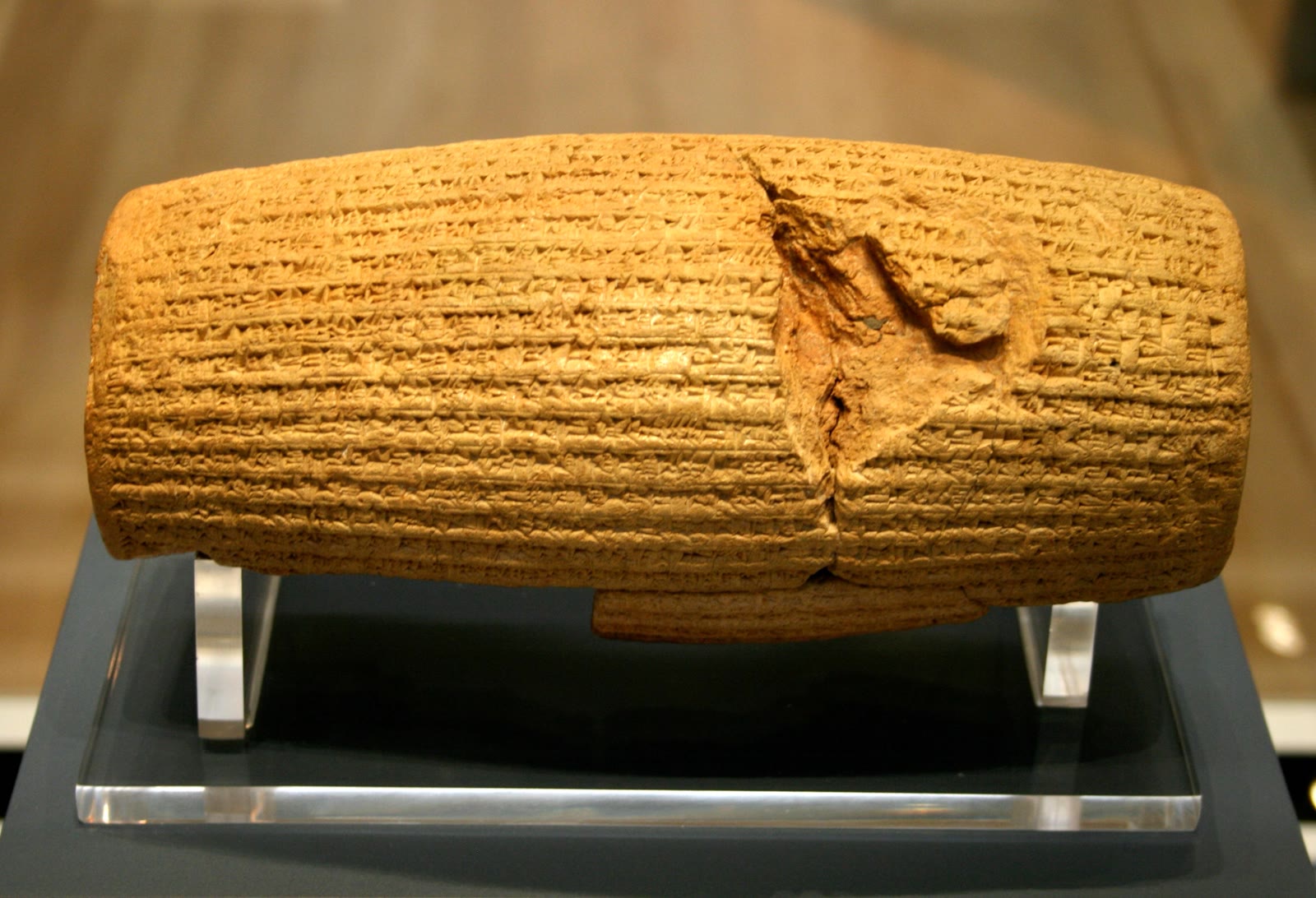
The Cyrus Cylinder is often made to carry a modern label that is too smooth for the object: first charter of human rights. That phrase is memorable, but it flattens the text. Read closely, the cylinder is not a universal declaration addressed to humanity. It is a Babylonian royal inscription composed after Cyrus of Persia took Babylon in 539 BC, written in Akkadian cuneiform, shaped for burial as a foundation deposit, and built to make a new conqueror sound like the restorer of an older order.[1][2][3]
That does not make it small. It makes it more interesting. The cylinder's power lies in translation: Persian victory is rendered in the political, religious, and architectural grammar of Babylon. The inscription does four things in sequence. It discredits Nabonidus, the defeated Babylonian king. It presents Cyrus as the ruler chosen by Marduk, Babylon's chief god. It describes returns: gods to sanctuaries, people to dwellings, cult order to damaged places. Then it turns to building work on Babylon's walls and quay.[1][2][3]
The result is a document of conquest that refuses to sound like conquest for long. It does not say, in modern language, that all people possess abstract rights. It says that Babylon's divine and urban order had been disturbed, that Cyrus entered as the chosen corrector, and that restoration made his rule legitimate.[2][4]
The Object Is Already A Political Form
The British Museum describes the cylinder as a clay object containing a Babylonian account of Cyrus's conquest of Babylon, his restoration of cult statues removed by Nabonidus, and his work at Babylon.[1] Its shape matters. The Museum notes that the cylindrical form was typical of Late Babylonian royal inscriptions and that the text shows it was written to be buried in the foundations of Babylon's city wall.[1] In other words, this was not primarily a poster for a public square. It was a foundation object, a text meant to place a claim under architecture.
The Met's exhibition account makes the same material point: the barrel-shaped cylinder was buried as a foundation deposit, inscribed in Babylonian language and script, and later found in Babylon in 1879.[3] That setting changes how the text should be read. It is both record and ritual. It preserves what the new king wanted remembered, but it also participates in the building or repair of the city. The cylinder makes political legitimacy literally foundational.
That is why the opening moves are so important. Before Cyrus can appear as restorer, Nabonidus must appear as a ruler whose disorder required correction. The text's political world is not neutral. It turns regime change into religious repair. A reader does not have to accept that claim as fact to recognize its function. The inscription is doing the work every successful conquest must do after force has opened the gate: explain why obedience to the new ruler is not merely survival.
Cyrus Becomes Babylonian By Letting Marduk Choose Him
The key close-reading move is the cylinder's divine vocabulary. Livius summarizes the text's premise sharply: Cyrus presents himself to his new subjects as the perfect ruler by copying Babylonian ideas about good governance.[2] That is the hinge. Cyrus does not need to become ethnically Babylonian; he needs to become politically legible inside Babylonian expectations.
Marduk is central to that maneuver. The inscription does not frame Cyrus simply as a Persian strongman who overwhelmed Babylon. It frames him as the ruler Marduk selected to correct Nabonidus's failures.[2] The conquest therefore becomes less an outside interruption than an inside judgment. Babylon's own god authorizes the new order.
This is imperial intelligence, not just piety. Achaemenid rule would eventually stretch across languages, cults, cities, and local elites. A ruler who can speak in local legitimacy codes does not need every province to hear the same ideological vocabulary. In Babylon, the appropriate language is temple restoration, divine favor, offerings, walls, and peace. The cylinder's political art is to make Cyrus's arrival feel continuous with Babylonian kingship even though it marks the city's incorporation into a larger Persian empire.[3]
Restoration Is The Text's Strongest Verb
The most famous passages are not about an abstract freedom. They are about return. In the Livius translation, Cyrus says he returned images of gods to their places, let them dwell in lasting abodes, gathered inhabitants, and returned them to their dwellings.[2] The Met summarizes the same claim more broadly: after Cyrus captured Babylon, the inscription records shrine restoration and the return of deported peoples.[3]
Those claims explain why the cylinder has had such a long afterlife. Restoration is a flexible political language. It can describe genuine relief after Nabonidus's unpopular cult policy; it can also serve the needs of a new ruler who wants cooperation from priests, cities, and local communities.[1][2][3] The two meanings are not mutually exclusive. A policy can be humane in effect and strategic in design.
The danger is to lift the return language out of its ancient setting and turn it into a modern rights instrument. World History Encyclopedia warns that calling the cylinder a human-rights charter is anachronistic, especially when later public versions have overstated or manipulated the text.[4] The Met likewise notes that the cylinder was never intended as a document guaranteeing human rights, even though it later acquired that symbolic importance, particularly in twentieth-century Iranian and international settings.[3]
The better reading is narrower and stronger. Cyrus did not proclaim a universal theory of individual liberty. He used restoration as a language of rule. Temples, gods, inhabitants, offerings, and walls are the objects of repair. The political subject is not the free individual; it is the ordered city and its cultic landscape.
The Building Section Keeps The Text From Becoming Pure Myth
The cylinder's final movement matters because it brings the inscription back to brick, bitumen, walls, and gates. The British Museum's object description says the text includes Cyrus's own work at Babylon and was linked to the city wall foundation.[1] The Met specifies two relevant features: the inner wall known as Imgur-Enlil, which Cyrus strengthened, and a baked brick quay wall, which he completed.[3]
This is more than construction trivia. The building language makes restoration measurable. A ruler chosen by Marduk and welcomed by Babylon still has to repair the city. The text therefore joins cosmic approval to administrative performance. Divine selection opens the claim; building work closes it.
That sequence is politically useful. If Cyrus only claimed that Marduk loved him, the inscription would be pious assertion. If he only claimed to repair a wall, it would be municipal boasting. By joining the two, the cylinder says that the right king is visible in order restored: gods returned, people settled, offerings increased, walls strengthened, and the city made stable again.[2][3]
The Afterlife Shows The Cost Of A Too-Modern Label
The cylinder's modern fame is part of its history, but it should not control the reading. The British Museum records that the object has been more or less continually displayed since its discovery in 1879, was loaned to Iran in 1971 for the 2,500th anniversary celebrations, and became the subject of press and political attention.[1] The Met notes that the cylinder began attracting increasing attention from 1958 onward, came to be called the first declaration of human rights, and was represented by a replica presented to the United Nations in October 1971.[3]
Those later uses are revealing. Modern audiences wanted the ancient object to certify tolerance, national heritage, or universal rights. The object can support part of that conversation, because the text really does emphasize restoration rather than annihilation, local cults rather than forced uniformity, and returned communities rather than permanent displacement.[2][3][4] But the cylinder's own terms remain royal, divine, urban, and imperial.
That boundary does not diminish the object. It preserves its historical force. The Cyrus Cylinder matters because it shows how conquest could be domesticated through local language. It is a document of empire learning to govern by repair. Its most important lesson is not that the ancient world secretly invented modern rights. It is that durable rule needed more than victory. It needed a story in which the conquered city could recognize itself.
Read that way, the clay barrel becomes sharper than the legend attached to it. It records a change of power, but it asks Babylon to experience that change as restoration. That is the cylinder's real political genius: it turns a foreign king into the answer to a local disorder, then buries that answer in the city's foundations.
Sources
- British Museum, "Cylinder" (collection object W_1880,0617.1941), official object page for the Cyrus Cylinder, its discovery, form, display history, and foundation-deposit context.
- Livius, "Cyrus Cylinder Translation," English translation and introduction to the Akkadian text, including the conquest, restoration, prayer, and building sections.
- The Metropolitan Museum of Art, "The Cyrus Cylinder and Ancient Persia," 2013 exhibition page with object context, excavation details, foundation-deposit explanation, restoration claims, and modern afterlife.
- World History Encyclopedia, "The Cyrus Cylinder," discussion of the modern "human rights charter" interpretation and cautions about anachronism.
- Wikimedia Commons, "File:Cyrus Cylinder.jpg," source page for the photograph of the Cyrus Cylinder in the British Museum used as the article image.