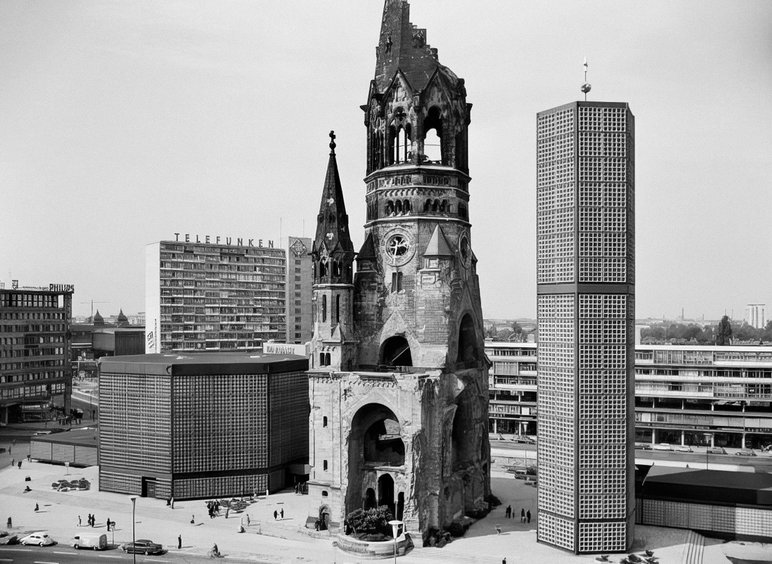
In 1957, the winning proposal for Berlin's Kaiser Wilhelm Memorial Church would have removed its most recognisable feature. Egon Eiermann planned to demolish the ruined tower and build an entirely modern group of buildings. Public opposition forced a revision.[2][4] The broken landmark survived because people wanted it to stay broken.
That decision looks inevitable from a distance. The tower now seems inseparable from the church beside it. Yet saving a ruin settled only the question of whether it would remain. What it should commemorate required further choices: about the buildings around it, the objects inside it and whose suffering visitors were asked to acknowledge.
A memorial before it became a ruin
The original church, built in 1891–1895, commemorated Kaiser Wilhelm I at the urging of his grandson, Wilhelm II. Architect Franz Heinrich Schwechten gave it a lavish neo-Romanesque form. Berlin's monument office connects its construction both to dynastic glorification and to a Protestant church-building campaign intended to counter growing Social Democratic influence.[2]
Inside the surviving entrance hall, the imperial purpose remains legible. Mosaics interweave Christian imagery with the Hohenzollern family; members of the dynasty approach Communion. The church's own interpretation describes this arrangement as an attempt to give Wilhelm's life sacred significance.[3] The visitor entered a religious space through a story about ruling authority.
Bombing in November 1943, followed by further wartime damage, transformed the building.[4] But broken masonry could not automatically cancel the ideas once displayed within it. The ruin preserved traces of the original claim to national greatness alongside evidence of the destruction that followed decades later. Those histories occupied the same stones.
The future had more than two options
Postwar debate extended beyond a choice between demolition and restoration. Werner March proposed incorporating surviving sections into a rebuilt church. His scheme lost official support as West Berlin's authorities pressed for a more modern architectural statement.[2]
The subsequent competition also permitted different treatments of the tower. Six of its nine architects proposed retaining it in some form. Eiermann was among the three who favoured demolition; after his proposal won, the foundation's trustees requested a revision within less than a week of the result becoming public.[1]
The church's retrospective account cautions that attachment to the ruin was shaped by Germans' sense of their own victimhood.[1] This later institutional interpretation cannot establish every protester's motive. It does distinguish between mourning destruction and confronting responsibility for the war. A beloved landmark could sustain attachment to the lost city while leaving harder questions about its history unanswered.
A church could continue beside the damage
Eiermann's revised design placed separate modern buildings around the tower on a raised platform. The octagonal church and hexagonal bell tower used concrete grids filled with coloured glass. Gabriel Loire's predominantly blue glazing gave the worship space its enveloping light.[4]
The new church was dedicated on 17 December 1961.[2] Its geometry allowed worship to resume in a visibly contemporary setting while the damaged tower remained nearby. Read as an arrangement of spaces, the ensemble makes renewal and historical injury simultaneously visible. Neither requires the other to disappear.
Other memories entered the buildings
A memorial installed in the new church on 20 July 1964 honoured Protestant victims of Nazi persecution. Its accompanying text also acknowledged Jews, Catholics, Social Democrats, Communists and others who had suffered in prisons and concentration camps. Berlin's district authority reproduces the inscription.[5]
That wording matters because an image of bomb damage cannot name these different experiences. An inscription can direct attention to people whose persecution would otherwise remain invisible in the exterior. It makes a more specific historical demand than a general appeal to deplore war.
The old entrance hall reopened as a memorial hall on 7 January 1987. Its bronze dedication identified a place of warning against war and destruction, and a Christian call to reconciliation.[5] The imperial mosaics remained. The room's new purpose therefore asked visitors to encounter inherited imagery within a changed account of what deserved remembrance.
Coventry's Cross of Nails made reconciliation material. The German Protestant church's account traces the symbol to nails recovered after German bombing destroyed Coventry Cathedral in November 1940; crosses modelled on that original became signs of an international reconciliation community. The Berlin church joined that community in 1987.[6] Placed within a German ruin, the cross brought the destruction of an English cathedral into the act of remembering.
Keeping a ruin requires interpretation
There is no permanent settlement between a monument and its audience. In a 2011 address celebrating the church, the EKD warned that even ruins become familiar and that their history must be explained again to younger generations.[6] The tower can remain conspicuous while the reasons for its survival grow obscure.
Its physical survival also requires intervention. Berlin's monument office described the conservation problem in 2008: exposed broken masonry had to meet structural requirements while retaining destruction as historical evidence.[2] Keeping the wound visible takes repair.
The same care is needed in interpretation. The rescued tower preserves something that a replica could not: material evidence of damage. The mosaics, inscriptions and Coventry cross ask different questions about it. Together they let visitors examine how a monument to an emperor acquired a public life that its builders could never have intended.
Sources
- Kaiser-Wilhelm-Gedächtnis-Kirche, “Ensemble aus Alt und Neu” — competition proposals, public opposition, retrospective interpretation and the 1963 saai archival photograph.
- Thomas Schmidt, Landesdenkmalamt Berlin, “Kaiser-Wilhelm-Gedächtnis-Kirche – Turmruine” (2008) — imperial origins, postwar planning, dedication chronology and conservation requirements.
- Kaiser-Wilhelm-Gedächtnis-Kirche, “Die alte Turmruine | 1895 / 1943” — the entrance hall's imperial imagery and its later interpretation.
- Landesdenkmalamt Berlin, monument record 09040472, “Kaiser-Wilhelm-Gedächtniskirche” — wartime damage, the revised ensemble and Gabriel Loire's glazing.
- Bezirksamt Charlottenburg-Wilmersdorf, “Gedenkstätte Kaiser-Wilhelm-Gedächtniskirche” — transcriptions of the persecution memorial and memorial-hall dedication.
- Evangelische Kirche in Deutschland, address for the presentation of the Kaiser Wilhelm Memorial Church commemorative stamp, 15 November 2011 — Coventry's Cross of Nails and the problem of familiar ruins.