Margaret Knight's paper bags could help establish who had invented the machine that made them. In her 1870 patent dispute, she submitted sample bags and prototype parts alongside testimony about her experiments.[1] A humble container became evidence of a sequence of decisions.
The difficulty was that Knight needed other people's hands to turn her design into durable machinery. Machinists built parts and helped develop working models. When a competing patent claim appeared, she had to show where their assistance ended and her authorship began. Her story follows that boundary from a factory in Springfield, Massachusetts, into the Patent Office—and then back to the unfinished business of making paper fold reliably.
A factory problem became her project
Born in York, Maine, in 1838, Knight received little formal schooling and entered cotton-mill work as a child. The Lemelson-MIT biography places her at the Columbia Paper Bag Company in Springfield in 1867.[2] The move brought her into a trade where a small change in an everyday object's shape presented a substantial manufacturing problem.
Flat-bottomed bags already existed, but making them by hand was slow. Mechanized bags with a V-shaped bottom were a different proposition.[7] Knight's opportunity lay in automating the more useful shape: a bag that opened into space for its contents. The desired object was easy to recognize. The necessary sequence of machine movements was harder to devise.
Economic historian B. Zorina Khan reproduces a passage from the interference report that gives the work a material chronology. Knight sketched her idea in February 1867, made a paper model the following month, and experimented with a guide finger and a folding blade. In February 1868 she attached these devices to an existing bag machine at her workplace. A wooden model followed, completed that July.[3]
This was development through successive tests. A paper model could embody an arrangement; an attachment could test it against moving material; a wooden machine could repeat the operation. The later dispute made those intermediate objects valuable because they connected the finished mechanism to work already done.
Paper had to move, then wait
Knight's patent 116,842, dated 11 July 1871, describes machinery making flat or satchel-bottom bags from a continuous paper tube. Rollers advance the paper. A guide finger holds back part of its upper edge while a blade brings the paper underneath, beginning the bottom's shape. Side folders, further folding movements, paste and a cutting knife complete the process.[4]
The crucial detail is the pause. The feed stops while the folders hold the paper and the bag is cut from the tube. Then it resumes. The machine's usefulness depends on coordinating motion with stillness: feeding at the wrong moment would interfere with work that requires the paper to remain held.[4]
Reading the specification makes Knight's achievement more tangible than calling her the inventor of a shopping bag. She had arranged a series of contacts between a flexible material and rigid parts. Each part needed to arrive, withdraw or hold its position in relation to the others.
Her earlier patent 109,224, issued on 15 November 1870, addressed another paper-handling problem. Its pneumatic feeder used suction to lift individual sheets from a pile and present them to a printing press or another machine. The specification also identified possible applications to bag and envelope machinery.[5]
That distinction matters. The sheet feeder and the later bag machine were separate inventions, even though both concerned controlling paper. One separated and delivered sheets; the other formed a bag bottom from a tube. Taken together, they show an inventor attending to the awkward transitions that determine whether a manufacturing process can keep going.
Who had directed the work?
Knight's application encountered Charles F. Annan's competing patent. The University of Maine library's account dates her interference request to 7 April 1870, with depositions following in June. The inquiry concerned who had conceived and developed the invention first.[1]
Annan's position, as the guide summarizes it, was that Knight might have had an earlier idea but had not perfected it before he did. Her answer combined physical exhibits with people who had seen the work. The guide identifies machinist William W. Abbott as a witness who described building according to her instructions. Other witnesses had observed her drawings, experiments or machine in operation.[1]
That distinction between construction and direction was central. Employing a machinist did not itself settle who had devised the mechanism. Testimony about instructions could connect a component made in someone else's shop to Knight's design. The evidence had to explain how the work happened, as well as establish that a machine existed.
Khan cautions against treating a patent interference as automatic proof of deliberate theft. Her account emphasizes the crowded field of competing bag-machine inventions and reproduces the report's finding that witnesses corroborated Knight's development history.[3] The strongest conclusion is also the most useful one here: Knight substantiated her claim to the disputed design. A claim about Annan's private motives would require additional evidence.
The favorable outcome retained a sting: the guide reproduces an examiner's language attributing limitations in business persistence to Knight's sex.[1] Recognition could coexist with a patronizing account of her abilities.
Winning left more work to do
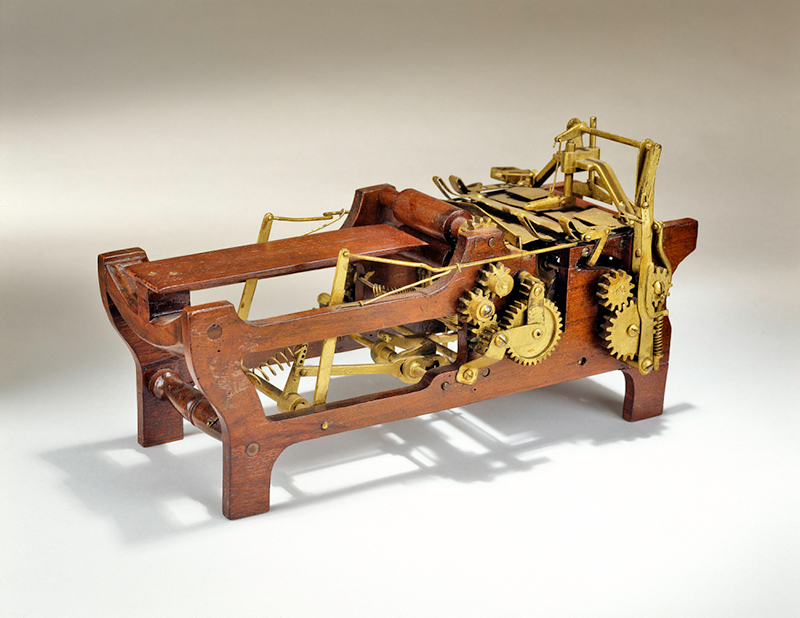
Knight went on to cofound the Eastern Paper Bag Company in Hartford, Connecticut.[2] Yet the model pictured above belongs to 1879, not to the moment when she secured her 1871 patent. It preserves another round of thinking.
Patent 220,925, dated 28 October 1879, explicitly identifies itself as an improvement on the earlier bag machine. Knight describes an auxiliary feeding blade working with the main folding blade and side folders. The objective was to form the bottom rapidly without tearing or pulling the paper out of shape; she claimed the arrangement enabled faster running with less waste.[6]
A small addition changes how we read the biography. Winning priority had answered a question about past work. It had not exhausted what the machine could become. Paper could still strain, folds could lose their uniformity, and the coordination of blades could still be improved. The patent gives those practical concerns more space than any celebration of a completed breakthrough.
Knight continued patenting inventions in other fields, including shoe manufacturing, and lived until 1914.[2] But the two bag-machine patents already offer a compact portrait of her working life. She could identify a useful operation, translate it into interacting parts, direct its construction and return to its weaknesses. The bags that helped establish her authorship were evidence of an inventive practice she kept pursuing.
Sources
- University of Maine Libraries, “The First Patent...And The Legal Battle,” Margaret E. Knight research guide — interference chronology, exhibits, supporting testimony and the examiner's decision.
- Lemelson-MIT, “Margaret Knight” — early life, employment in Springfield, the Eastern Paper Bag Company and later inventions.
- B. Zorina Khan, “Notable Women Inventors of Maine,” Bowdoin College, 6 February 2022 — interpretation of the dispute and an extended excerpt from the patent interference report documenting Knight's prototypes.
- Margaret E. Knight, US Patent 116,842, “Improvement in paper-bag machines,” 11 July 1871 — specification describing feeding, folding, pasting and cutting.
- Margaret E. Knight, US Patent 109,224, “Improvement in paper-feeding machines,” 15 November 1870 — pneumatic sheet feeding and proposed applications.
- Margaret E. Knight, US Patent 220,925, “Improvement in paper-bag machines,” 28 October 1879 — auxiliary feeding blade, coordinated folding and claimed reductions in waste.
- Michael Abrams, “Margaret Knight,” American Society of Mechanical Engineers, 23 May 2012 — earlier bag-making methods and a photograph of the Smithsonian's 1879 patent model.