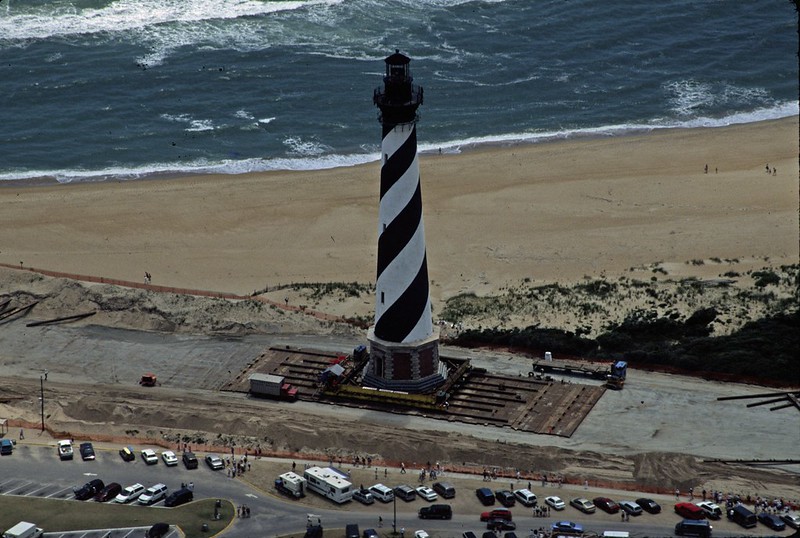
On 17 June 1999, the Cape Hatteras Lighthouse began a journey that would carry it 2,900 feet across Hatteras Island. Hydraulic jacks advanced the tower along a track in increments of about five feet. After each stroke, the equipment had to reset before the next push. On 9 July, after a journey spanning 23 days, the lighthouse reached its new site.[1]
That slow procession was the visible end of a much longer argument. Preserving a lighthouse ordinarily suggests keeping it firmly attached to its foundations. At Cape Hatteras, the shoreline was moving while the tower stayed put. Eventually, survival required separating the historic structure from the ground beneath it.[2]
The remarkable part was how much the move attempted to keep together. The black-and-white tower would travel intact. The keepers' houses and other supporting structures would also move, retaining their arrangement around it. This was the relocation of a working place with a history, requiring decisions about both its masonry and its setting.[2]
The sea kept revising the site
Completed in 1870, the lighthouse originally stood about 1,500 feet from the ocean. By 1970, the distance was roughly 120 feet. Storms redistributed sand across the barrier island, eroding its ocean side and depositing material toward the sound. Attempts to defend the tower included groins, beach nourishment and sandbags. They did not make its location permanent.[2][3]
In 1980, the National Park Service began planning a longer-term response. Relocation was initially dismissed as impractical; a protective seawall emerged as the preferred option. That approach carried its own uncomfortable prospect: as the surrounding coast retreated, the defended lighthouse could eventually stand on an island.[3]
The choice therefore involved two different kinds of loss. Moving endangered the building during a concentrated operation and changed its historic location. Staying exposed it to continuing erosion, with protection measures potentially transforming the setting anyway. The apparent simplicity of leaving it alone concealed a substantial intervention of its own.
The 1988 National Academy of Sciences study recommended relocation. A North Carolina State University review endorsed that approach in a report issued in January 1997, and congressional funding began in fiscal 1998.[3] Technical endorsement had arrived well before construction money.
The paperwork preserves the distance between a recommendation and agreement. The Outer Banks History Center's collection PC.5003 holds reproductions of 317 documents assembled in connection with litigation over the move. Its finding aid lists environmental reports, engineering memoranda, cost estimates and opinions from opposing lighthouse committees. The collection spans documents dated from 1967 into early 1999.[4] It records an extended contest over the acceptable way to save the same landmark.
Later recollections convey the argument's personal force. Reporting on the twentieth anniversary in 2019, WUNC described former opponent Danny Couch acknowledging that relocation had saved the lighthouse. Terry Ann Jennette Ponton, granddaughter of its last keeper, recalled being asked to leave her godfather's house after supporting the move.[5] These are retrospective memories, rather than a measure of opinion across the island. They nevertheless explain why a successful engineering calculation could not, by itself, settle the dispute.
Changing what carried the weight
The reconstruction becomes unusually concrete in engineer Paul C. Cloyd's paper, presented to an ICOMOS symposium in October 1999. Cloyd had chaired the contractor-selection committee. His account follows the transfer of weight beneath the tower: selective cutting of the old foundation, temporary shoring, installation of steel beams, then a coordinated hydraulic lift. A diamond cable saw helped create the separation between the lighthouse and the foundation below.[6]
International Chimney Corporation led the project, assisted by Expert House Movers and other contractors. The tower was raised about six feet so that the equipment for horizontal travel could be installed underneath.[3] The operation depended on a succession of supports. The tower's weight always needed somewhere to go as workers changed what carried it.
Cloyd distinguishes lifting from travel. The lifting system raised its points together. During movement, three hydraulic zones cushioned the structure and let operators correct its alignment over irregularities in the route. Crews monitored jack pressures and the tower's position. The objective was to limit the stresses transmitted into the masonry.[6]
That distinction explains the apparent contradiction in the photographs. A tall brick building could move because the temporary machinery beneath it accommodated conditions the building itself could not safely absorb. The hydraulic system made small adjustments; the lighthouse was supposed to retain its shape.
A railway that moved with its passenger
The journey began on 17 June. Each approximately five-foot advance was followed by retraction and resetting of the push jacks.[1] Cloyd describes another repeating operation: crews recovered the steel matting behind the tower and transferred it ahead. Only part of the travel system was laid out at any one time.[6] The route was longer than the railway assembled beneath the lighthouse.
Meanwhile, sixty automated sensors tracked such conditions as load transfer, tilt and vibration; a weather station monitored conditions at the top.[3] Progress meant advancing the building while continuing to check what the movement was doing to it. The interruptions between strokes were part of the method.
The Park Service's move summary puts the journey at 23 days, following more than a year of preparation, and gives the project cost as $11.8 million.[1] Those different timescales matter. The brief spectacle depended on surveying, design, reinforcement and the construction of temporary support before horizontal travel could begin. Treating the first push as the start would leave out much of the work that made it possible.
What arrived on 9 July
When the tower reached its destination, its companions were already there: the keepers' quarters, oil house and other elements had been moved earlier that year. Their relative placement was retained, allowing the group to remain legible as a light station.[2] The result preserved relationships as well as individual buildings. A tower standing alone would have told less of the story of keeping a light operating.
Arrival did not mean that installation was complete. A contemporary NPS report issued on 7 September 1999, after Tropical Storm Dennis, recorded that the lighthouse had not yet been placed on its new foundation. The report said the tower had escaped harm, while the surrounding communities and park were dealing with flooded roads and disrupted electricity.[7] The lighthouse had finished travelling; the rescue still had work to do.
The beacon finally returned on 13 November 1999. An NPS account of the ceremony records a flare signalling the relighting and park historian Rob Bolling throwing the switch.[7] Arrival, installation and return to service belonged to different stages of the rescue.
Relocation also left a problem behind. Granite stones engraved with keepers' names marked the old position, but overwash and burial subsequently affected them. The Park Service's 2015 coastal-adaptation case study records their relocation into a new amphitheater near the lighthouse. It also acknowledges that sea-level rise and storm surge could threaten the tower's new site in the future.[8]
The smaller move of those memorial stones is a useful ending to the larger one. Saving the tower did not suspend the coastal processes that had endangered it. It bought distance and preserved a coherent historic place while accepting that its stewardship would continue. The lighthouse's 23-day journey succeeded through close control of movement; its longer survival required abandoning the expectation that preservation always means staying still.
Sources
- National Park Service, “The Move” — dates, distance, incremental movement, preparation and cost.
- National Park Service, “Landscapes of Change: Cape Hatteras Lighthouse” — shoreline history, arrival and preservation of the station's spatial relationships.
- National Park Service, “Moving the Cape Hatteras Lighthouse” — planning history, contractors, lifting, monitoring, return to service and archival photographs.
- Outer Banks History Center, “Administrative Record for the Relocation of the Cape Hatteras Light Station,” PC.5003 — collection finding aid describing the litigation record.
- Will Michaels, “Park Service Celebrates 20 Years Since Moving Cape Hatteras Lighthouse,” WUNC, 1 July 2019 — retrospective recollections of local opposition.
- Paul C. Cloyd, “Saving the Cape Hatteras Light Station from the Sea,” ICOMOS General Assembly and Symposium, 17–23 October 1999 — participant account, especially “Technical Move Method”; PDF preserved by NPS History.
- National Park Service Morning Reports, 7 September and 24 November 1999, Cape Hatteras entries — contemporary reports on the unfinished installation after Dennis and the November relighting; compiled by NPS History.
- John Kowlok, “Relocating the Lighthouse,” in NPS, Coastal Adaptation Strategies: Case Studies (2015), pp. 20–21 — relocation of the commemorative stones and continuing coastal risks.