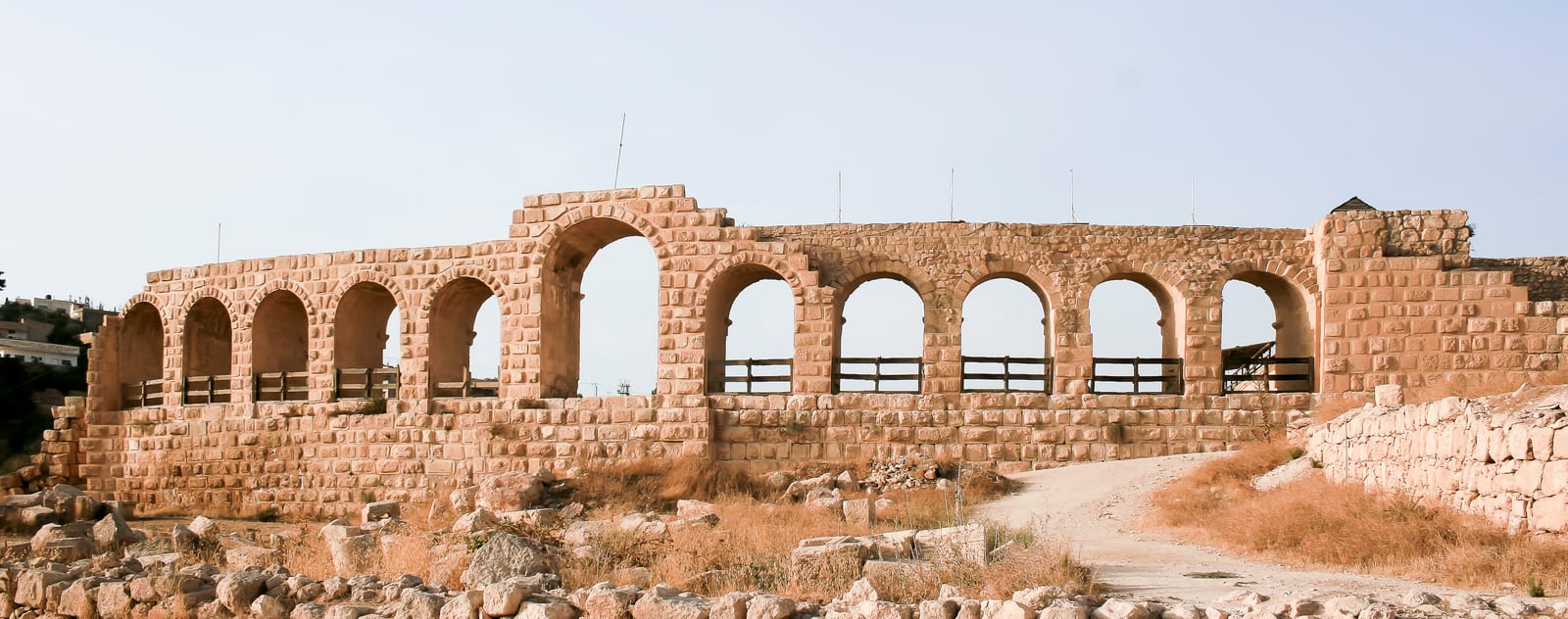
Beneath the stone seating of the Roman hippodrome at Jerash, Jordan, chambers W2 and W3 held a historical argument in unusually physical form: roughly 230 people, deposited densely and quickly with little of the spacing or ceremony of an ordinary cemetery. In 2025, researchers reported Yersinia pestis DNA from five of those individuals. A 2026 archaeological study concluded that the bodies were laid down in one crisis over days or weeks.[5][6]
The grave is direct evidence of an acute plague disaster at one eastern Mediterranean city. It is not an empire-wide death certificate.
That distinction is the center of the modern debate over the so-called Plague of Justinian. Ancient DNA has resolved the old diagnostic question: the bacterium that caused the sixth-century outbreaks was Y. pestis, the pathogen responsible for bubonic plague.[4][5] What remains unsettled is scale. Did the pandemic kill on a level that materially reorganized the late Roman world, or have vivid texts and scattered graves been made to carry a demographic claim that broad economic and environmental evidence cannot support?
The strongest answer is no longer “catastrophe” or “nothing happened.” It is a layered one: a pathogen can travel very far, strike some communities catastrophically, recur for two centuries, and still leave no defensible single mortality rate for an empire.
One name has been doing four jobs
“Justinianic plague” often compresses four questions into one. Diagnosis asks what disease killed people. Reach asks where it circulated. Local severity asks what happened in a particular place and outbreak. Historical consequence asks whether repeated mortality changed population, production, taxation, armies, settlement, or imperial power across regions. Evidence can answer one of those questions without answering the next.
The surviving chronology begins in the summer of 541, when written accounts located an outbreak at Pelusium on Egypt’s Mediterranean edge. By the spring of 542, plague had reached Constantinople. Sources then recorded it across Syria, Anatolia, Greece, Italy, North Africa, Armenia, and Gaul; recurrences followed, including another Constantinopolitan outbreak around 558, and reports continue into the mid-eighth century.[1][3]
Procopius, a contemporary historian in Constantinople, supplies the best-known narrative of 542. He describes fever, swellings, overwhelmed burial arrangements, deserted work, and daily deaths in escalating numbers. His testimony establishes what mass mortality looked and felt like to one educated observer near the imperial center. It does not function as a civil register. His largest numbers are estimates inside a literary account whose opening imagines nearly all humanity at risk.[1]
That does not make Procopius useless. It defines his evidentiary scale. He is strongest on sequence, symptoms, fear, and social disruption in Constantinople; he is weakest as the source of a precise Mediterranean death toll.
The case for a historically consequential pandemic
The consequentialist reading starts with convergence. Contemporary writers in several languages described recurring bubonic disease. Genomes now place Y. pestis in people buried from the Mediterranean’s hinterland to western and northern Europe. At Jerash, pathogen DNA sits inside a rapidly filled mass grave rather than an isolated burial. On this reading, the written and biological archives illuminate different parts of a large, uneven event.[3][4][5][6]
Peter Sarris’s 2022 intervention is the clearest recent defense of that position. He argues that the skeptical scholarship understates both the geographical spread revealed by ancient DNA and the difficulty of turning fragmentary late-antique records into statistics. A search for plague references across surviving laws, coins, papyri, and narratives is not neutral when the material was written in several languages, survives unevenly, and was never designed to measure mortality. State documents continuing to exist after 542 demonstrate administrative survival; they do not by themselves reveal how many taxpayers, laborers, or soldiers were missing in a particular province.[3]
The strongest version of this argument does not claim that plague single-handedly “ended Rome.” The western empire had already ceased to exist in the fifth century, while the eastern empire survived the sixth-century outbreak by many centuries. The narrower claim is that survival and consequence are compatible. A durable state can absorb a severe demographic shock, shift burdens, preserve paperwork, and remain recognizable.
This interpretation is most persuasive when it stays geographically specific. Dense cities connected by shipping and grain supply need not experience plague like inland villages. A recurrence need not revisit every region equally. If plague ecology was patchy, an empire-wide average may conceal the very urban and fiscal centers where disruption mattered most.[3]
The case against an empire-sized catastrophe
The skeptical reading begins with a warning about extrapolation. In 2019, Lee Mordechai and colleagues surveyed narrative texts alongside legislation, papyri, inscriptions, coinage, pollen records, ancient DNA, and mortuary archaeology. They found no synchronized break large enough to support claims that the first pandemic removed a third or half of the Mediterranean population. Their conclusion was intentionally provocative: the pandemic’s broad demographic importance had been exaggerated.[2]
Its best argument is methodological. Detecting Y. pestis in a skeleton proves infection at that place and time; it does not supply a denominator. A positive burial cannot tell us whether ten neighbors died or ten thousand. Likewise, a horrifying account from a capital cannot be multiplied across every province. For the fourteenth-century Black Death, historians can combine richer serial records with graves and narratives. For the sixth century, that kind of demographic ledger is largely absent.[2]
The skeptical survey therefore looks for indirect traces of population loss. If deaths were both immense and widespread, one might expect sharp changes across cultivated pollen, papyri, coinage, inscriptions, or cemetery use. The authors found continuity more often than a coherent empire-wide rupture and argued that local studies should replace one grand mortality curve.[2]
That is a real evidentiary check, not plague denial. It correctly separates proof of a pathogen from proof of its prevalence. It also has limits. Pollen can register regional land use while missing an urban crisis. Surviving papyri measure preserved administration, not the population at risk. Cemeteries without precise dating can blur a brief mortality pulse across decades. An absence becomes meaningful only after the archive’s resolution and preservation biases are made explicit.[2][3]
What the genomes settle—and what they cannot count
Ancient DNA changed the debate because it answered a question texts could not close. A 2019 genomic study recovered eight new Y. pestis genomes from sites in Britain, France, Germany, and Spain. Together with earlier finds, they showed distinct strains branching within the same First-Pandemic lineage and demonstrated that infection reached well beyond the best-documented Mediterranean outbreaks.[4]
Those genomes make two propositions increasingly hard to defend: that the sixth-century disease was something other than plague, or that it was only a Constantinopolitan literary event. They do not establish how many people died between infected sites. Genomic geography is a map of confirmed presence constrained by where archaeologists have excavated, where teeth preserve DNA, which remains are sampled, and which tests succeed.[4]
Jerash brings exceptional resolution to one point on that map. The hippodrome burial dates to the mid-sixth through early seventh century. Its approximately 230 bodies were packed into two chambers in a rapid deposition. Five sampled individuals yielded closely related Y. pestis genomes; stable-isotope results also suggest varied childhood water ecologies among a potentially heterogeneous group of victims.[5][6]
This new evidence changes the balance without ending the argument. It gives the eastern Mediterranean a biomolecularly confirmed mass burial at a site near the pandemic’s earliest recorded zone. It rebuts any blanket assumption that plague-positive graves were necessarily isolated or socially minor. Yet even 230 bodies at Jerash cannot be scaled into a percentage for Constantinople, Egypt, Italy, or the empire as a whole. The grave proves local catastrophe. Its refusal to become a universal denominator is precisely why it matters.
The debate now turns on resolution
The strongest two interpretations have moved closer than their labels suggest.
One reads the plague as a widely consequential but uneven pandemic. Recurrent outbreaks, long-distance genomic evidence, and acute burials such as Jerash imply substantial losses whose effects may be obscured by resilient institutions and coarse proxies. Under this interpretation, the mistake is demanding that every regional archive show the same break before allowing plague historical weight.[3][4][5][6]
The other reads it as a real pandemic with severe local episodes but an unproven continental demographic role. Dramatic sources and pathogen-positive graves show where plague occurred, while broad proxies fail to support a synchronized population collapse. Under this interpretation, the mistake is turning confirmed reach into assumed mortality.[2]
Both positions can be tested more sharply. The consequentialist case would strengthen if tightly dated cemeteries repeatedly combined excess simultaneous burial, Y. pestis DNA, and local evidence of contraction in settlement, taxation, food supply, or labor. The skeptical case would strengthen if similarly high-resolution regional sequences showed infected burials without excess mortality and stable population indicators across multiple recurrences. Either way, evidence must be joined at the same place and time. A genome from Bavaria cannot validate a casualty estimate for Constantinople; Egyptian papyrus continuity cannot erase a mass burial in Jerash.
For now, confidence should descend by level. Confidence is high that Y. pestis caused the First Pandemic and traveled across a wide zone. It is high that particular communities suffered acute mortality. It is lower when assigning consequences across whole regions, and lowest when attaching one death toll to two centuries spanning western Eurasia and the Mediterranean.[1][2][3][4][5][6]
That hierarchy produces a less cinematic history, but a better one. An empire’s survival does not prove a pandemic was small. A mass grave does not prove an empire collapsed. At Jerash, the bodies under the hippodrome settle the reality of one disaster while preserving the boundary of what one site can say. The bacterium has a name. The demographic map still has blank spaces.
Sources
- Procopius, History of the Wars, II.22–23, “The Plague, 542,” Internet Medieval Sourcebook at Fordham University — contemporary narrative of symptoms, sequence, mortality claims, burial pressure, and disruption in Constantinople.
- Lee Mordechai et al., “The Justinianic Plague: An inconsequential pandemic?” Proceedings of the National Academy of Sciences 116, no. 51 (2019) — skeptical synthesis of texts, documents, pollen, ancient DNA, and mortuary archaeology.
- Peter Sarris, “New Approaches to the ‘Plague of Justinian,’” Past & Present 254, no. 1 (2022) — open accepted manuscript and repository record for the critique of the minimalist interpretation and review of textual, legal, archaeological, and genomic evidence.
- Marcel Keller et al., “Ancient Yersinia pestis genomes from across Western Europe reveal early diversification during the First Pandemic (541–750),” Proceedings of the National Academy of Sciences 116, no. 25 (2019) — genomic evidence for the pathogen’s reach and branching strain diversity within a single First-Pandemic lineage.
- Swamy R. Adapa et al., “Genetic Evidence of Yersinia pestis from the First Pandemic (541–750 CE) in the Eastern Mediterranean,” Genes 16, no. 8, article 926 (2025) — genomes recovered from five individuals in the Jerash hippodrome mass burial.
- Karen Hendrix et al., “Bioarchaeological signatures during the Plague of Justinian (541–750 CE) in Jerash (ancient Gerasa), Jordan,” Journal of Archaeological Science 186 (2026) — burial context, rapid deposition, isotopes, and maternal-lineage evidence from the approximately 230 individuals.
- Wikimedia Commons, “Hippodrome, Jerash, Jordan1.jpg” by Diego Delso — source page and metadata for the 2011 site photograph used as the article image.