Inside the Jeju 4·3 Peace Memorial Hall, a white gravestone lies flat beneath an opening to the sky. It carries no inscription. The museum calls it Baekbi: a blank monument waiting for the history of Jeju 4·3 to receive a name adequate to what happened.[2]
The stone is easy to misunderstand. It does not mean that the facts are blank. South Korean law defines a period beginning with the police shooting of demonstrators on 1 March 1947, passing through the armed uprising of 3 April 1948, and ending when restrictions on Mount Halla were lifted on 21 September 1954. A government investigation has described large-scale state violence. A president has apologized. Thousands of victims have been officially recognized, and testimony fills an international heritage collection.[1][2][5]
What remains unsettled is the word that should organize all of that evidence. “Incident” can sound evasive. “Uprising” centers armed resistance. “Massacre” centers the destruction of civilians. “Genocide” makes a still-contested legal and historical claim. The familiar expression 4·3 avoids choosing among them, but it also turns one date into shorthand for seven and a half years.[2][7]
Jeju's memorial culture therefore performs two tasks at once. It names people and preserves evidence with increasing precision. It refuses to make that precision look like final interpretive closure. The archive came first; the monument is still waiting.
1947–1954: a date became larger than a day
On 1 March 1947, Jeju residents gathered to commemorate the 1919 Korean independence movement. Police fired on the crowd, killing six people and wounding eight. The shooting was followed by strikes, arrests and a widening confrontation under the United States Army Military Government. On 3 April 1948, guerrillas associated with the Jeju branch of the South Korean Labor Party attacked police stations and right-wing organizations. Counterinsurgency then expanded into the destruction of villages, summary killing, detention and disappearance; guerrillas also killed civilians.[2]
That sequence matters because no single label describes every actor or phase equally well. The present Special Act does something deliberately narrower. Rather than settle the historiographical name, it defines Jeju 4·3 by a beginning, a middle and an end: the March 1947 shooting, the April 1948 disturbances, and the armed conflict and suppression operations through September 1954 in which residents were killed.[1]
The official investigation completed in 2003 estimated that 25,000 to 30,000 people died. Its victim accounting includes people killed by guerrillas as well as the much larger civilian toll associated with the crackdown. Women, children and older people appear in numbers that make a purely combatant history impossible to sustain.[2] The estimate is not the same as a complete list. Death, disappearance, destroyed villages, hurried burial and decades of stigma all damaged the record from which names could later be recovered.
“4·3” became durable partly because it could hold this complicated chronology without forcing immediate agreement over what to call the whole. Its ambiguity made public reference possible. It also stored a conflict for later generations: whether a date that enabled speech could eventually become a definition.
Silence lasted longer than the fighting
The violence ended before the system that enforced forgetting did. Bereaved families lived under guilt by association and the National Security Act. Through the 1980s, school textbooks still reduced Jeju 4·3 to a communist riot. To speak about a dead relative could invite suspicion toward the living.[2]
Memory did not disappear during those decades. It moved into forms less dependent on official permission: family accounts, private mourning, ancestral rites and literature. Chansik Park traces a breach in the taboo through Hyun Ki-young's 1978 novel Aunt Suni and Jeju residents in Seoul who quietly held an April ancestral rite, circulated books and translated material published abroad. After the 1987 democracy movement, students and civic groups brought 4·3 into public forums and commemorations; poetry, theater, visual art and Jeju shamanic ritual helped turn suppressed fragments into a public demand for truth.[3]
This distinction changes the usual story of state recognition. The government did not turn silence into memory by itself. Families, writers, journalists, researchers, civic groups and ritual specialists had already kept fragments in circulation. Democratization widened the space in which those fragments could be compared, recorded and demanded as evidence.
The brief opening after South Korea's April 1960 revolution allowed an early investigation movement, but authoritarian rule closed it again. The later campaign gathered force through testimony projects, local reporting and civic organization. On 16 December 1999, the National Assembly passed the Special Act on Discovering the Truth of the Jeju 4·3 Incident and the Restoration of Honor of Victims; it was promulgated on 12 January 2000.[2]
The law made testimony actionable
The Special Act did more than authorize a history book. Its current form gives victims and relatives a right to submit views, directs the state to respect Jeju residents in the resolution process, and assigns a prime-ministerial committee to collect records, determine victim status, prepare reports, investigate mass graves, recommend retrials, support compensation and maintain commemorative work.[1]
That machinery converted memory into claims the state had to process. A family account could help identify a victim. A prison record could support review of a conviction. A burial site could become a forensic investigation rather than a dangerous rumor. The law also connected evidence to public form: its committee's remit includes both an archive and memorial grounds.[1]
On 15 October 2003, the committee finalized its investigation report, characterizing Jeju 4·3 as a violation of human rights by state power and recommending an apology, education, further investigation, excavation, family support and a peace park. On 31 October, President Roh Moo-hyun accepted state responsibility and apologized to victims, relatives and the people of Jeju.[2]
Those acts were decisive, but they were not an ending. A statutory report can establish responsibility without absorbing every local memory. An apology can alter the state's relationship to victims without deciding how every dead person should be classified. Law is powerful at assigning duties; it is less suited to supplying one morally complete noun.
The blank stone refuses a false ending
The Peace Memorial Hall, opened in March 2008, makes that limit physical. Visitors enter through a sloping passage modeled on one of Jeju's lava caves—the kind of terrain in which residents hid during punitive operations. At the passage's end lies Baekbi. In Korean, baek can refer to white, but here it means empty: a gravestone left horizontal and uninscribed until Jeju 4·3 has what the museum considers its rightful historical name.[2][7]
This is not a neutral object. The museum around it narrates state violence, centers victims and places Jeju within a wider history of mass atrocity. Conservative critics have challenged parts of that account and disputed which names should appear among the memorial tablets. Scholars likewise disagree about whether “genocide” clarifies the history or outruns the category most Jeju residents use.[4][7]
The stone does not resolve those conflicts. It exposes them. Its blank face separates factual settlement from naming settlement. Much can be established about chronology, responsibility and suffering while the umbrella term remains politically charged. Raising the stone too soon would risk turning one victorious label into the appearance of unanimous memory.
Geonyoung Kim's study of the park describes a state-led museum that nevertheless makes room for bottom-up narratives: victims speak, state violence becomes visible inside a public institution, and visitors encounter interpretations that must be negotiated rather than merely received.[4] Baekbi is the sharpest expression of that design. The state has built the room, but the room preserves evidence that the state cannot own outright.
Names are not the same as a name
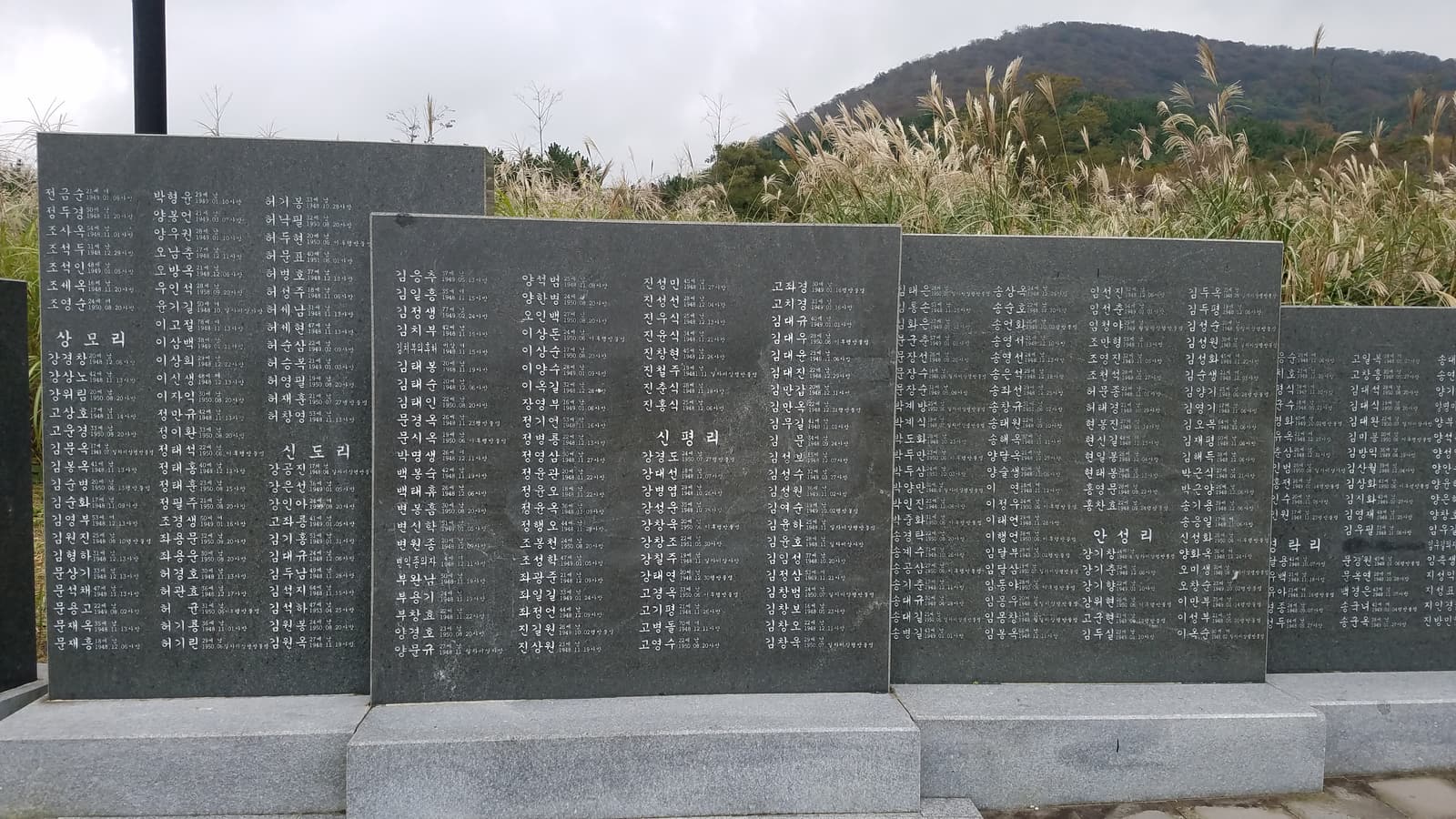
Outside that room, the memorial works in a different register. Tablets carry individual names. Families and communities can address particular dead. When researchers uncovered the remains of eleven people in Darangshi Cave in 1992, testimony, physical evidence and press reporting combined to intensify the demand for a public investigation. Ancestral rites and Jeju shamanic commemoration likewise treat the dead not as an abstract casualty total but as members of a community from which violence and secrecy tore them away.[3]
The contrast with Baekbi is exact. The wall says: identify this person. The blank stone asks: what do we call the history that killed this person? The first task can advance case by case even when the second remains disputed.
That distinction also explains why commemoration could become more official without becoming less local. In 2014, South Korea designated 3 April as a national memorial day. The ceremony gave state recognition to losses once marked as disloyal. Yet ancestral rites and Jeju shamanic commemoration continued to carry forms of relation that a national calendar cannot manufacture.[2][3]
Official and vernacular memory need not cancel each other. The park is strongest where they remain visibly joined but not collapsed: law supplies recognition and resources; families supply names, practices and claims; the uninscribed monument protects the fact that their meanings are not identical.
2025: the truth movement entered a world archive
In April 2025, UNESCO added “Revealing Truth: Jeju 4·3 Archives” to the Memory of the World Register. The collection contains 14,673 records. Testimony from victims and families accounts for 14,601 of them; the remainder includes prisoner lists and postcards, records of civil-society truth campaigns, and official investigation reports.[5][6]
The proportions are the argument. This is not primarily an archive of commands issued during the violence. It is an archive of the long work required to make suppressed experience publicly credible. Testimony vastly outnumbers the official reports because the state record rests on thousands of people agreeing to reopen family histories that earlier governments had made dangerous to tell.
UNESCO describes the collection as evidence of grassroots democratic work toward restored honor, reconciliation and coexistence.[5] That framing should not be mistaken for universal agreement. Reconciliation is documented here as a process: gathering statements, challenging stigma, comparing records, legislating an inquiry, acknowledging state violence and continuing to argue about commemoration.
The 2025 inscription therefore did not fill Baekbi. It made the reason for leaving it blank more legible. Jeju 4·3 is no longer an absence in the documentary record. It is a densely evidenced history whose public name still carries choices about resistance, civilian suffering, state responsibility, Cold War division and the boundary of the victim community.
A poor memorial would treat uncertainty as an excuse not to know. An equally poor one would treat a large archive as permission to declare every question finished. Jeju's more demanding arrangement does neither. It records individual names, preserves testimony, assigns responsibility, sustains ritual and leaves one stone on the ground.
The blank monument is not waiting for evidence. It is waiting for a name that does not erase any of it.
Sources
- Korean National Law Information Center, “Special Act on Discovering the Truth of the Jeju 4·3 Incident and the Restoration of Honor of Victims” — current statutory definition, victim rights, state duties and committee remit.
- Jeju 4·3 Peace Foundation, Handbook for the Jeju 4·3 Peace Memorial Hall (2021) — official English account of the chronology, victim estimate, truth movement, Special Act, 2003 report and apology, national memorial day, and Baekbi.
- Chansik Park, “Toward Justice in History: Achievements and Challenges on the Seventieth Anniversary of Jeju 4.3,” S/N Korean Humanities 4, no. 2 (2018) — study of enforced silence, clandestine and public commemoration, the democratization-era truth movement, testimony collection and the Darangshi Cave discovery.
- Geonyoung Kim, “Making Bottom-up Narratives in the Korean War Heritage: The Case of the Jeju 4.3 Peace Park,” Heritage, Memory and Conflict Journal 6 (2026) — open-access analysis of victim voices, state violence and negotiated interpretation in the museum.
- UNESCO Memory of the World, “Revealing Truth: Jeju 4·3 Archives” (2025) — international register entry and assessment of the collection's suppressed memories, grassroots truth work and reconciliation record.
- Permanent Delegation of the Republic of Korea to UNESCO, “Jeju 4·3 Archives and Korea Reforestation Archives Inscribed on UNESCO Memory of the World Register” (14 April 2025) — official breakdown of the 14,673-item collection.
- Guy Podoler, “Addressing a difficult past in South Korea: Was Cheju 4.3 a genocide?” Memory Studies (2025) — analysis of the unsettled terminology, contested memorial tablets and the Peace Memorial Hall's blank stone.
- GtDX8NNO3Efn2oF6q0s3, “Jeju 4.3 Peace Park — Memorial Wall” (14 October 2018), Wikimedia Commons — documentary photograph used above, licensed CC BY-SA 4.0.