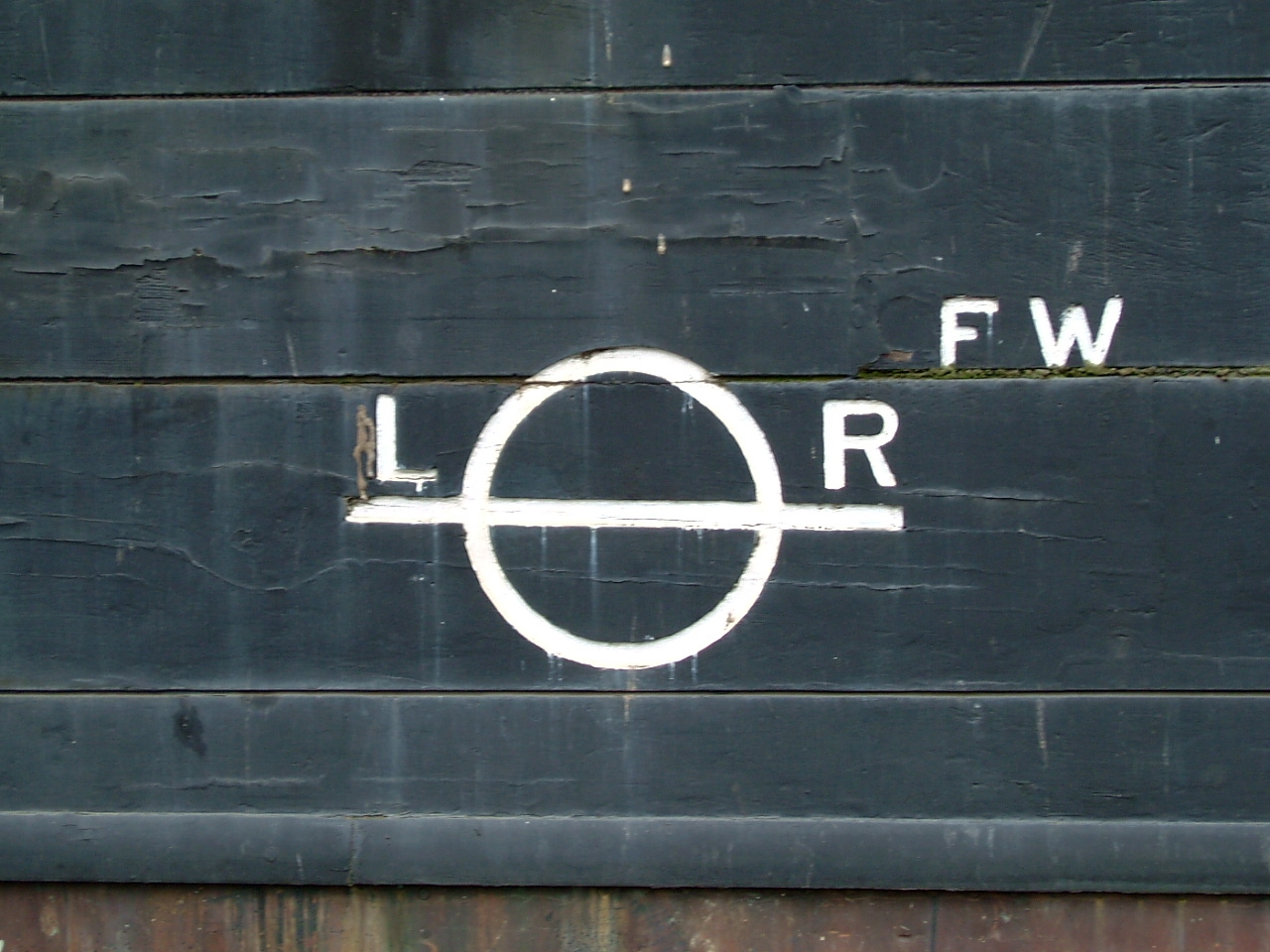
The Plimsoll line looks like a law condensed into paint. A circle crossed by a horizontal bar sits amidships, beside shorter lines for different waters and seasons. If the permitted mark disappears beneath the surface, the ship is too deeply loaded. The symbol seems to make safety self-evident: water meets line, and an invisible risk becomes visible.[6]
Its usual origin story is equally clean. Samuel Plimsoll exposed Britain's “coffin ships,” Parliament acted in 1876, and the mark that bears his name stopped owners from loading vessels past a safe limit. The story preserves a real political achievement. It also skips the strangest fact in the first permanent law: the load line was compulsory, but the shipowner chose where to put it.
That is not a minor drafting curiosity. It reveals why a mark alone cannot regulate danger. The modern load line had to be assembled in stages: campaigners made overloading a public problem; Parliament required owners to declare a limit; naval architects developed a repeatable way to calculate freeboard; surveyors applied the rule ship by ship; and certificates allowed authorities in distant ports to recognize the result. Plimsoll helped force the first breach in owner discretion. The line became a safety standard only after discretion was redistributed rather than simply erased.
The myth: Parliament painted safety onto the hull
Plimsoll's campaign mattered because nineteenth-century merchant shipping made risk easy to disperse. An owner, insurer, master, crew, cargo interest and port authority could each hold only part of the information about a vessel. Sailors might discover dangerous loading after signing on, when refusal to sail exposed them to punishment. A ship lost offshore took its evidence, and often its witnesses, with it.
In 1873, Plimsoll published Our Seamen: An Appeal, a heavily illustrated indictment of unseaworthy vessels, overloading and the incentives surrounding insured loss. The book did not invent concern about freeboard, but it gave scattered wreck statistics, testimony and accusation a political protagonist. Its surviving digitized copy also shows the method of the campaign: tables and ship particulars share space with wreck images and moral appeal.[1]
After a temporary measure in 1875, the Merchant Shipping Act 1876 made deck and load-line marking permanent for covered British vessels. This is the moment at which compressed retellings often stop. Parliament had required a line; therefore Parliament must have fixed the safe limit.
The Commons debate says otherwise. Clause 18 required the owner to mark the maximum load line he intended to observe. Plimsoll objected that an owner could place it wherever he liked. He told the House that some marks had been put level with the deck in mockery of the earlier measure, and warned that a generously positioned line could encourage foreign agents to load right down to it. His amendment sought at least to send the owner's statement to the Board of Trade.[2]
The government did not deny that the line was owner-positioned. Its defense was institutional. The Board of Trade could not survey the thousands of vessels leaving British ports at all hours, and experts did not agree on a single rule for the correct line. Making government approve every mark might falsely certify ships it had not examined. The bill therefore kept responsibility with the owner while reserving intervention for vessels believed dangerous.[2]
The result was not a modern safety assignment. It was a compulsory declaration painted where seamen, officials and insurers could see it.
The evidence: even Plimsoll said the first line was not enough
A parliamentary exchange on 27 March 1877 removes any remaining ambiguity. Asked what rules governed load-line placement, the president of the Board of Trade replied that Parliament had deliberately avoided letting government fix the lines. The duty rested on shipowners, so the Board had issued no placement rules.[3]
This evidence changes the hero story without reversing it. Plimsoll did not triumphantly design the defective compromise and mistake it for a finished system. In the 1876 debate, he identified its central weakness himself. The political victory was that owners could no longer keep intended loading wholly invisible. The unresolved question was whether the visible intention corresponded to a defensible margin of safety.
Nor was that question as simple as painting the same height on every hull. Freeboard—the vertical distance between the water and the exposed deck—preserves reserve buoyancy and reduces the danger of seas boarding the deck. A safe assignment also depends on hull form and strength, watertight integrity, stability, loading condition, water density, season and operating area. Modern marks therefore distinguish tropical, freshwater, summer, winter and Winter North Atlantic limits.[6][7]
The 1876 law possessed the symbol before the state possessed an agreed calculation. It could require an answer without yet standardizing how the answer was produced.
The missing machinery sat partly outside government
Recent archival research by Anna Finiguerra and Alex Gould shows that the gap was filled neither by Plimsoll alone nor by a suddenly capable state. Lloyd's Register, a private classification society, had accumulated ship data, technical expertise and a network of surveyors extending far beyond the personnel and jurisdiction of the Board of Trade. Its certificates also mattered to insurers, giving a nominally voluntary rule commercial force.[4]
That role should not be polished into a second uncomplicated hero story. Lloyd's Register was close to shipowning interests, and owners resisted a “hard and fast” freeboard rule that could reduce cargo. Yet the society also had what consistent implementation required: comparative information about ships, rules tied to classification, and trained people able to inspect vessels in multiple ports. Public authority needed private infrastructure even while public regulation constrained the private clients who helped sustain it.[4]
The technical hinge was a set of freeboard tables associated with Lloyd's chief surveyor Benjamin Martell. Instead of asking each owner merely to announce an intended draught, the tables related a vessel's dimensions and construction to a required margin above the water. A Board of Trade committee took evidence across 1884, then adopted the Lloyd's approach with limited modifications in 1885. The important change was not the discovery of one perfect number. It was agreement on a repeatable method and on institutions capable of applying it.[4]
This is where the painted circle acquired a chain of custody. A table could turn ship particulars into an assignment. A surveyor could connect the calculation to the actual hull. Classification could connect the survey to a certificate. Port officials could treat the certificate and mark as evidence produced elsewhere rather than begin the whole inquiry again.
In 1890, an owner's line became an assigned line
The Merchant Shipping Act of 1890 supplied the legal turn missing from 1876. In December of that year, the Board of Trade told Parliament that its surveyors had received the Load Line Committee's tables, a memorandum on their application and directions for owners seeking an official assignment. The new provisions applied to British vessels even if Lloyd's had marked them before.[5]
The contrast is exact. In 1877 the Board said it had made no rules because Parliament left the mark to owners. In 1890 it described tables and instructions for fixing the mark. The thirteen-year interval separates a declared intention from a standardized assignment.[3][5]
The later international story followed the same logic. British law could control British shipping and exert pressure on vessels using British ports, but ships routinely crossed jurisdictions. Classification societies carried compatible practices through their overseas survey networks; national regimes adopted related rules; and the 1930 international Load Line Convention gave the system a multilateral form. Finiguerra and Gould argue that the global standard grew through this mixture of law, commercial leverage, technical expertise and inspection infrastructure—not through legislation traveling by itself.[4]
The present International Convention on Load Lines was adopted in 1966. Its rules calculate freeboard while also addressing doors, freeing ports, hatchways and other openings through which water can turn low reserve buoyancy into a casualty. Zones and seasonal areas recognize that a safe margin is conditional, not universal.[7]
That larger apparatus is easy to miss when looking at the elegant mark. The paint is the interface. Behind it sit plans, formulas, vessel categories, survey practice, certificates, port enforcement and periodic inspection.
What the simple story gets right—and what it hides
Calling this a myth does not mean Plimsoll's achievement was imaginary. He helped convert lost seamen from an accepted cost of trade into a problem for Parliament. He made a hull mark politically unavoidable, and the record shows him pressing against the weakness of the owner-positioned compromise. A reform can be incomplete and still change what later reform becomes possible.
What fails is the single-moment version: one campaigner, one law, one line, safety achieved. It mistakes visibility for measurement and legislation for capacity. In 1876, Britain required owners to expose an intended limit. By 1890, tables and assigning institutions had made the limit less dependent on an owner's claim. International conventions later made certificates and marks legible across borders.
The Plimsoll line endures because it is wonderfully easy to read. Its history is valuable because it was so difficult to make trustworthy. Paint could show where the rule ended only after politics, engineering and inspection had decided where the rule began.
Sources
- Wellcome Collection, Samuel Plimsoll, Our Seamen: An Appeal (1873) — digitized public-domain copy of Plimsoll's illustrated campaign against unseaworthy and overloaded ships.
- UK Parliament, Hansard, “Committee, Progress 24th April: Merchant Shipping Bill” (27 April 1876) — primary debate on Clause 18, the owner-positioned load line, Plimsoll's objection and the government's defense.
- UK Parliament, Hansard, “Merchant Shipping Act (1876)—The Load-Line” (27 March 1877) — primary confirmation that Parliament left placement to shipowners and the Board of Trade issued no rules.
- Anna Finiguerra and Alex Gould, “Practically Becoming International: Expertise, Infrastructure and Classification Societies in Maritime Governance,” European Journal of International Relations (2025) — open-access archival study of Lloyd's freeboard tables, survey network, the 1885 committee, the 1890 settlement and international diffusion.
- UK Parliament, Hansard, “The New Load Line Law” (5 December 1890) — primary statement on the Load Line Committee tables, surveyor instructions and application to British vessels.
- NOAA National Ocean Service, “What is a Plimsoll line?” (updated 16 June 2024) — official explanation of maximum immersion and the freshwater, tropical, summer, winter and North Atlantic marks.
- International Maritime Organization, “International Convention on Load Lines” — official history and scope of the 1966 convention, including freeboard, openings, zones and seasonal areas.
- Robert Brook, “Lloydsloadlinecuttysark.jpg” (20 March 2005), Wikimedia Commons — documentary photograph of the Lloyd's Register load line on Cutty Sark, licensed CC BY 2.0.