
The most important object in Commander George F. Kosco's color film is not the battleship. It is the small green-covered table placed on the deck of USS Missouri. Around it, white caps, khaki uniforms, dark suits, cameras, railings, and gun housings crowd the frame. At it, a war spread across Asia and the Pacific is reduced to a controlled sequence: approach, sign, step away, make room for the next authority.[1]
That compression can mislead. Japan's surrender did not occur in a single clean instant. The imperial broadcast announcing acceptance of the Potsdam terms was heard on 15 August 1945; a ceasefire order went out the next day; some distant commands could not be expected to receive and obey it immediately; and a Japanese fighter attack on two American B-32 reconnaissance aircraft still killed an airman on 18 August.[3] Initial occupation movements, prisoner recovery, and regional capitulations belonged to the ending too. The ceremony on 2 September was final in a formal sense, but it stood near the center of a process rather than at the end of every gunshot.
Kosco's film matters because it shows how officials made that dispersed ending publicly legible.[1][2] The order of signatures joined three things that were not identical: the Japanese government's acceptance, the military high command's obligation to transmit and enforce it, and the Allied coalition's authority to receive the surrender and begin occupation. The deck was therefore more than a victory stage. It was a diagram made from bodies—who waited, who signed, who witnessed, and who would command next.
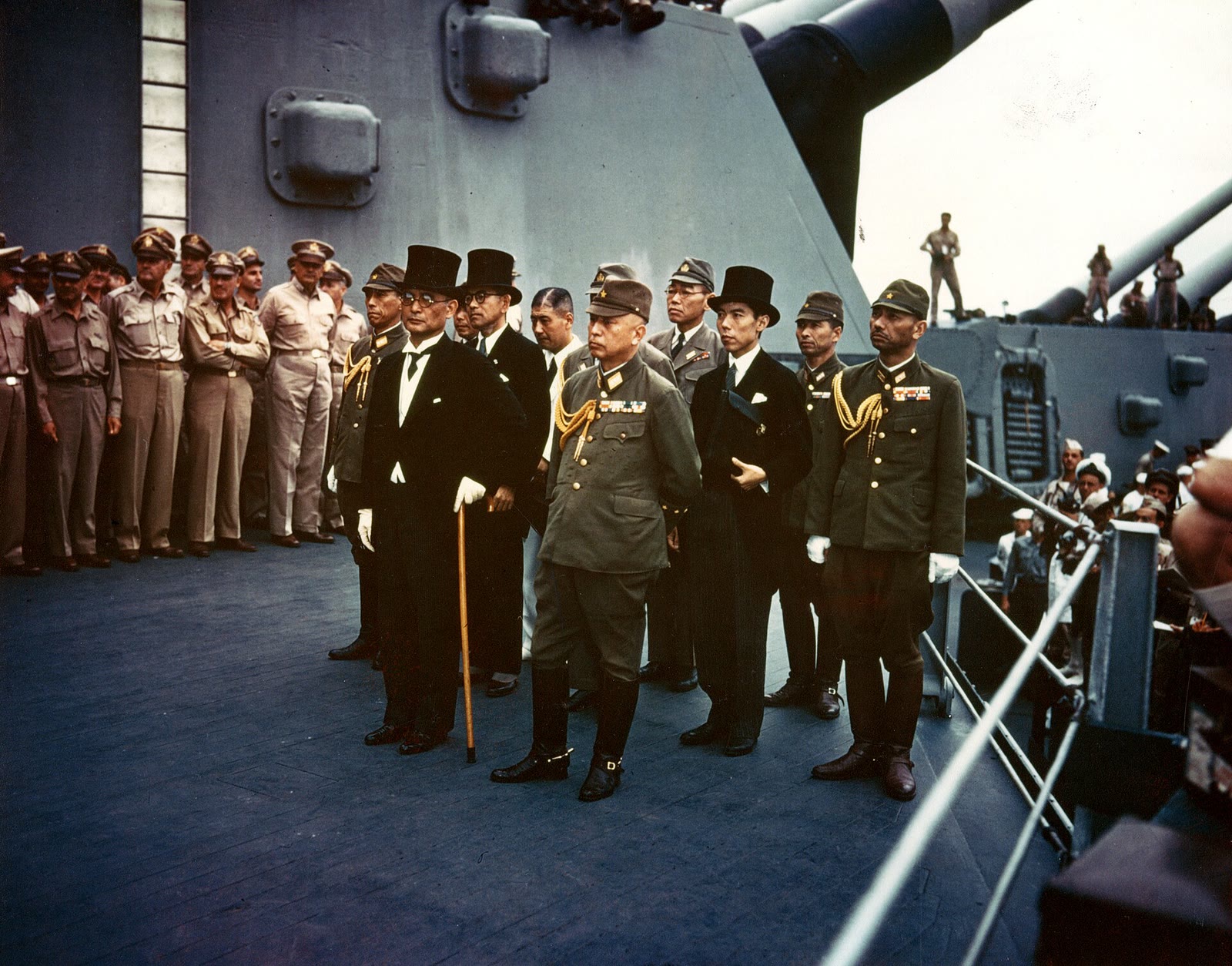
Image context: The cover is a real Army Signal Corps color photograph, catalogued as USA C-2719 and held in the U.S. National Archives. It shows Foreign Minister Mamoru Shigemitsu, in a top hat, and General Yoshijiro Umezu at the front of the Japanese delegation aboard USS Missouri. The photograph belongs here because the article's argument depends on the delegation's structure, not just the fame of the ship.[6]
A surrender spread across weeks
On 26 July 1945, the United States, Britain, and China issued the Potsdam Declaration, demanding the unconditional surrender of Japan's armed forces and setting broad terms for occupation and demilitarization.[2][3] By the middle of August, after the atomic bombings of Hiroshima and Nagasaki and the Soviet Union's entry into the war, Japan communicated that it would accept those terms. Celebration began in Allied countries before the machinery of cessation had caught up.[3]
The lag was not a technical footnote. On 16 August, orders to stop fighting began moving through a military system scattered across large parts of Asia and the Pacific. The National WWII Museum notes that Tokyo warned the ceasefire would take effect in stages and that news might take as long as twelve days to reach some units.[3] On 19 August, Japanese envoys flew via Ie Shima to Manila to receive detailed instructions from General Douglas MacArthur's headquarters.[3] A surrender announced by radio still had to become a chain of authenticated orders, local compliance, safe routes, prisoner releases, and occupation landings.
The Instrument of Surrender signed on Missouri was short—eight paragraphs—but built precisely that chain.[2] Mamoru Shigemitsu signed on behalf of the emperor and the Japanese government. Yoshijiro Umezu signed on behalf of Imperial General Headquarters. The document proclaimed the surrender of Japanese armed forces wherever situated, directed commanders to obey Allied proclamations and orders, required the liberation of prisoners of war and civilian internees, and placed the emperor's and government's authority under the Supreme Commander for the Allied Powers.[2] The two Japanese signatures were not redundant. One spoke for the emperor and government; the other attached the military high command responsible for making armed compliance real.
The Allied order mattered as well. Within the Allied sequence, MacArthur accepted first in his role as Supreme Commander. Fleet Admiral Chester Nimitz then signed for the United States, followed by representatives of China, the United Kingdom, the Soviet Union, Australia, Canada, France, the Netherlands, and New Zealand.[2] The sequence acknowledged a coalition, but the setting asserted an American center: an American commander, an American battleship, and an occupation designed around the Supreme Commander's authority.
President Harry Truman's broadcast captured that tension almost too neatly. Speaking from Washington as the Tokyo ceremony was carried to listeners, he called Missouri a “small piece of American soil” and proclaimed 2 September V-J Day.[4] Yet he immediately added that it was “not yet the day” for a formal proclamation ending the war or declaring a general cessation of hostilities.[4] Even the victory address distinguished the symbol from the unfinished process. The table could certify a new legal and command relationship; it could not, by itself, synchronize every place the war had reached.
Video provenance
The embedded film is “Japanese Surrender in Color (1945),” published by the official Naval History and Heritage YouTube channel.[1] A Veterans Breakfast Club account based on material shared by Kosco's son, William, says that Commander Kosco—Admiral William Halsey's fleet aerologist—filmed from Missouri's navigation deck after borrowing a camera from Chief Petty Officer Leif Erickson.[5] The same family account says the film remained unseen in storage for about sixty-five years before the Kosco family restored it; the Navy channel made the footage public in 2010.[1][5]
That history is essential to reading the clip. This is genuine period color film, not modern colorization. The original was silent. The family restoration added music performed by the U.S. Navy Band, but the channel says the current YouTube presentation removes that overdub to avoid possible copyright violations, returning the viewer to silent images.[1] The result is neither the live broadcast audiences heard in 1945 nor a newsreel narrated into a ready-made meaning. It is one officer's elevated visual record, preserved long after the event and now presented by the Naval History and Heritage Command with its provenance described.
Close reading: hierarchy becomes visible as spacing
Kosco's high viewpoint makes the table look almost too small for its historical burden.[1] It sits inside a human enclosure rather than on an empty ceremonial platform. Sailors line the margins; officers and delegates occupy narrow bands of deck; photographers lean toward the action. The frame therefore refuses the fiction that a signature is a private meeting of principals. Surrender is shown as a witnessed procedure. The people who do not touch the paper still help make it authoritative by watching, recording, guarding, and carrying the result outward.
Color intensifies the ordinariness of that procedure. The deck is green-gray, the table covering is dark green, and uniforms separate into whites, khakis, and deeper naval tones.[1] Black-and-white stills can turn the scene into instant monument. Kosco's color instead returns it to material life: painted steel, a functional table, paper that must be held in place, bodies that wait for space. This does not make the footage more truthful than monochrome records. It makes a particular truth harder to miss—the formal end of a vast war was enacted with improvised-looking objects inside a heavily organized military environment.
The silence makes the same point by subtraction.[1] Without speeches or martial music guiding emotion, gesture and sequence carry the clip. A delegate bends to sign; officials look toward the table; another representative advances; the surrounding ranks hold their positions. The viewer can see compliance being serialized without mistaking the film for a complete account of why Japan surrendered or what surrender meant to civilians across China, Korea, Southeast Asia, Japan, the Pacific islands, and former battle zones. Those histories remain outside Kosco's frame. The film records the transfer of authority, not the total human experience of the war's end.
There is another absence worth noticing. The footage now feels like a direct color window into 1945, but it did not form the public's original visual memory of the ceremony. It was released only in 2010.[1][5] Contemporary audiences knew the surrender through radio, press photographs, and black-and-white newsreel and broadcast images. Kosco's film is an archival afterlife: a record whose lateness lets twenty-first-century viewers feel unusual proximity while requiring unusual caution. Vividness is not the same as completeness.
What the deck could settle—and what it could not
The ceremony's legacy lies in the distinction between legal finality and historical closure. The signed instrument established obligations, named a command hierarchy, and supplied a document that could travel back to Washington, where the National Archives ultimately accessioned it on 1 October 1945.[2] Regional surrenders, occupation, demobilization, prisoner return, reckoning with atrocities, and political reconstruction continued on their own clocks.[2][3]
Kosco's footage is most valuable when it is not asked to stand for all of that.[1] It shows something narrower and more exact: how institutions turn a scattered change in behavior into an event the world can recognize. On Missouri, the war's end became a queue around a green table. Each signature narrowed the space for denial; each witness widened the audience; and the ordered movement of bodies made a new chain of command visible before its consequences had finished moving across the map.
Sources
- Naval History and Heritage, “Japanese Surrender in Color (1945),” YouTube video, filmed by Commander George F. Kosco and restored by the Kosco family.
- U.S. National Archives, “Surrender of Japan (1945),” with the Instrument of Surrender transcript, signatories, and archival history.
- The National WWII Museum, “V-J Day: The Surrender of Japan,” on the ceasefire, negotiations, occupation movements, and formal ceremony.
- Harry S. Truman Presidential Library, “Radio Address to the American People After the Signing of the Terms of Unconditional Surrender by Japan,” 1 September 1945.
- Veterans Breakfast Club, “Only Color Footage of the Japanese Surrender on Sept. 2, 1945,” a family-interview account of Kosco's camera position and the film's restoration history.
- Wikimedia Commons, “File: USA C-2719 (Color) (23925987372).jpg,” source page for the Army Signal Corps cover photograph held by the U.S. National Archives.