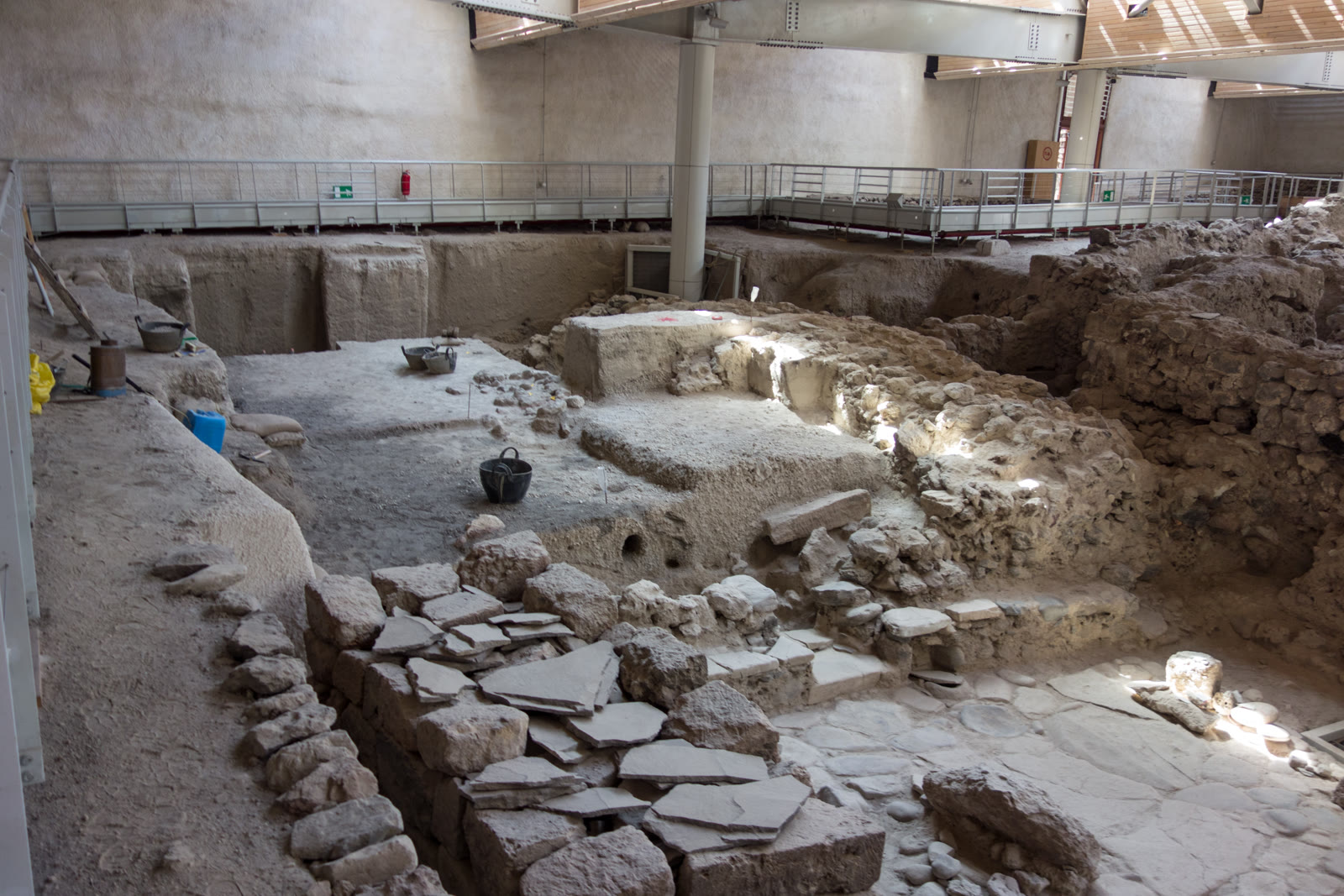
At Akrotiri on the Aegean island of Thera, now Santorini, the volcanic destruction layer is almost brutally clear. Streets, walls, vessels, seeds, and abandoned rooms belong below it; the pumice and ash arrived after them. Across the eastern Mediterranean, primary tephra or securely eruption-associated deposits can connect otherwise separate archaeological sequences. Reworked or traded pumice alone cannot. In relative time, the eruption is a line.[1][11]
In calendar time, that line still wavers.
The live argument is no longer well described as “science says 1628 BCE, archaeology says 1500 BCE.” Those poles grew from real evidence, but the scientific-date argument has moved. An olive branch once seemed to confine the eruption to 1627–1600 BCE. Annual radiocarbon measurements later reopened much of the sixteenth century. A famous 1627 BCE tree-ring signal and its apparent ice-core match turned out to belong to an Alaskan volcano. Ice now preserves plausible volcanic horizons at 1611 BCE, 1561 BCE, 1558 BCE, 1555 BCE, and around 1538 BCE, but no recovered glass identifies any of them as Thera. They are search targets, not five dates for the eruption. Recent radiocarbon models concentrate probability in different parts of the late seventeenth and sixteenth centuries—and that difference can move Late Minoan Crete from the world of Egypt's Hyksos rulers toward the opening of the New Kingdom.[1][8][12]
How can a catastrophe that left a physical layer be so difficult to date? Because the layer does not carry a year. Scholars must translate it through two imperfect clocks: radiocarbon and archaeological synchronism. The disagreement lies less in whether the eruption happened than in how those clocks should be built, calibrated, and joined.
One horizon, two clocks
The secure starting point is relative chronology. The eruption occurred late in, or around the end of, the ceramic phase archaeologists call Late Minoan IA. Objects in earlier and later phases can be compared across Thera, Crete, Cyprus, the Levant, and Egypt. But a sequence such as “LMIA before LMIB” is not an absolute date. To attach a calendar year, the sequence must meet something dated independently.[1]
The conventional archaeological route joined it to Egypt. Later LMIB material appeared in Egyptian contexts associated with Thutmose III, whose long reign sits in the fifteenth century BCE. Working backward placed the end of LMIA—and therefore the eruption—around 1500 BCE, with many later formulations preferring roughly 1530–1500 BCE. That is a chain of inference: Egyptian regnal chronology dates a context; a transported object links that context to an Aegean ceramic phase; the duration of the intervening phase is then estimated. It is not an inscription saying that Thera erupted in a named regnal year.[1][3]
Radiocarbon takes a different route. A living plant absorbs atmospheric carbon. After it dies, the remaining carbon-14 decays at a known rate, producing a radiocarbon age. That age is not itself a calendar year, because the concentration of atmospheric carbon-14 varied. Researchers therefore compare it with a calibration curve built largely from wood whose tree rings already have calendar dates. A measurement from seed or wood at Akrotiri becomes a range of possible calendar years, shaped by the curve and by assumptions about the sample's life, context, and order.[6][9]
The ash horizon is thus exact in one sense and borrowed in another. It separates before from after without ambiguity at the site. Its year depends on evidence outside the ash.
The early case: organic material close to the eruption
The strongest argument for a late-seventeenth-century date begins with proximity. Short-lived seeds and other material from contexts immediately before the eruption repeatedly returned compatible radiocarbon ages. Then, in 2006, Walter Friedrich and colleagues published a striking sample: part of an olive tree found beneath the eruption deposits, interpreted as buried alive. They measured four successive wood segments and “wiggle-matched” their order and assumed annual spacing against the calibration curve. The result placed the outermost growth at 1627–1600 BCE with 95.4 percent probability.[2]
Its attraction was obvious. Imported pottery may circulate for years, and a reign may be revised; a branch killed by the eruption seems almost to timestamp the event itself. Multiple laboratories and different kinds of pre-eruption organic material also clustered in broadly the same older window. For advocates of the higher Aegean chronology, agreement among those samples matters more than any single branch.[1][6]
The historical consequence is larger than moving a label. A date around 1600 BCE places LMIA within Egypt's Second Intermediate Period, when the Hyksos capital at Avaris was a major eastern Mediterranean center. A date after the opening of the New Kingdom instead puts the phase beside an expanding Eighteenth Dynasty state. The same Aegean objects then belong to different political geographies.[1]
For a time, an apparently independent witness made the early case look even tighter. Frost damage in bristlecone pine around 1627 BCE had been associated with a major volcanic event, and an ice-core horizon seemed to offer a matching eruption. In 2019, John McAneney and Mike Baillie argued that the match was probably Aniakchak II in Alaska. In 2022, Charlotte Pearson and colleagues recovered microscopic volcanic glass from the 1628 BCE ice layer and geochemically matched it to Aniakchak II. The finding did not invalidate the Thera radiocarbon samples. It removed a seductive exact-year corroboration by identifying the wrong volcano.[7][8]
The later case: the sample and the calibration are not neutral
The sixteenth-century case begins by pressing on what the olive branch must be assumed to record. Olive wood does not reliably form one clean, cross-dateable ring per year. A 2013 comparison of Santorini olives found intra-annual density changes, discontinuous growth, and different apparent counts along different radii. Even intact bark does not solve the problem. A 2018 radiocarbon study of living olives found that the newest wood immediately beneath bark could differ in age around the circumference by as much as several decades because growth shifts between sectors. The 2006 branch did have bark; the uncertainty is whether the wood beneath it represents the tree's final year everywhere sampled.[4][5]
Manfred Bietak's 2014 intervention joined that biological challenge to the archaeological case for a younger eruption. Four wood segments can retain an older-to-younger order without their visible increments functioning as an annual ruler. Treating the increments as exact years creates more precision than the olive can independently supply.[3][4]
That criticism has a limit. Uncertain ring counts do not make the carbon measurements disappear, and the sampled sequence still runs from older inner wood toward younger outer wood. The question is how much chronological constraint its spacing supplies. A model that knows only the segments' order will produce a wider range than one that treats every visible increment as a year.[2][4][5][6]
The calibration curve then changed. In 2018, Pearson and colleagues published 285 annual measurements from calendar-dated bristlecone pine and Irish oak spanning 1700–1500 BCE. Between about 1660 and 1540 BCE, their annual series differed from the then-standard IntCal13 curve enough to move the posterior means of several Thera models into the sixteenth century. Yet the same work did not deliver a replacement year. It exposed a plateau: a stretch where different calendar years can return very similar radiocarbon ages. Depending on the assumptions used, their recalibrated 95 percent intervals for eruption-adjacent seeds and the olive sequence spread across parts of both centuries.[6]
IntCal20 incorporated far more high-resolution data, but it did not turn the plateau into a steep, unique slope. A 2020 analysis led by Sturt Manning showed why tiny technical choices have conspicuous historical effects here. Around a reversal or plateau, a difference of only several radiocarbon years—potentially arising from growing season, latitude, laboratory variation, or the plant's relationship to the reference trees—can shift much of a model's calendar probability from the late seventeenth century into the early or middle sixteenth.[9]
This is not license to choose any date. It is a measurement boundary. Radiocarbon strongly constrains the region of the calendar while resisting an exact landing within it.
A second olive did not break the tie
In 2023, Pearson and colleagues published a different plant: a small olive shrub excavated on neighboring Therasia, carbonized in place by hot eruption deposits. Several samples retained bark or the outermost wood edge, improving knowledge of what survived even though olive growth remained irregular. The youngest portions calibrated broadly to 1610–1510 BCE without a local offset, or about 1602–1502 BCE with the authors' proposed offset. Probability increased in the middle to later sixteenth century, making that part of the interval newly attractive, but the intervals still covered the late seventeenth and much of the sixteenth century.[10]
The result generated two interpretations rather than a verdict. Pearson's team emphasized the younger probability and its fit with possible mid-sixteenth-century volcanic signals. Manning's 2024 reanalysis modeled the dated pieces as parts of one shrub killed in a common event, retained their inner-to-outer order, and constrained plausible sequence lengths. The envelope of 95.4 percent bounds across his principal Therasia model variants was 1617–1565 BCE; combining the shrub, the 2006 olive, and 25 Akrotiri samples produced 1618–1584 BCE. He argued for a date around 1600, possibly the 1611 BCE volcanic horizon. That is an attributed interpretation, not an identification: the ice also records candidate eruptions at 1561 BCE, 1558 BCE, 1555 BCE, and around 1538 BCE, and none has yet yielded glass matched to Thera.[1][8][10][11]
The difference between these readings is methodological and visible. One gives substantial weight to the broad calibrated distributions of the outer samples; the other adds prior information about how the samples relate in time. Neither side is merely choosing between “pots” and “physics.” Both combine physical measurements with judgments about context.
The newest annual data have not supplied a hidden master key. In 2026, a University of Groningen team published 93 new measurements across a calendar-dated series spanning 1660–1507 BCE. It found possible small offsets among laboratories and tree species, but no definitive eruption-dating marker: a 1557–1556 BCE decrease did not reproduce the proposed 1557 radiocarbon-production spike, while the rise near 1528 developed gradually from 1534 to 1515 rather than as a sharp annual spike. When the team reran published Thera models against several test curves, the probabilities continued to favor a late-seventeenth- or early-sixteenth-century placement. Better calibration refined the terrain; it did not make one summit unavoidable.[12]
What would change the assessment
Three discoveries could move this from a debate map to a date.
The clearest would be Thera tephra chemically identified in an independently annual archive—an ice layer or tree-linked sequence whose calendar counting is secure. The failure of the 1627 association shows that a generic volcanic signal is not enough: a large eruption elsewhere can leave the same environmental punctuation.[7][8]
A second route would be new eruption-killed material with known annual growth and an intact final season, measured in several laboratories and calibrated against trees that capture the relevant Mediterranean growing season. Another olive may add data without escaping olive biology.[4][5][9][12]
The third would be a tighter archaeological bridge to an absolute Egyptian date: a sealed context close to the LMIA eruption horizon, rather than a later object used to set a minimum through an assumed phase length. That would shorten the dependency chain on the archaeological side.[1]
Until one of those appears, the responsible conclusion is asymmetric. High-resolution radiocarbon has narrowed and reshaped the scientific-date argument, but it has neither produced a consensus year nor eliminated the traditional archaeological chronology around 1530–1500 BCE, which remains defended. Several current radiocarbon models put substantial probability around 1600 BCE, while broad calibrated intervals keep a mid-sixteenth-century solution in play. The ice horizons are candidates to test, not labels to paste onto the ash. No source yet justifies printing a single year as settled.[1][10][12]
Akrotiri's ash does something more modest and, historically, more useful. It holds an instant still. Everything beneath it belongs to a world before the eruption; everything above it belongs after. Historians can reconstruct that order with confidence. Converting the instant into a numbered year is a separate act—and the uncertainty belongs to the conversion, not to the catastrophe.
Sources
- Sturt W. Manning, “Thera, the Aegean, Egypt, the Hyksos and Anatolia: rethinking the orthodox synchronisations and histories,” Journal of Greek Archaeology 9 (2024) — relative chronology, Egyptian dependency chain, the 1611/1561 alternatives, and the author's current early-date case.
- Walter L. Friedrich et al., “Santorini eruption radiocarbon dated to 1627–1600 B.C.,” Science 312 (2006) — the buried olive branch, ordered wood segments, and original 95.4 percent range.
- Manfred Bietak, “Radiocarbon and the date of the Thera eruption,” Antiquity 88 (2014) — critique of ring-based precision, sample interpretation, and conflict with archaeological chronology.
- Paolo Cherubini et al., “Olive Tree-Ring Problematic Dating: A Comparative Analysis on Santorini (Greece),” PLOS ONE 8 (2013) — intra-annual density fluctuations, sectorial growth, and the lack of dependable annual ring counts.
- Yael Ehrlich, Lior Regev, and Elisabetta Boaretto, “Radiocarbon analysis of modern olive wood raises doubts concerning a crucial piece of evidence in dating the Santorini eruption,” Scientific Reports 8 (2018) — modern tests showing that outermost wood beneath bark can differ in age by decades around one olive.
- Charlotte L. Pearson et al., “Annual radiocarbon record indicates 16th century BCE date for the Thera eruption,” Science Advances 4 (2018) — 285 annual tree-ring measurements, recalibrated eruption contexts, model ranges, and the plateau's precision limit.
- John McAneney and Mike Baillie, “Absolute tree-ring dates for the Late Bronze Age eruptions of Aniakchak and Thera in light of a proposed revision of ice-core chronologies,” Antiquity 93 (2019) — the proposal that the 1627 BCE tree and ice association probably belonged to Aniakchak II.
- Charlotte Pearson et al., “Geochemical ice-core constraints on the timing and climatic impact of Aniakchak II (1628 BCE) and Thera (Minoan) volcanic eruptions,” PNAS Nexus 1 (2022) — glass fingerprinting of Aniakchak II and the remaining unidentified candidate horizons for Thera.
- Sturt W. Manning et al., “Radiocarbon offsets and old world chronology as relevant to Mesopotamia, Egypt, Anatolia and Thera (Santorini),” Scientific Reports 10 (2020) — IntCal20, possible regional and seasonal offsets, and their effects across the 1620–1540 BCE plateau.
- Charlotte Pearson et al., “Olive shrub buried on Therasia supports a mid-16th century BCE date for the Thera eruption,” Scientific Reports 13 (2023) — in-situ shrub context, outer-sample ranges, growth-band cautions, and increased mid-sixteenth-century probability.
- Sturt W. Manning, “Problems of Dating Spread on Radiocarbon Calibration Curve Plateaus: The 1620–1540 BC Example and the Dating of the Therasia Olive Shrub Samples and Thera Volcanic Eruption,” Radiocarbon 66 (2024) — sequence-constrained models for the Therasia shrub, earlier olive, and Akrotiri samples.
- Pınar Erdil et al., “Investigating potential radiocarbon anomalies around the time of the Minoan eruption of Thera: A new high-resolution dataset from Groningen,” Radiocarbon 68 (2026) — 93 new measurements spanning 1660–1507 BCE, inter-dataset offsets, absent proposed markers, and rerun eruption models.
- Christos Koudounis, “Excavation in action” (5 July 2016), Wikimedia Commons — source record and licensing for the photograph of the Akrotiri excavation used above.