On December 12, 1899, Honolulu physicians confirmed that plague had reached the Hawaiian Islands. On March 6, 1900, a postmortem in San Francisco's Chinatown revealed the same disease in the continental United States. The two Pacific ports sat on connected shipping routes, feared damage to trade, possessed the new ability to identify Yersinia pestis, and directed their first coercive measures at Chinese neighborhoods.[1][2][7]
Then their responses diverged. Honolulu's transitional government placed extraordinary emergency authority in the Board of Health, whose plague response was effectively directed by three physicians. The board quarantined people, condemned property, commanded armed guards, and ordered infected buildings burned. One of those burns escaped on January 20, 1900, destroying Chinatown and dispossessing more than 5,000 people.[2][3][10] In San Francisco, authority splintered among a city health board, federal doctors, a hostile governor, commercial interests, courts, newspapers, and Chinese community organizations. Officials could cordon Chinatown and threaten compulsory inoculation, yet California's political leadership denied the diagnosis that supposedly justified those actions.[5][6][7]
This was not a clean contrast between decisive science and timid politics. Both cities mixed bacteriology with racial assumptions. Both treated “Chinatown” as if a neighborhood boundary could contain a biological mechanism that doctors did not yet fully understand. The important difference was institutional: Honolulu concentrated power so completely that a dangerous policy could be executed before it was corrected; San Francisco distributed power so widely that coercion, denial, resistance, and disease control collided for years. One system moved catastrophically fast. The other stalled—then improved as intergovernmental coordination and community participation changed together.[1][2][7][8][9]
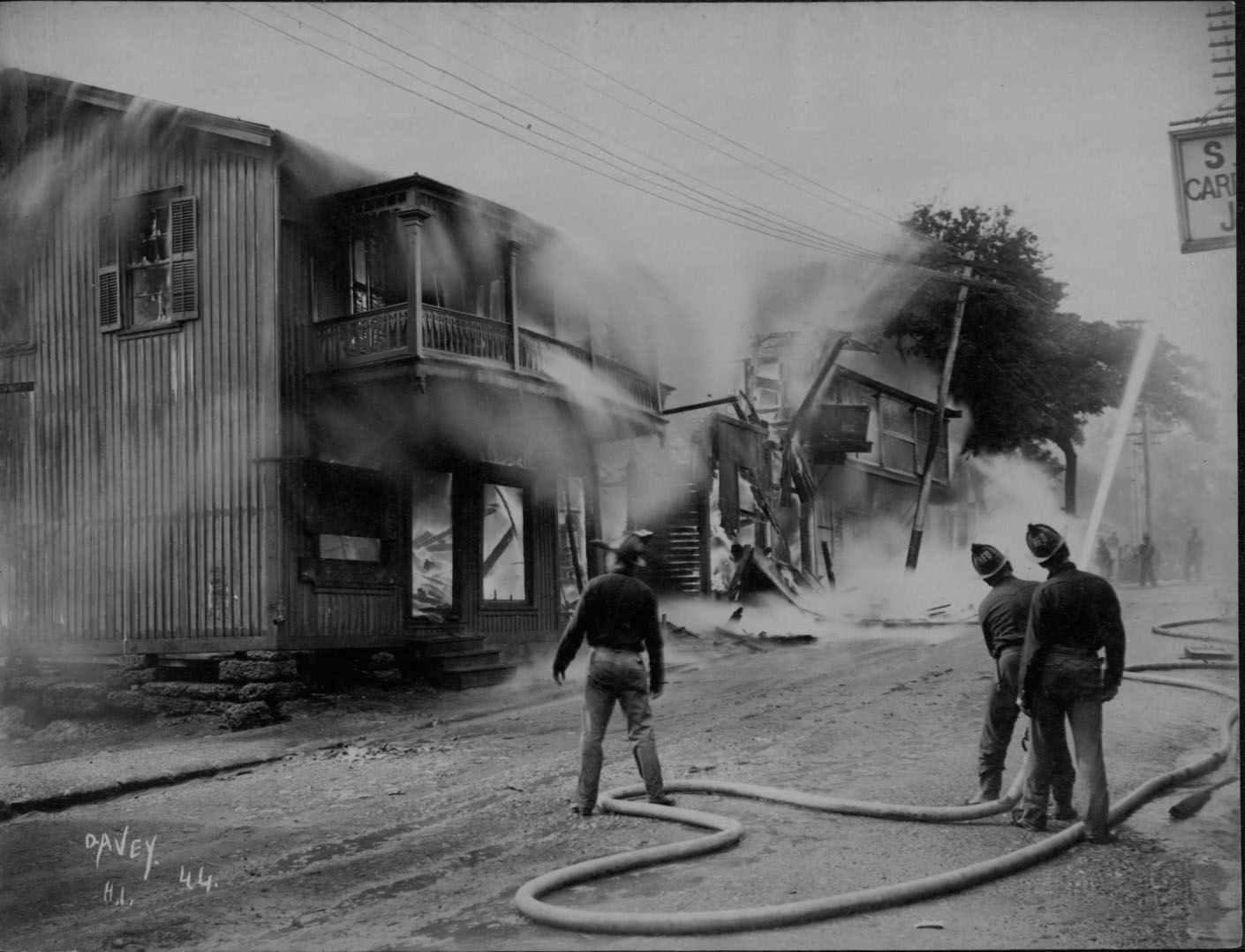
Image context: The cover is a real archival photograph by Frank Davey, preserved and catalogued as PP-17-11-001 by the Hawaiʻi State Archives; the corresponding Wikimedia Commons record marks the reproduction public domain in the United States. It shows firefighters confronting the Chinatown blaze rather than a staged symbol of epidemic disease. The image belongs here because the comparison turns on what public-health authority could physically do to a city.[12]
One pathogen, an unfinished theory
The third plague pandemic traveled through the late nineteenth-century steamship network from southern China to ports around the world. Researchers working in Hong Kong identified the plague bacillus in 1894. Paul-Louis Simond demonstrated a rat–flea transmission mechanism in 1898, but other investigators did not reproduce and broadly confirm that result until 1905. At the turn of the century, officials could therefore diagnose the bacterium with more confidence than they could explain how it moved between animals, houses, and people.[1]
That gap made older sanitary ideas unusually durable. Crowded rooms, leaking sewers, refuse, insects, and rats appeared together in poor waterfront districts. Cleaning such conditions could genuinely reduce rat habitat and human exposure, even when officials wrongly imagined that infected walls, soil, air, or personal habits were the principal carriers. A useful intervention and a false theory could travel in the same cart.[1]
So could prejudice. Long before either outbreak, white officials and newspapers had described Chinese quarters as intrinsically diseased spaces. Plague seemed to validate a ready-made racial geography: an “Asiatic” infection belonged inside Chinatown, while the commercial city beyond it represented the healthy public to be protected. The premise concealed an obvious contradiction. Honolulu and San Francisco were connected to Asia by the ships, docks, warehouses, labor, and capital on which their wider economies depended. Officials racialized the neighborhood while the disease moved through an urban and maritime system.[1][7]
Honolulu: emergency power becomes a government
Honolulu faced plague during an unsettled constitutional interval. The United States had annexed Hawaiʻi in 1898, but the territorial government would not formally begin until June 1900. Historian James C. Mohr distinguishes the formal Board of Health from the three physician leaders who effectively ran the emergency response. Existing authorities gave the board sweeping control over the archipelago's armed forces, public money, movement, and plague policy; its medical triumvirate became, for the emergency, something close to an executive government.[2][10]
Concentration solved one coordination problem. The board did not need to persuade a separate city, state, and federal hierarchy each time it sealed a block, moved residents, or condemned a building. It could act on a bacteriological diagnosis while commercial leaders worried that a declared epidemic would isolate the port. But the same structure weakened correction. People whose homes, shops, temples, and schools fell within the quarantine had little institutional leverage over what the board defined as necessary.[2]
The board initially resisted proposals to raze all of Chinatown. Instead, it chose controlled burns of buildings associated with plague deaths, following a method used elsewhere to destroy suspected reservoirs of infection. Firefighters soaked neighboring structures and set condemned premises alight one at a time. The distinction matters: the destruction of the whole district was not the plan. Yet the policy deliberately introduced flame into a dense neighborhood of wooden buildings because a small group with emergency powers judged burning to be a controllable disinfectant.[1][2]
On January 20, 1900, that control failed. Wind carried fire from a condemned cluster toward Kaumakapili Church and through Chinatown. The National Library of Medicine records 38 acres burned; Mohr estimates that more than 5,000 people lost their possessions and were marched to detention camps under guard.[2][3] Chinese residents bore much of the loss, but the district also held Japanese and Native Hawaiian residents. A policy organized through a racial label destroyed a more varied community than the label admitted.[1][2]
The fire's apparent decisiveness should not be mistaken for proof that it solved the epidemic. A federal report written on February 8, 1900 described new infection sites outside Chinatown and suggested that “rats or other vermin” may have been driven outward. It recorded continuing official burns, detention camps, and the formidable task of exterminating rats across the islands.[4] The report does not prove that the great fire spread plague. It does show officials confronting, after the catastrophe, a vector problem that a neighborhood burn could never neatly bound.
A congressional accounting later bounded Honolulu's initial epidemic from December 12, 1899, to April 1, 1900, at 71 cases and 61 deaths.[10] That was the end of the first recorded wave, not eradication. Public Health Service officers George McCoy and Donald Bowman reported in 1914 that cases had continued to appear from time to time in Honolulu through July 1910.[11] Concentrated authority made the first response rapid; it did not make the port's rodent ecology disappear.
San Francisco: coercion without agreement
San Francisco began with less centralized power and no less racial targeting. After Wong Chut King's death on March 6, 1900, city officials surrounded Chinatown almost immediately. Joseph Kinyoun, the federal Marine Hospital Service bacteriologist, confirmed plague in tissue samples. Yet Mayor James Phelan, Governor Henry Gage, business leaders, much of the press, local doctors, and federal officers did not form one response. Some denied plague outright; some accepted the diagnosis but opposed measures that might trigger trade restrictions; others demanded quarantine, inspections, inoculation, or even destruction of the district.[5][7]
The result was not simply inaction. Power was contradictory. Authorities could restrict Chinese and Japanese travel and push Haffkine prophylactic inoculation on Chinese residents while political leaders insisted that California did not have plague. Chinatown residents had to evaluate medical advice delivered through institutions that marked them as a threat, searched homes, disrupted livelihoods, threatened bodies and property, and sometimes refused to acknowledge the disease publicly.[6][7]
Chinese merchants and residents answered through newspapers, associations, negotiation, noncompliance, and federal court. In Jew Ho v. Williamson, decided on June 15, 1900, the court blocked a twelve-block quarantine. It found that the cordon was enforced against Chinese people while allowing people of other races within its mapped boundary to pass. The judges also identified a public-health flaw: confining thousands of healthy and potentially exposed people together, with free movement inside the cordon, could facilitate rather than limit infection.[6]
The ruling did not decide that plague was imaginary. It decided that emergency claims did not make a discriminatory and poorly fitted intervention reasonable. This is where fragmentation had a value that simple stories about “decisiveness” miss. Courts could interrupt a measure; Chinese organizations could force officials to negotiate; rival laboratories and an outside commission could test a contested diagnosis. Those veto points delayed coherent control, but they also exposed policies whose target was a race and district more clearly than a transmission chain.[5][6][7]
Fragmentation's cost remained severe. A federal review received in January 1903 counted 93 plague cases from March 1900 through December 1902 and described long gaps between recognized cases, uncertain surveillance, extensive postmortems, and persistent disputes over what had been found.[5] By the last recorded case of the first outbreak in February 1904, the official total had reached 121 cases and 113 deaths; the later federal summary cautioned that the record was probably incomplete.[8] Governor Gage's denial campaign damaged the credibility of valid bacteriological evidence. Kinyoun's racial assumptions and abrasive enforcement damaged trust in the people producing that evidence. Each side could point to the other's conduct as a reason not to cooperate.[5][7][8]
1903–1905: coordinating the orders and changing the relationship
San Francisco's first epidemic began to turn after political coordination and on-the-ground relationships changed together. A February 1903 city–state–federal agreement aligned case reporting, street cleaning, garbage removal, and rat extermination. Surgeon Rupert Blue, meanwhile, placed an office and laboratory near Chinatown, hired Chinese Six Companies secretary Wong Chung as a full-time interpreter and collaborator, and gained access to households that had reason to hide sickness from earlier teams.[7][9] The National Park Service account stresses that Wong did more than translate words: he supplied cultural knowledge, maintained case tracking, and helped federal doctors enter a community that associated autopsy and inspection with violation.[7]
Blue did not abandon sanitation or state power. Buildings were disinfected, cellars concreted, rat harbors removed, and streets made easier to clean. But the program was less dependent on sealing an ethnic district and more capable of treating residents as participants in surveillance. The last recorded case of the first outbreak came in February 1904; the federal plague laboratory closed on April 13, 1905.[8][9] When plague returned after the 1906 earthquake, cases appeared across the city; in the initial cluster described by the Park Service, only one patient was Chinese. Rat catching, testing, garbage control, and citywide outreach then displaced Chinatown quarantine as the dominant logic.[7]
Honolulu had also recognized rats and vermin by February 1900.[4] The comparison is therefore not a fable in which one city knew the vector and the other did not. Nor does San Francisco's eventual adjustment erase years of discriminatory enforcement and political denial. The contrast lies in how policy learned. Honolulu's board could revise its ideas after the fire, but decision and execution sat inside the same emergency apparatus. San Francisco's divided system generated destructive delay; court rulings removed particular discriminatory tools, the 1903 agreement aligned agencies, and Blue's collaboration with Wong Chung altered fieldwork. None of those changes alone explains the turn.[1][2][6][7][9]
What the two cities make visible
Fire leaves the more legible failure. Frank Davey's camera could record smoke, hoses, streams of water, burning wooden buildings, and the physical scale of an official decision escaping its boundary.[12] Denial leaves a dispersed archive: hostile editorials, disputed cultures, interrupted quarantines, court opinions, gaps between cases, and agencies blaming one another. The first looks like too much government and the second like too little. That description is incomplete.
Both cities had ample power over Chinese residents. What differed was the arrangement of power around the people making policy. Honolulu's emergency board combined diagnosis, command, property destruction, detention, and finance. San Francisco divided diagnosis from state recognition, city enforcement from federal authority, and executive orders from judicial review. Concentration made action coherent but made one technical error enormous. Fragmentation made action inconsistent but left openings through which residents and evidence could challenge a bad fit.[1][2][6]
The deeper comparison is therefore not “act fast” versus “wait for certainty.” Epidemics rarely permit either luxury. It is whether emergency power carries a correction mechanism proportional to its capacity for harm—and whether the people most exposed to both disease and policy can alter the response before error hardens into landscape. Honolulu's fire and San Francisco's stalemate were opposite institutional failures born from a shared premise: that officials could manage plague by governing Chinatown as an object. San Francisco improved when cooperation made the neighborhood part of the governing system. By then, Honolulu had already photographed the cost of learning after the flames.
Sources
- Y. H. Phoebe Tang, Lionel Frost, Ruth Morgan, and Andrea Gaynor, “Public Health in a Transnational Context: Hong Kong and the Third Bubonic Plague Pandemic,” Journal of Urban History 51, no. 3 (2025) — comparative analysis of plague theory, Honolulu and San Francisco policy, urban conditions, and later rat-control measures.
- James C. Mohr, Plague and Fire: Battling Black Death and the 1900 Burning of Honolulu's Chinatown (Oxford University Press, 2004) — emergency authority, controlled-burning policy, the January 20 fire, detention, and community impact.
- U.S. National Library of Medicine, “1900: Honolulu destroyed in ‘The Great Fire’” — institutional timeline entry on the controlled burns, Kaumakapili Church, burned area, and confinement of residents.
- U.S. Marine-Hospital Service, Public Health Reports, March 2, 1900, pp. 499–502, via CDC Stacks — contemporary dispatches on Honolulu cases, suspected rat or vermin movement, official burns, detention camps, and port precautions.
- D. M. Currie, “Review of plague situation at San Francisco,” Public Health Reports, January 30, 1903, via CDC Stacks — contemporary federal review of recognized cases, surveillance, bacteriological tests, and institutional disagreement.
- U.S. Circuit Court for the Northern District of California, Jew Ho v. Williamson, 103 F. 10 (June 15, 1900), Harvard Law School H2O — primary text of the decision against San Francisco's discriminatory and overbroad Chinatown quarantine.
- U.S. National Park Service, “Better Lives, Bitter Lies” — sourced public-history transcript on the Honolulu and San Francisco cases, Kinyoun, racialized measures, Chinese resistance, Rupert Blue, Wong Chung, and later rat control.
- Brock C. Hampton, “Plague in the United States,” Public Health Reports 55, no. 26 (June 28, 1940), via CDC Stacks — retrospective federal tally and endpoint for San Francisco's first outbreak, with the later citywide recurrence and rat-control history.
- Vernon B. Link, “Development of Plague Control in the Western States,” in CDC Bulletin 7, no. 3 (1948), via CDC Stacks — the 1903 intergovernmental agreement, first-outbreak control campaign, and 1905 federal laboratory closure.
- U.S. House Committee on the Territories, Payment of Judgments on Claims Growing Out of Suppression of Bubonic Plague in Hawaii, H.R. Report No. 3098 (January 12, 1903) — transition government, initial epidemic dates and toll, emergency measures, detention, property destruction, and claims.
- George W. McCoy and Donald S. Bowman, “Plague in Hawaii,” Public Health Reports 29, no. 25 (June 19, 1914), via CDC Stacks — later account of rodent transmission and intermittent Honolulu cases through July 1910.
- Hawaiʻi State Archives, “Epidemics: Bubonic Plague,” PP-17-11-001 — primary catalog record for Frank Davey's circa-January 20, 1900 photograph used as the article's cover image. Wikimedia Commons supplies the reproduced file and its U.S. public-domain statement.