Jacob Riis is often remembered in compressed form: immigrant reporter, flash photographer, reform crusader, author of How the Other Half Lives.[1][5][6] That version is true, but it leaves out the mechanism that made his work historically durable. Riis did more than "show poverty." He built a way for dark tenement interiors, alleys, and lodging houses to travel into rooms where the people making judgments did not have to enter those spaces themselves.[1][2][3][4]
That is the sharper historical question: why did Riis's New York slum reporting become more than one more pile of grim observation in the late nineteenth century? The strongest answer the sources support is that he turned urban misery into portable evidence. Flash powder opened low-light scenes; stereopticon lectures gave those scenes an audience; the 1890 book fixed them in print; and the reform network around housing, parks, sanitation, and police lodging houses gained a visual language that could move between newspapers, civic groups, and officials.[2][3][4][5][6]
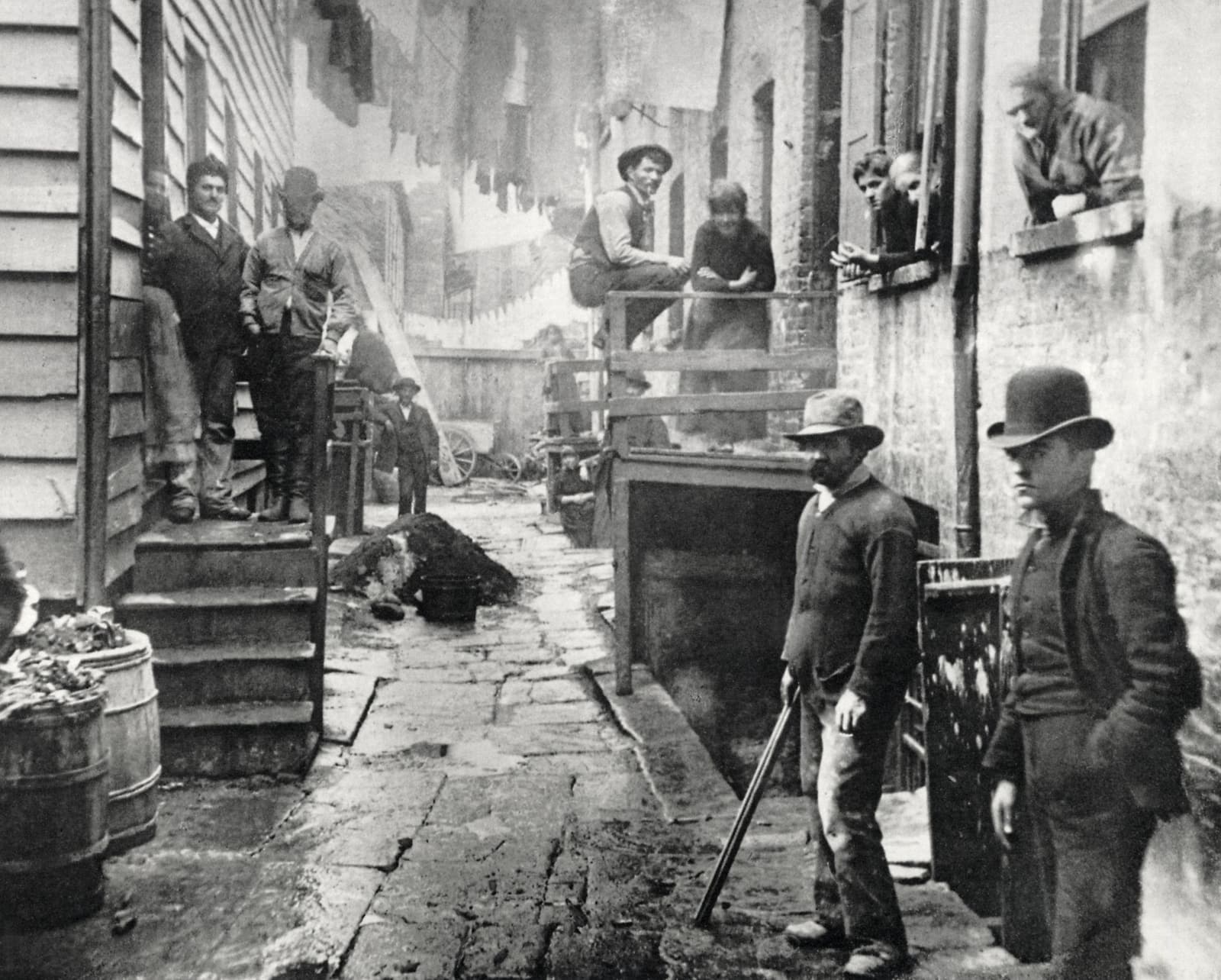
The cover image uses Bandits' Roost, made in 1887-1888 and associated by the Library of Congress exhibition with Riis, Richard Hoe Lawrence, and Henry G. Piffard.[4][7] It works for this article because the picture is narrower than the reform story it helped energize. A few bodies, one alley, one camera position: those are small units. Yet Riis's career shows how a scene that small could be made to circulate outward until it attached itself to arguments about Mulberry Bend, rear tenements, crime, parks, and public obligation.[2][4][7]
Timeline anchors
- 1873: Riis becomes a police reporter in New York, working the Lower East Side and seeing tenement conditions at close range.[5][6]
- January 22, 1888: he delivers his first illustrated lecture, "How the Other Half Lives and Dies in New York," at the Society of Amateur Photographers of New York.[3]
- 1887-1888: Riis, Lawrence, and Piffard produce early flash-lit photographs in the slums, including Bandits' Roost and other nighttime or low-light work.[2][4][7]
- 1890: How the Other Half Lives is published by Charles Scribner's Sons, with illustrations chiefly from photographs taken by Riis.[1]
- 1896: with Theodore Roosevelt's help, the police lodging houses Riis had campaigned against are closed.[4][6]
- 1901: the Tenement House Department is created after the Roosevelt-appointed commission, consolidating reform work on air, light, sanitation, and safer housing design.[4]
Those dates matter because they keep the story from collapsing into a generic invention tale. Riis did not simply discover that cameras matter. He spent nearly three decades moving from street observation to a reproducible reform workflow.
The reporter came before the photographer
Riis's power started in reporting rather than image-making. Britannica notes that after arriving from Denmark, he eventually became a police reporter in 1873 and found tenement districts where infant mortality could reach one in ten.[5] The National Park Service biography adds the personal edge: Riis had himself known joblessness, police lodging houses, and the humiliations of urban precarity before he wrote about them.[6]
That sequence matters because it clarifies what the camera did for him. Riis did not begin as an aesthete looking for striking city scenes. He began as a reporter already saturated in streets, station houses, and tenements, already trying to make a complacent readership admit that New York's prosperity rested beside severe overcrowding, filth, disease risk, and exploitative rent structures.[4][5][6] The photographs entered a reporting system that already had targets: middle-class conscience, city neglect, and municipal routines that treated certain neighborhoods as permanently offstage.
In that sense, Riis's photography was never only about visual discovery. It was a delivery upgrade for an investigative project that already existed.
Flash powder made darkness distributable
The Library of Congress exhibition states the point plainly: Riis was the first reformer to recognize the power of low-light flash photography for social advocacy.[2] He did not begin alone. His earliest photographs were made with Richard Hoe Lawrence and Henry G. Piffard, amateur collaborators willing to test new flash techniques in slum environments.[2][4] That detail is historically useful because it keeps the origin story honest. Riis mattered as organizer, guide, reporter, lecturer, and editor of evidence as much as shutter-operator.
The technical change was larger than it first appears. Before flash powder, many of the spaces Riis wanted to expose were effectively self-protecting. Rear tenements, cramped lodging rooms, and alley interiors did not offer enough light for ordinary photography. The dark itself helped preserve social distance. Once flash powder entered the workflow, that darkness stopped functioning as a practical shield.[2][5]
Riis then carried those scenes into public space through projection. The Library of Congress multimedia page records that on January 22, 1888, he gave his first lecture with a stereopticon, taking audiences on a visual tour through the tenements.[3] The Photographer page adds that he eventually assembled 100 images for his "Other Half" slides and charged lecture fees substantial enough to mark this as a real public circuit, not an occasional aside.[2]
That is why "portable evidence" feels like the right phrase. Riis did not only capture scenes. He built a transport chain for them.
Bandits' Roost is evidence, but it is also argument
The strongest way to read Bandits' Roost is not as transparent truth, nor as mere propaganda, but as a hybrid of both. The Riis and Reform page identifies the alley as a Mulberry Street site in the Lower East Side where Italian immigrants paid high rents to live in rear tenements, and it notes that Riis used a stereoscopic camera for the image.[4] The same page ties the photograph to his decade-long campaign against Mulberry Bend's conditions.[4]
What the photograph does well is concentrate several arguments into one frame: compression, surveillance, wary bodily posture, adults and children sharing constricted circulation space, and an alley that reads less like open city street than like a trap between buildings.[4][7] A viewer does not need statistical tables to feel that this is a built environment under pressure.
At the same time, the sources warn against treating Riis as a neutral machine. The Photographer page explicitly says one early flashlight image, The Tramp, was posed, and it records Riis's own harsh contempt for the man he photographed.[2] That does not prove Bandits' Roost was staged, but it does establish a boundary: Riis's slum pictures were shaped by selection, captioning, and moral judgment. They were arguments with people in them, not untouched slices of urban reality.
That caution makes the historical claim stronger, not weaker. Riis mattered because he knew how to turn a scene into civic pressure, even when his own language carried bias, simplification, or ethnicized assumptions common to his era.
The book widened the audience even when print weakened the image
When How the Other Half Lives appeared in 1890, it gave Riis's campaign durability beyond the single lecture night.[1] The Library of Congress catalog notes that the book was published in New York by Charles Scribner's Sons and came "with illustrations chiefly from photographs taken by the author."[1] Britannica adds the downstream effect: the book shocked readers, helped stimulate major New York housing legislation, and became a precursor to twentieth-century muckraking journalism.[5]
Yet one of the most interesting details in the Library of Congress exhibition is that print actually blunted the images somewhat.[2] Slides shown in a lecture hall could land with harsh immediacy; 1890 printing technology flattened tones into engravings or crude halftones.[2] The book therefore did not simply preserve the original visual force. It traded some of that force for reach, permanence, and citability.
That trade was crucial. A lecture can disturb an audience for an evening. A book can circulate among readers, libraries, ministers, editors, reform clubs, and officials. It can be quoted, assigned, excerpted, lent, attacked, and remembered. Riis's innovation lay in accepting that compromise. He gave up some visual intensity in order to widen the jurisdiction of the evidence.[1][2][3]
Reform followed circulation, not revelation alone
The temptation is to imagine that once Riis showed the city its underside, reform naturally followed. The sources point to a messier but more useful sequence. Riis and allies had to gather statistics, raise public awareness, advocate specific housing changes, and keep attaching images to municipal questions about air, light, sanitation, fire safety, parks, and lodging houses.[4] The same Library of Congress page traces outcomes that were cumulative rather than magical: rear tenements torn down, parks and playgrounds created, more than 40,000 windows cut through interior walls, and finally the 1901 Tenement House Department.[4]
Mulberry Bend is the clearest example. The reform page says Riis spent ten years crusading against the area and later counted the creation of Mulberry Bend Park among his triumphs.[4] That sequence shows why the article's central claim is about portability. The alley in Bandits' Roost did not reform itself because it had been photographed. It became harder to ignore because the photograph joined lectures, articles, maps, civic advocacy, and a reform network able to keep translating one alley into a citywide problem.[3][4]
The same pattern appears in the police lodging houses. The NPS biography and the Library of Congress exhibition both connect Riis's work to Theodore Roosevelt and to the closure of those lodging houses in 1896.[4][6] Here again, the camera was one instrument inside a larger campaign.
The lasting achievement was logistical
There are two easy ways to flatten Riis. One makes him a saint of reform photography. The other reduces him to a sensationalist moralizer whose images cannot escape the prejudices of his age. The record supports a harder synthesis.[2][4][5]
Riis did carry bias. He could romanticize respectable poverty, speak harshly about "tramps," and turn immigrant neighborhoods into theaters of danger for outsiders.[2][4] Yet the sources also show that he altered the practical relation between hidden urban suffering and public action. He made tenement life portable. He developed a chain in which dark rooms could become slides, slides could become lectures, lectures could become books, and books could help push housing, sanitation, and public-space questions into civic institutions.[1][2][3][4]
That is why Riis still matters in 2026. His deepest historical importance does not lie in inventing sympathy or in taking a few famous pictures. It lies in building a transport system for social evidence, one capable of moving a cramped New York alley into the moral and administrative field of people who had preferred not to see it.[1][2][3][4][5]
Sources
- Jacob A. Riis, How the Other Half Lives: Studies Among the Tenements of New York (Project Gutenberg edition of the 1890 book).
- Library of Congress, "Photographer" section of Jacob Riis: Revealing "How the Other Half Lives" - on low-light flash photography, collaboration with Richard Hoe Lawrence and Henry G. Piffard, the slide lectures, and the limits of 1890s print reproduction.
- Library of Congress, "Multimedia" section of Jacob Riis: Revealing "How the Other Half Lives" - on Riis's January 22, 1888 lecture, stereopticon projection, and the structure of his illustrated talks.
- Library of Congress, "Riis and Reform" section of Jacob Riis: Revealing "How the Other Half Lives" - on Mulberry Bend, Bandits' Roost, housing reform, parks, police lodging houses, and the 1901 Tenement House Department.
- Encyclopaedia Britannica, "Jacob Riis" - on Riis's police-reporting years, flash-lamp photography, Roosevelt's reaction, and the legislative effect of How the Other Half Lives.
- National Park Service, "Jacob Riis Biography" - on Riis's early hardship in New York, police-reporting work, anti-slum campaigns, and the closure of police lodging houses.
- Wikimedia Commons, "File:Jacob Riis - Bandits' Roost.jpg" - archival image page for the hero photograph used in this article.