The legend of Shackleton's Endurance expedition often gets told as one indivisible masterpiece of leadership, as if the whole ordeal were a single uninterrupted performance of endurance.[1][3][4] The chronology is harsher and more interesting. What saved the expedition was not one dramatic quality that stayed constant from beginning to end. It was Shackleton's willingness to keep reducing the size of the mission as reality worsened. A trans-Antarctic crossing became a trapped ship. The trapped ship became a camp on drifting ice. The drifting camp became three open boats. Elephant Island became a waiting room for twenty-two men and a desperate six-man gamble toward South Georgia.[1][2][3][4]
That sequence matters because it keeps the story from dissolving into motivational fog. In August 1914, Shackleton left with a continental ambition still intact.[1][4] By January 1915, Endurance was beset in pack ice before the landing party had even reached the coast.[1][3] By late October 1915, the ship was finished as a ship, and by 21 November 1915 it had slipped under the ice.[2][3] From that point forward, survival depended on how quickly the expedition could stop thinking like an expedition of conquest and start thinking like a mobile ration-and-shelter problem.
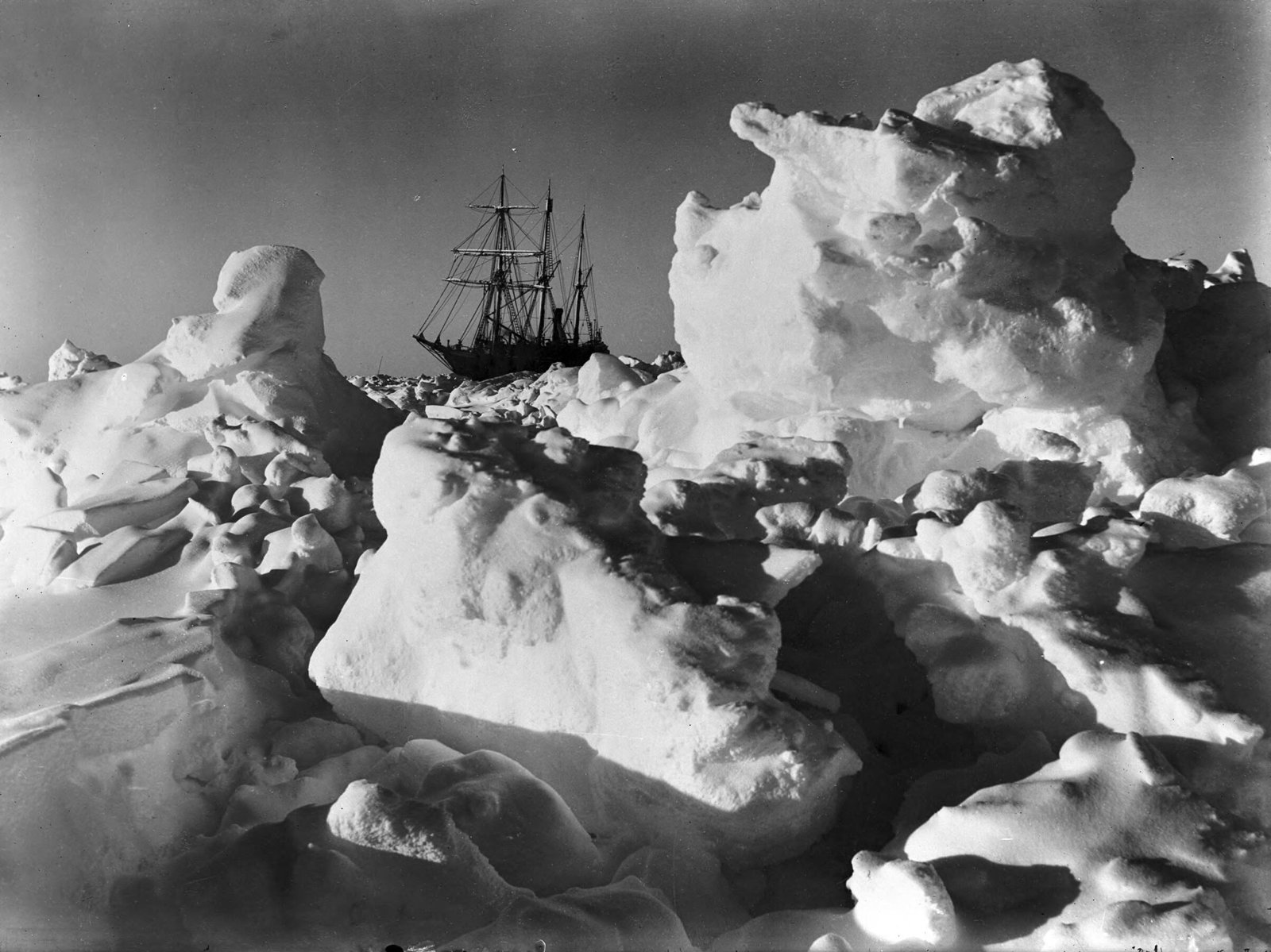
The cover image shows Frank Hurley's famous photograph of Endurance trapped in the Antarctic pack in February 1915.[5] It fits the article because the vessel still looks recognizably whole. The masts stand, the hull remains visible, and the eye can still imagine forward motion. Historically, though, the crucial transformation had already occurred. The ship had become a hostage to drift.
Timeline anchors
- August 1914: Shackleton and a crew of 27 sailed for Antarctica in Endurance.[1][2]
- January 1915: the ship became beset in heavy pack ice, about 85 miles short of its intended destination.[1][2]
- 27 October 1915: Shackleton ordered all hands onto the floe as the pressure made the ship untenable.[2]
- 21 November 1915: Endurance sank beneath the ice after weeks of crushing pressure.[3][4]
- 9-15 April 1916: the party launched the lifeboats and reached Elephant Island after six days in stormy seas.[3]
- 24 April 1916: the James Caird left Elephant Island for South Georgia.[4]
- 20 May 1916: Shackleton, Worsley, and Crean reached Stromness after crossing South Georgia.[1][4]
- 30 August 1916: the fourth rescue attempt finally recovered the 22 men still on Elephant Island.[1]
Those dates are useful because they show how little of the celebrated story happened on the original terms. The crossing of Antarctica never began. The real achievement started after the expedition's stated purpose had already failed.
When the plan froze
At the outset, Shackleton's design was imperial in scale. One ship would land his Weddell Sea party; another would lay depots from the Ross Sea side; the continent would be crossed on foot through the South Pole corridor.[1] That plan depended on one precondition: Endurance had to act as a transport long enough to put men and stores ashore. When the ship was trapped in the Weddell Sea in January 1915, the expedition did not merely encounter delay. It lost the condition that made the entire enterprise possible.[1][3]
This is the first place where the later survival story acquires its real shape. Plenty of expeditions cling to the original objective for too long. Shackleton's crew wintered in the ice, but the sources make clear that the ship's passive drift was already writing the next stage of the story.[1][3] Ten months of pressure and movement turned the vessel from platform into burden. By the time Shackleton recorded the collapse of the ship in his diary on 27 October 1915, the commanding problem was no longer exploration. It was extraction: what food, boats, instruments, and clothing could be pulled away from a dying hull before the floe itself became unsafe?[2]
That shift sounds obvious in retrospect, yet it is one of the hardest moves in disaster history. Institutions are built to preserve purpose. Shackleton's strength here was more negative than glamorous. He allowed the expedition to stop pretending it was still a crossing party. Once that concession was made, salvaging the boats and preserving the command structure became more important than preserving the ship's dignity.[2][3]
Ocean Camp and Patience Camp were schools in lowered ambition
The months after the loss of the ship are often compressed into a single white blur. The SPRI exhibition essay makes them much more legible.[3] The men first established Ocean Camp, hauling away stores and the three lifeboats. Later, worried that drift was carrying them away from possible safety, they tried man-hauling the boats across the ice toward open water. The effort produced almost no effective progress, exhausted the party, and intensified resentment.[3] Within days, Shackleton abandoned that attempt and created Patience Camp, where the expedition waited for the floes to break up enough for a boat journey.[3]
This is the middle act people skip, but it explains why the expedition survived. Heroic narrative likes decisive motion. Survival in polar conditions often comes from knowing when motion is false economy. A march that gains a mile a day while wrecking bodies and morale is not action in any useful sense.[3] Patience Camp looks passive only if one forgets the alternatives. It was an acceptance that the environment, not willpower, was setting the timetable.
The same logic appears in the change of destination. At one stage Paulet Island had been the hope; later Elephant Island became the more realistic target as the drift made earlier assumptions obsolete.[3] Each change was a smaller claim on the map. That repeated downsizing is the real structure of the expedition. Shackleton kept discarding plans at the moment they ceased to buy survival.
Elephant Island made waiting look fatal
When the ice finally opened enough on 9 April 1916, the party took to the boats and spent six soaked, freezing days pushing through floes and heavy seas before landing first at Cape Valentine and then shifting camp to Point Wild on Elephant Island.[3] Dry land should have felt like resolution. Instead it clarified the scale of the remaining trap. The island was remote, exposed, and away from ordinary shipping routes; supplies were low, health was poor, and nobody at home knew where the Weddell Sea party had ended up.[3][4]
That is why Elephant Island is the hinge of the entire chronicle. A reader can imagine wintering in place after a shipwreck if a rescue network exists. On Elephant Island, waiting had no visible mechanism behind it. The camp could hold men for a while, but it could not summon help. In that sense the famous James Caird voyage was not a flourish added to an already successful escape. It was the consequence of discovering that mere survival on land still left the expedition outside the world's line of sight.[1][3][4]
Here again the story turns on reduction. Twenty-eight men could not move efficiently in one body anymore. The expedition had to split. Twenty-two would remain under Frank Wild; six would become a navigation gamble.[1][4]
The James Caird gamble was small enough to work
The Antarctic Heritage Trust's reconstruction of the South Georgia journey helps recover what kind of choice this really was.[4] The James Caird left Elephant Island on 24 April 1916 carrying Shackleton, Frank Worsley, Tom Crean, Timothy McCarthy, John Vincent, and Harry McNish.[4] The boat was tiny, modified, constantly threatened by seas breaking over it, and headed toward a 1,500 km passage through some of the roughest water on earth.[4] Yet the same smallness that made the voyage appalling also made it possible. A whole camp could not sail that route. Six men, rotating watches and bailing continuously, just barely could.[4]
Once they reached South Georgia, the logic repeated itself. The boat could not realistically take them around the island to the whaling stations in its damaged condition, so three men stayed behind while Shackleton, Worsley, and Crean attempted the island crossing on foot.[1][4] Even on land, the answer was reduction: fewer men, fewer provisions, less gear, faster movement. By the time they heard the Stromness whistle on the morning that confirmed they were within reach of human help, the expedition had been cut down to the minimum viable unit for action.[4]
That is the point the myth often misses. Shackleton did not defeat Antarctic conditions through sheer magnitude of spirit. He kept finding the smallest organized group that could still do the next necessary thing.
Rescue came from discipline in sequence, not from one miracle
The end of the story is usually told in a single sentence: all hands survived.[1][4] That sentence is true and deservedly famous, but it can hide the structure that produced it. The rescue of the Elephant Island party did not happen the moment Shackleton reached South Georgia. It required multiple attempts and finally succeeded only on 30 August 1916, when the Chilean tug Yelcho reached the island on the fourth try.[1] Survival therefore depended on endurance in the plainest operational sense: maintaining order among the 22 men left behind, preserving belief in return, and extending a camp economy long enough for the outside world to reconnect with them.[1][4]
Put differently, the expedition survived because Shackleton kept replacing dead forms with smaller live ones. A polar crossing failed, so a shipboard winter replaced it. The ship failed, so an ice camp replaced it. The march failed, so Patience Camp replaced it. Elephant Island could not rescue itself, so a six-man boat journey replaced static waiting. The damaged boat could not round South Georgia, so a three-man mountain crossing replaced it. The story's grandeur comes from that repeated act of contraction.[1][2][3][4]
That is why Hurley's photograph still feels historically exact.[5] It captures a ship in the ice, but the deeper subject is the instant when a large plan has already begun to shrink. In 2026, the Endurance story remains compelling partly because it resists the usual grammar of exploration triumph. Nothing about it is clean conquest. The achievement lies in disciplined retreat from scale, one hard reduction after another, until survival finally becomes possible.
Sources
- Scott Polar Research Institute, "Virtual Shackleton - expeditions" - overview of the Imperial Trans-Antarctic Expedition, including the beset ship, Elephant Island, South Georgia crossing, rescue sequence, and total duration.
- Scott Polar Research Institute, "Ernest Shackleton's Endurance diary, 1915" - diary context and the 27 October 1915 entry on abandoning the ship for the floe.
- Scott Polar Research Institute, The Imperial Trans-Antarctic Expedition exhibition essay - Ocean Camp, Patience Camp, the April 1916 boat departure, and the landing on Elephant Island.
- Antarctic Heritage Trust, "Crossing South Georgia" - the James Caird voyage, landing at King Haakon Bay, and the overland push to Stromness.
- Wikimedia Commons, "File:Endurance trapped in pack ice.jpg" - Frank Hurley's February 1915 photograph used as the article image, with source attribution to the National Library of Australia.