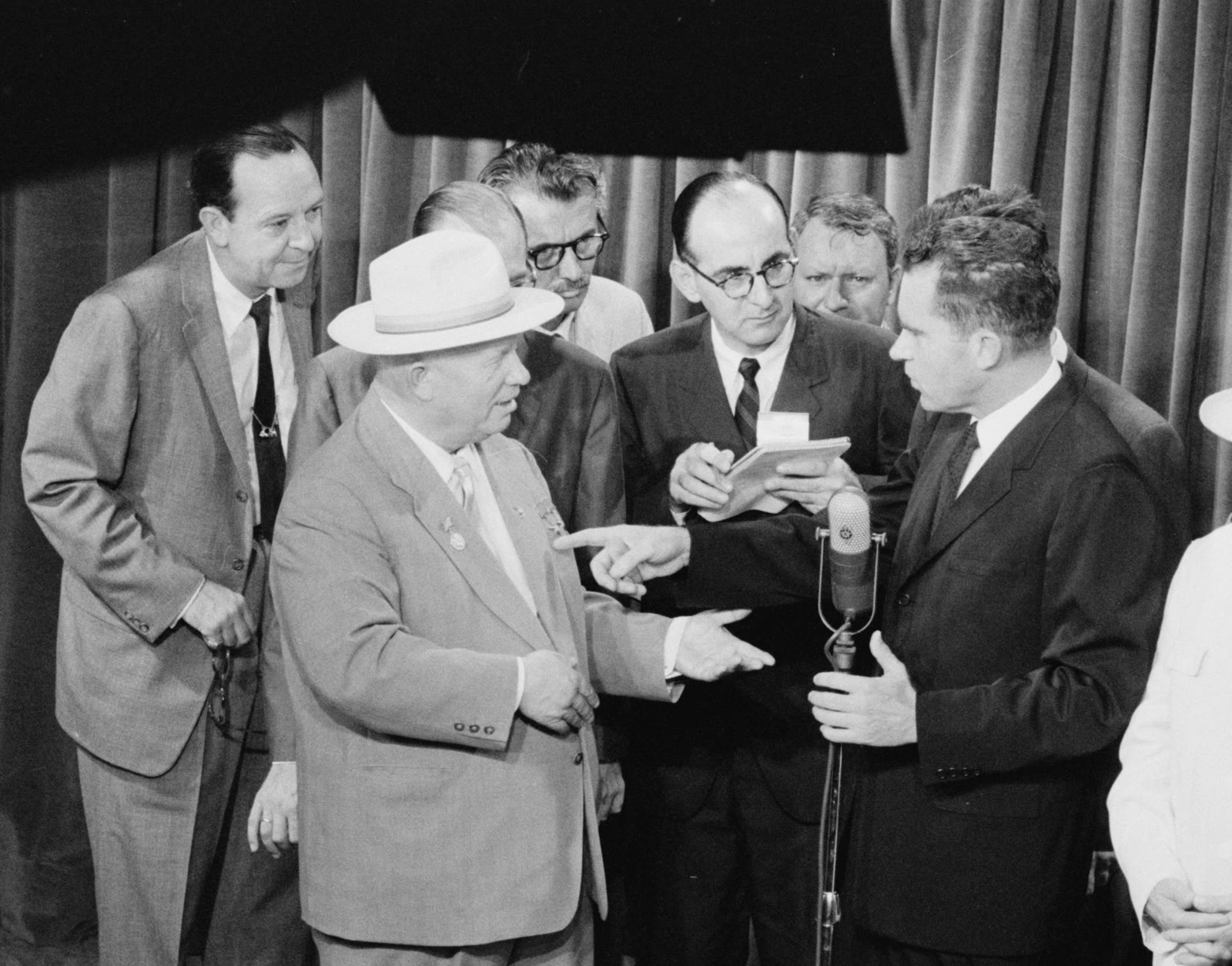
The Kitchen Debate is usually remembered as a Cold War photograph before it is remembered as a text. Richard Nixon points, Nikita Khrushchev pushes back, reporters crowd in, and a model American kitchen in Moscow becomes a convenient symbol for capitalist and communist swagger.[2][6] That memory catches the scene's energy, but it misses the sharper historical point. Read closely, the exchange on July 24, 1959 was not mainly a theatrical contest over who sounded tougher. It was a compressed argument about household time: how long a house should last, how quickly a kitchen should be replaced, what a worker could afford each month, and whether modern life should be organized around durable provision or serial innovation.[1][4]
That is why the kitchen mattered. Nixon did not try to win the argument by boasting about American destiny in the abstract. He tried to win it by translating capitalism into installment payments, built-in appliances, and the promise that even after twenty years many families would want something newer.[1][4] Khrushchev answered on the same terrain. He did not dismiss consumer goods as bourgeois nonsense. He argued that Soviet workers and peasants could also afford houses, and that houses should be built "for our children and grandchildren" rather than for an endless cycle of planned replacement.[1][4] Both men were arguing about systems. They simply chose to stage the difference through the most ordinary room in the house.
The lead image, a Library of Congress photograph of Nixon pointing toward Khrushchev during the exchange, works because it shows the debate in its proper register.[6] This was a diplomatic confrontation, but it was also a retail demonstration. Microphones, cameras, and the crowd around the model home make clear that the United States was not just exhibiting appliances. It was trying to make a political economy visible in the language of domestic comfort.[2][3][6]
Timeline anchors: the kitchen came after the television set and before a mass exhibition run
- July 24, 1959: Nixon and Khrushchev toured the American National Exhibition in Sokolniki Park and argued first near a color television setup, then inside the model home kitchen.[2][4]
- July 25, 1959: American television networks aired the earlier videotaped exchange from the model television studio before Nixon had approved the release sequence, and newspaper reconstructions circulated the kitchen exchange itself.[2][4]
- July 25 to September 6, 1959: the American exhibition ran in Moscow and drew an estimated 2.5 to 3 million Soviet visitors.[3]
- August 1959: a State Department INR report judged the exchange broadly successful and noted that Soviet visitors asked detailed questions about prices, waiting periods, and the cost of consumer goods.[3]
These dates matter because they keep the event from shrinking into one famous snapshot. The Kitchen Debate took place inside a much larger information project: the first U.S.-Soviet exchange of national exhibitions, a setting designed to let rival systems compare themselves through things ordinary people could touch, watch, and price.[2][3] The kitchen was the memorable climax, but the surrounding exhibition made that climax legible.
First layer: the debate began as an argument about communication before it narrowed into appliances
Teaching American History's transcription is useful because it preserves the sequence often lost in the shorter legend.[4] Before the kitchen exchange, Nixon and Khrushchev were already sparring around a color television demonstration. Nixon argued that peaceful competition would be most useful if it came with a "free exchange of ideas," while Khrushchev insisted that if the exchange was being taped, his words had to be translated and heard as well.[4] In other words, the first dispute was about who controlled transmission.
That opening matters for how the kitchen should be read. The model home did not appear in isolation. It sat inside a media environment where television, translation, and circulation were already being contested.[2][4][5] The FRUS editorial note makes the point even sharper. It records that the television-studio exchange was videotaped, that the networks aired it in the United States before Nixon approved the agreed release sequence, and that the kitchen debate itself was reported by the press rather than carried live in the same way.[2] The event's history therefore begins with a communication problem: who gets seen, in what language, and under whose timing.
That is one reason the kitchen became such a durable Cold War object. The National Archives motion-picture record, preserved under the records of the U.S. Information Agency, shows that American officials treated the exchange as an exportable media artifact almost immediately.[5] The kitchen was a room, but it was also a broadcast set. Its political force came from the fact that mass domestic life could be turned into something legible on camera.
Second layer: Nixon's case for capitalism was really a case for serial replacement
Once the conversation reached the model kitchen, Nixon's argument became very specific. He pointed to built-in appliances, described the house as one that could be bought for $14,000, said most veterans could buy homes in the $10,000 to $15,000 range, and gave the steelworker example: $3 an hour, about $100 a month on a contract running twenty-five to thirty years.[1][4] These are not ornamental details. They are the argument.
Nixon was trying to turn capitalism into a system of ordinary repeatability. The model house was said to be built in thousands of units; the appliances were built for direct installation; the mortgage payment was translated into a monthly figure; the worker was made legible through wage arithmetic rather than class theory.[1][4] What mattered was not elite luxury, but the claim that a mass consumer order could standardize comfort and spread it across a broad public.
The most revealing sentence comes later, when Nixon answers Khrushchev's durability criticism by saying that even if American houses last more than twenty years, many Americans will want a new house or a new kitchen because the old one will be obsolete.[1][4] That line is the center of the whole debate. Nixon was not embarrassed by replacement. He treated replacement as a feature of the system. Capitalism justified itself through innovation cycles, refreshed interiors, and the social legitimacy of wanting newer things.
Read that way, the Kitchen Debate was about time more than space. The question was not only what an American kitchen looked like in 1959. The question was how a system imagined the next twenty years. Nixon's answer was dynamic and restless. Progress meant rising access plus continual redesign. A worker's dignity lay partly in the ability to enter that stream again and again.[1][4]
Third layer: Khrushchev's answer was not anti-consumer. It was anti-obsolescence
Khrushchev's reply is often flattened into bluster, but the primary-source record gives it more structure than that. He did not claim that Soviet citizens had no interest in domestic comfort. He said the Soviet Union also had steel workers and peasants who could afford such a house, rejected Nixon's implication that American domestic technology was unique, and attacked the American house as a form built to wear out so builders could sell another one later.[1][4]
His most telling phrase is the one about building "for our children and grandchildren."[1][4] That line shifts the standard of value. Instead of measuring success through rapid product turnover and consumer choice, Khrushchev measures it through endurance, inheritance, and long-use stability. The socialist house is supposed to be less glamorous as an episode and more respectable as an intergenerational commitment.
That does not make Khrushchev the enemy of abundance. The August 1959 State Department report shows that Soviet visitors were intensely interested in prices, waiting periods, automobiles, color television, the model house, Pepsi-Cola, and the mechanics of everyday American life.[3] Soviet authorities themselves tried to answer the American fair by emphasizing their own consumer goods and by criticizing the model house as something beyond the reach of ordinary Americans.[3] The dispute, then, was not over whether consumer life mattered. It was over what kind of consumer future counted as politically superior.
This is where the Kitchen Debate becomes historically richer than a stereotype about communist austerity facing capitalist plenty. Khrushchev wanted to deny the United States a monopoly on modern household aspiration.[1][3][4] His rebuttal was: we have appliances too, we can build houses too, and permanence is a strength rather than a lag. He accepted the domestic battlefield while trying to change the rules of scoring.
Fourth layer: the room was gendered on purpose
Nixon's line about making life easier for "our housewives" is one of the most quoted pieces of the exchange, and it deserves close attention.[1][4] The sentence is not incidental. It shows how both consumer politics and Cold War politics were routed through a particular image of domestic management. The system proves itself by reducing labor in the kitchen, speeding washing and cleaning, and making the modern home the theater of everyday freedom.
That gendered framing helps explain why a kitchen could carry so much ideological weight in the first place. A missile silo or a steel mill would have signaled national power. A kitchen signaled lived power. It implied that the competition between systems should be judged not only by armies or heavy industry, but by whether ordinary families could inhabit a cleaner, easier, more technologically mediated routine.[1][3][4]
The State Department's own reporting after the exhibition confirms that Soviet visitors treated the fair that way. They asked how much goods cost, how long they had to wait, what American workers earned, and how domestic life was actually organized.[3] The home was not a side show to the Cold War. In this exhibition setting, it was the scoreboard.
Two readings still compete
Reading one: the Kitchen Debate was mainly political theater
This reading emphasizes gesture, sarcasm, finger-pointing, and the personal chemistry of Nixon and Khrushchev. It sees the event as memorable because it produced an iconic image of Cold War swagger in a strangely domestic setting.[2][6]
That reading is correct as far as it goes. The image is real, and the performance mattered.
Reading two: the Kitchen Debate was a condensed argument about how a modern household should move through time
This reading emphasizes the transcript and the exhibition context. It treats the exchange as an argument over affordability, replacement cycles, durability, and who could make domestic abundance ordinary for workers rather than exceptional for elites.[1][3][4]
This reading is stronger. It explains why the disputants spent so much time on wages, mortgage terms, durability, and obsolescence, and why the exhibition drew such detailed questions from Soviet visitors about costs and waiting periods.[1][3][4] The theatrics mattered because the content was already sharp.
Why the second reading is stronger
The Kitchen Debate lasts in history because it translated ideological rivalry into a room people already understood.[1][2][4] Nixon made capitalism sound like access to installment-financed novelty. Khrushchev made socialism sound like durable provision without built-in waste. Neither man argued in the language of pure theory for very long, because both knew theory had to arrive wearing cabinets, dishwashers, wages, and monthly payments.
That is why the Library of Congress photograph works so well as the article image.[6] The pointing gesture has often been read as macho confrontation. It can also be read more carefully as a sales gesture inside a mass political demonstration. Nixon is literally indicating the evidence. Khrushchev is contesting the evidence on the spot. The Kitchen Debate was not a detour from the Cold War's main argument. It was the moment when that argument was made to stand inside a model home and defend itself appliance by appliance.
Sources
- Central Intelligence Agency, "The Kitchen Debate - transcript 24 July 1959" (CIA Reading Room PDF).
- Office of the Historian, U.S. Department of State, Foreign Relations of the United States, 1958-1960, Volume X, Part 1, Document 92, "Editorial Note" - context on Nixon's Moscow trip, the exhibition, the broadcast sequence, and the Kitchen Debate's reporting trail.
- Office of the Historian, U.S. Department of State, Foreign Relations of the United States, 1958-1960, Volume X, Part 2, Document 16, "US-Soviet Exhibits a Successful Exchange" - attendance figures, visitor reactions, and the popularity of the model house and consumer-goods displays.
- Teaching American History, "The Kitchen Debate" - transcript and reconstruction of the television-studio and model-home exchanges.
- National Archives DocsTeach, "The 'Kitchen' Debate" - motion-picture record from the Records of the U.S. Information Agency.
- Library of Congress, "Richard Milhous Nixon, Pres. U.S., 1913-1994, pointing finger at Khruschev during famous 'kitchen debate' at the American exhibition in Moscow" - photo record for the archival image used here.