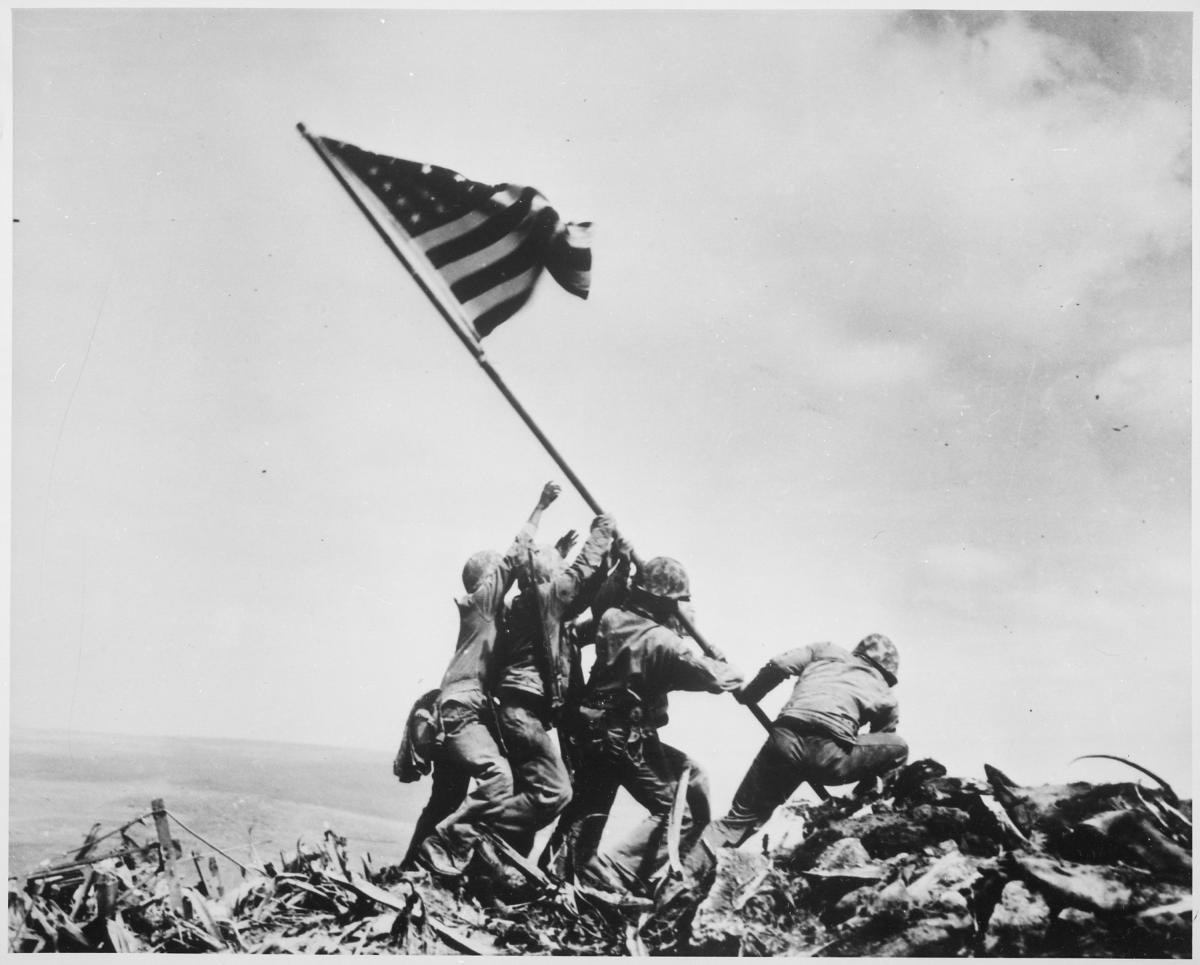
The Iwo Jima flag-raising photograph is so familiar that it often feels like the battle's natural ending. Six figures lean into a pole, the line of force runs upward, and the picture seems to freeze victory at the exact instant it becomes visible.[1][2] That reading is emotionally powerful and historically incomplete. The sharper question is not whether Joe Rosenthal made an iconic image on February 23, 1945. He did. The sharper question is how quickly that image stopped being only about one volcanic slope on one Pacific island and started serving as a national memory machine.[1][2][3][4]
That shift happened almost at once. The photograph recorded the second flag raising on Mount Suribachi, not the first, and the battle for Iwo Jima was still far from over when the image began circulating.[1][2] Yet the picture's afterlife moved in three stages that made it larger than the event that produced it. First, it abstracted one tactical moment into a collective symbol of exertion. Second, the Treasury Department turned that symbol into the visual center of the Seventh War Loan drive.[2][3] Third, the Marine Corps and the federal commemorative landscape recast it in bronze at Arlington, where it came to honor Marines far beyond Iwo Jima itself.[2][4]
The cover image uses the original National Archives reproduction of Rosenthal's February 23, 1945 photograph.[1] It works for this article because the essay is less interested in whether the image is famous than in what fame did to it. A combat photograph became a fundraising device and then a memorial form. That sequence is the real history here.
The mountain produced a picture that already leaned toward commemoration
The National Archives still introduces the photograph in stark terms: Rosenthal's image of the flag raising on Mount Suribachi is among the most recognized pictures of the Second World War, won the 1945 Pulitzer Prize, and later served as the model for the Marine Corps memorial in Arlington.[1] That summary is accurate, but it compresses a detail that matters for memory history. The famous image shows the second, larger flag, raised after a smaller first flag had already gone up earlier on the summit.[2]
The Marine Corps history explains why that distinction mattered. Early on D plus 4, February 23, 1945, Marines moved toward the summit of Suribachi, and an initial smaller flag was raised first.[2] Later, a larger replacement flag went up, and Rosenthal photographed that second moment.[2] Public memory would eventually treat the photograph as though it captured the instant the mountain, and almost the island, had been decisively won. The sources point in a more precise direction. The image recorded a real act under combat conditions, but it did not record the end of the battle. It recorded a moment that was visually complete before the campaign itself was complete.[2]
That gap between visual closure and military chronology helps explain the photograph's power. The picture offers strain without visible carnage. It shows teamwork, upward motion, and a flag large enough to read at a distance. The enemy is absent. So are the American dead. Faces are partly obscured or turned away. The image is therefore unusually easy to generalize. It is specific enough to feel true and stripped-down enough to travel.[1][2]
This is the first step in the commemorative transformation. A battlefield image became memorable not only because it was dramatic, but because it edited the battle into a form the home front could absorb quickly. A viewer did not need a map of Suribachi, a long explanation of Japanese defenses, or even a full account of the campaign's cost. The composition already offered a usable national sentence: effort, ascent, flag, victory.[1][2]
The war-bond poster detached the picture from the island almost immediately
The Marine Corps pamphlet says the quiet part plainly. The Rosenthal photograph became "the symbol of the Seventh War Loan drive," appeared on millions of posters, appeared on a three-cent postage stamp, and then moved toward its later bronze afterlife.[2] The Library of Congress poster record gives the administrative form of that transformation. The official 1945 poster is titled "7th war loan. Now--all together," funded by the United States Department of the Treasury, derived by C. C. Beall from the Associated Press photograph, and summarized by the Library as a poster showing U.S. Marines raising the flag at Iwo Jima.[3]
That poster matters because it marks the instant when the image stopped being mainly descriptive. On the mountain, the photograph referred to one particular act by particular men on a specific day. In Treasury form, it became a demand addressed to civilians. Buy bonds. Join the effort. Convert the picture's visible strain into financial participation.[2][3]
The historical change is larger than simple publicity. A combat photograph ordinarily points backward: this happened. The Seventh War Loan poster pointed forward: now act. The image was being used not as retrospective memory but as real-time mobilization. That is why the article's title says the photograph became bigger than Iwo Jima before the battle ended. The home-front state recognized that the picture could carry more than battlefield reference. It could stand in for common burden.
The Marine Corps source adds another layer by describing President Franklin Roosevelt's request that the flag raisers be identified and brought back to the United States.[2] This is where memory began to attach itself to bodies, names, and publicity tours. The picture had already generalized the act; the war-bond campaign then tried to reconnect that symbol to living representatives who could embody it for the public. The result was unstable from the beginning. Some participants had already been killed. Identifications were imperfect in the immediate aftermath. But the symbolic work did not wait for perfect clarity.[2]
That impatience is historically revealing. The state did not need a fully settled microhistory before using the image. It needed a compelling visual shorthand. The poster provided exactly that: the battle translated into civic obligation.
Arlington turned a World War II image into all-Marines memory
The third stage was the most durable. The National Park Service's place page states that the U.S. Marine Corps War Memorial is based on Rosenthal's photograph of Marines raising the flag on Mount Suribachi and that the memorial honors Marines who served in all conflicts in U.S. history.[4] The Marine Corps history fills in the chronology: the memorial was dedicated by President Dwight D. Eisenhower on November 10, 1954, and although it depicts one of the best-known incidents of World War II, it is dedicated to Marines who gave their lives in defense of the United States across the Corps' full history.[2]
This is the decisive commemorative leap. A picture born from one Pacific assault was reauthored as a memorial grammar for the entire institution. Iwo Jima remained the source image, but the memorial's claim was larger. The six struggling bodies and the angled pole no longer stood only for Suribachi, or even only for World War II. They became the sculptural language through which Marine sacrifice in every war could be imagined.[2][4]
That expansion depended on the same formal qualities that had already helped the image travel into the bond drive. The photograph did not lock viewers inside one messy battlefield narrative. It offered a clean line of collective exertion. Bronze intensified that quality. In sculpture, the men read less as identifiable servicemen caught in one camera instant and more as a permanent upward push. The memorial universalized what the poster had already simplified.
The NPS page makes that institutional broadening explicit in a way the wartime photograph alone does not.[4] The memorial's inscriptions and official purpose carry the image out of 1945 and into a larger military lineage. What had once been a still photograph of a second flag raising on one mountain became a federal site of ritual, tourism, and corporate Marine remembrance.[2][4]
Why the image endured in this form
There are other famous American war photographs, and many are more explicit about loss. Rosenthal's Iwo Jima image endured differently because it could hold three things together at once. It was unquestionably real. It looked collective rather than solitary. And it offered a near-perfect balance between specificity and abstraction.[1][2]
If the picture had shown the dead, it would have stayed closer to mourning. If it had shown faces clearly, it might have remained more tightly attached to biography. If it had shown only the first small flag, it might have looked less monumental. Instead it presented a moment that public institutions could scale up. The National Archives presents it as a famous war photograph.[1] The Treasury reused it as a financing command.[3] The Marine Corps and the commemorative state reused it as an all-service elegy.[2][4] Each layer preserved part of the original event while also thinning out local detail.
That is the best way to read the image now. It was not fake, and it was not merely staged patriotic theater.[1][2] It captured a genuine wartime act. But the history of the photograph's afterlife is the history of how genuine acts get repackaged into public memory. Iwo Jima became bigger than Iwo Jima because the photograph was visually ready for reassignment. By the time it stood in Arlington bronze, the picture no longer belonged only to the mountain where it was made. It belonged to a national repertoire of sacrifice, obligation, and military continuity.
Sources
- National Archives, "Photograph of Flag Raising on Iwo Jima, February 23, 1945" - official record for Rosenthal's image, National Archives Identifier 520748, with its wartime and commemorative significance.
- Bernard C. Nalty and Danny J. Crawford, The United States Marines on Iwo Jima: The Battle and the Flag Raisings (History and Museums Division, Headquarters, U.S. Marine Corps) - on the first and second flag raisings, the Seventh War Loan drive, and the 1954 memorial dedication.
- Library of Congress, "7th war loan. Now--all together" - official 1945 Treasury poster record derived from the Associated Press Iwo Jima photograph.
- National Park Service, "US Marine Corps War Memorial" - official place page describing the memorial's basis in Rosenthal's photograph and its all-conflicts commemorative role.